

Calcium Cobalt Oxide
₹0.00
Calcium Cobalt Oxide
Calcium Cobalt Oxide
| Product |
Calcium Cobalt Oxide |
| Colour | Black powder |
| Purity | 99% |
| Particle Size | 1-5µM(customizable) |
| Ingredient/MF | Ca3Co4O9 |
| Product Code | NCZ-CP-384/20 |
| CAS Number | 12514-78-2 |
| Density | 4.92 Mg·m−3 |
| Melting point | N/A |
| Boiling Point | N/A |
| Molecular Weight | 499.96 |
| Exact Mass | N/A |
Calcium Cobalt Oxide
Calcium is a Block S, Group 2, Period 4 element with an atomic weight of 40.078. The number of electrons in each of Calcium’s shells is [2, 8, 8, 2] and its electron configuration is [Ar] 4s2. The calcium atom has a radius of 197 pm and a Van der Waals radius of 231 pm. Calcium was discovered and first isolated by Sir Humphrey Davy in 1808.
It is the fifth most abundant element in the earth’s crust and can be found in minerals such as dolomite, gypsum, plagioclases, amphiboles, pyroxenes and garnets. In its elemental form, calcium has a dull gray-silver appearance. Calcium is a reactive, soft metal that is a member of the alkaline earth elements.
It frequently serves as an alloying agent for other metals like aluminum and beryllium industrial materials like cement and mortar are composed of calcium compounds like calcium carbonate. It is also an biologically essential substance found in teeth, bones, and shells. The name “calcium” originates from the Latin word “calics,” meaning lime.
Cobalt:
Cobalt is a Block D, Group 9, Period 4 element with an atomic weight of 58.933195. The number of electrons in each of cobalt’s shells is 2, 8, 15, 2 and its electron configuration is [Ar] 3d7 4s2The cobalt atom has a radius of 125 pm and a Van der Waals radius of 192 pm. Cobalt was first discovered by George Brandt in 1732.
In its elemental form, cobalt has a lustrous gray appearance. Cobalt is found in cobaltite, erythrite, glaucodot and skutterudite ores. Cobalt produces brilliant blue pigments which have been used since ancient times to color paint and glass. Cobalt is a ferromagnetic metal and is used primarily in the production of magnetic and high-strength superalloys. Co-60, a commercially important radioisotope, is useful as a radioactive tracer and gamma ray source.
The origin of the word Cobalt comes from the German word “Kobalt” or “Kobold,” which translates as “goblin,” “elf” or “evil spirit.” For more information on cobalt, including properties, safety data, research, and Nanochemazone catalog of cobalt products, visit the Cobalt element page.
Related Information
Storage Conditions:
Airtight sealed, avoid light and keep dry at room temperature.
Please contact us for customization and price inquiry
Email: contact@nanochemazone.com
Note: We supply different size ranges of Nano and micron as per the client’s requirements and also accept customization in various parameters.
Note: For pricing & ordering information, please contact us at sales@nanochemazone.com
Please contact us for quotes on Larger Quantities & Customization. E-mail: contact@nanochemazone.com
Customization:
If you are planning to order large quantities for your industrial and academic needs, please note that customization of parameters (such as size, length, purity, functionalities, etc.) are available upon request.
You must be logged in to post a review.
Related products
Aluminum Sulphide Powder
Aluminum Sulphide Powder
Product Name: Aluminum Sulphide Powder
| Product | Aluminum Sulphide |
| CAS No. | 1302-81-4 |
| Appearance | White Powder |
| Purity | 99.9% |
| APS | 1 – 5 Microns (Can be customized) |
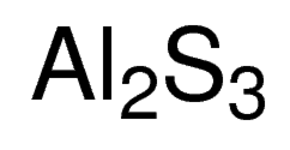
| Ingredient | Al2S3 |
| Product Code | NCZ-MP-S101 |
| Molecular Weight | 150.16 g/mol |
| Theoretical Density | 2.02 g/cm³ |
| Melting Point | 1,100°C (2,012°F) |
Al2S3 Description :
Sulfides
Inorganic sulfides are ionic compounds containing the sulfide ion S2−. Sulfide compounds can be used in a wide variety of applications including solid-state electrolytes, cathode materials in lithium-ion and thermal batteries, semi-conductors in thermoelectric devices, as part of phosphor compositions, as photovoltaic materials, as pigments, and a variety of other applications. Nanochemazone is a world-leading manufacturer in the production of sulfide compounds with one of the most comprehensive selections of sulfides and extensive sulfide-manufacturing expertise. Most sulfides are manufactured as powders in large batch quantities but certain commercial sulfides are available in large metric-ton quantities. Additionally, Nanochemazone can custom synthesis sulfides that may not be listed in our catalog and can modify sulfides to customer's specifications including producing mixed sulfides, non-stoichiometric compositions, or special purities and particle sizes.
Aluminum Sulfide Applications:
Aluminum sulfide, also known as aluminium sulphide, is a compound of aluminum and sulfur with the formula Al2S3. A colorless or gray solid with an exceptional sensitivity to moisture, aluminum sulfide is not to be confused with the more widely used aluminum sulfate, Al2(SO4)3. Exposed to the atmosphere or other sources of moisture, aluminum sulfide will hydrolize into aluminum hydroxides and hydrogen sulfide gas. This makes careful storage and handling a priority.
Many of the most interesting applications of aluminum sulfide remain in the early research phases, with many researchers eager to explore its value in aluminum-sulfur energy story.
- Energy storage. A subject of research in the production of aluminum-sulfur batteries, a potentially superior alternative to lithium batteries.
- Like several similar metal sulfides, aluminum sulfide may be of value for its photovoltaic properties at smaller scales.
- Useful for its reactivity in producing several commercially or academically valuable compounds.
- Aluminum source. Moderately water and acid soluble source for aluminum.
RELATED INFORMATION
Storage Conditions:
Airtight sealed, avoid light and keep dry at room temperature.
Please contact us for customization and price inquiry
Email: contact@nanochemazone.com
Note: We supply different size ranges of Nano and micron as per the client’s requirements and also accept customization in various parameters.
Charcoal Powder
Charcoal Powder
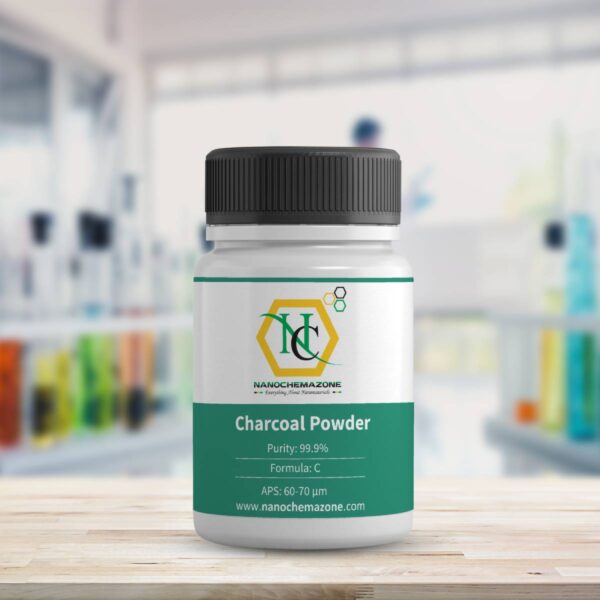
Product Name: Charcoal Powder (C, APS: 60-70µm, Purity: 99.9%)
| Product | Charcoal Powder |
| Cat No | NCZ-MN-162/20 |
| CAS No | 7440-44-0 |
| Purity | 99.9% |
| APS | 60-70µm |
| Molecular Formula | C |
| Form | Powder |
| Color | Black |
| Bulk Density | 0.34g/ml |
Please email us for the customization.
Email: contact@nanochemazone.com
Please contact us for customization and price inquiry
Note: We supply different size ranges of Nano and micron as per the client’s requirements and also accept customization in various parameters.
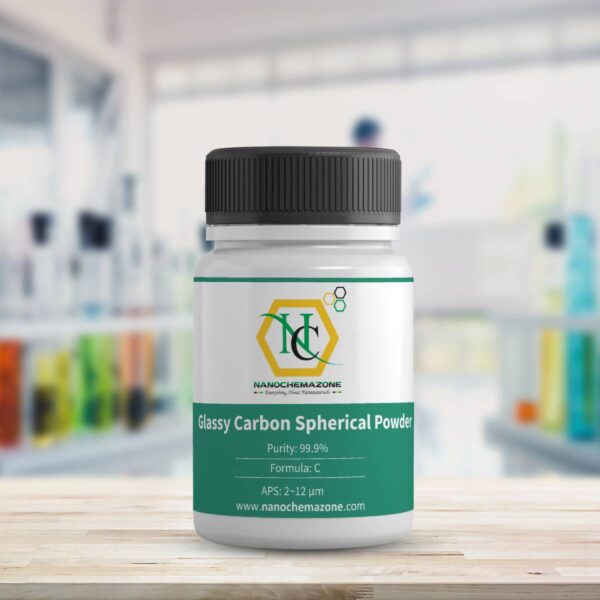
Glassy Carbon Spherical Powder
Glassy Carbon Spherical Powder
Product Name: Glassy Carbon Spherical Powder (C, Purity: 99.9%, APS: 2~12µm)
| Product | Glassy Carbon Spherical Powder |
| Cat No | NCZ-MN-163/20 |
| CAS No | 7440-44-0 |
| Purity | 99.9 % |
| APS | 2~12µm |
| Molecular Formula | C |
| Molecular Weight | 12.01 g/mol |
| Density | 2.267 g/cm³ |
| Appearance | Black solid |
| Melting Point | 3652 - 3697 °C (sublimes) |
| Boiling Point | 4200 °C |
| Thermal Conductivity | 119-165 W/m/K |
| Heat of Vaporization | 128 K-Cal/gm |
| Electronegativity | 2.55 Paulings |
| Solubility | Insoluble in water |
Please email us for the customization.
Email: contact@nanochemazone.com
Please contact us for customization and price inquiry
Note: We supply different size ranges of Nano and micron as per the client’s requirements and also accept customization in various parameters.
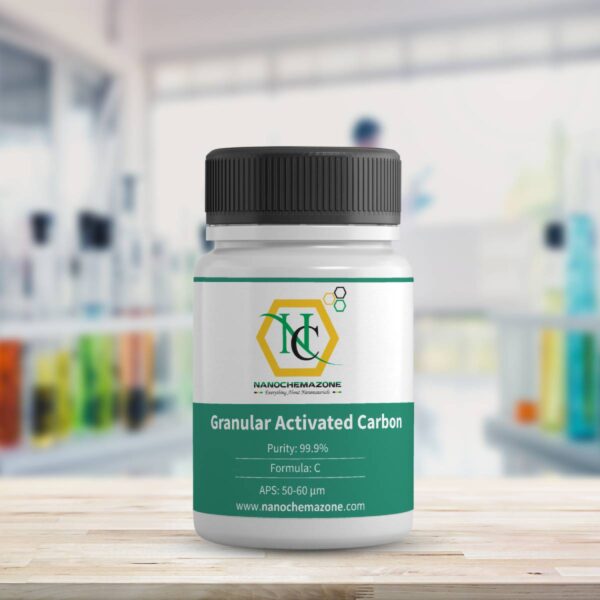
Granular Activated Carbon
Granular Activated Carbon
Product Name: Granular Activated Carbon (C, Purity: 99.9%, APS: 50-60µm)
| Product | Granular Activated Carbon |
| Cat No | NCZ-MN-164/20 |
| CAS No | 7440-44-0 |
| Purity | 99.9% |
| APS | 50-60 µm |
| Molecular Weight | 242.62 g/ mol |
| Form | Granules |
| Color | Black |
| PH value | 6-7 |
| SSA | 900-1100 m2/g |
| Bulk Density | 0.45 g/ cm3 |
| Solubility | Insoluble In Water |
Please email us for the customization.
Email: contact@nanochemazone.com
Please contact us for customization and price inquiry
Note: We supply different size ranges of Nano and micron as per the client’s requirements and also accept customization in various parameters.
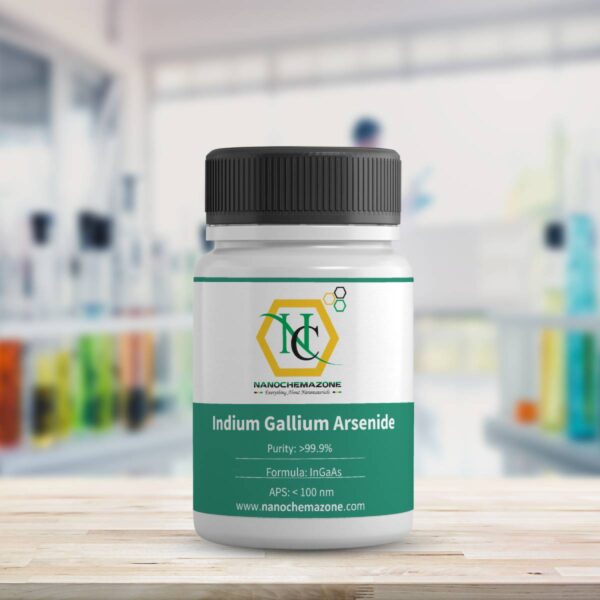
Indium Gallium Arsenide Nanopowder
Indium Gallium Arsenide Nanopowder
Product Name: Indium Gallium Arsenide Nanopowder (InGaAs, Purity: 99.9%, APS: < 100 nm)
| Product | Indium Gallium Arsenide Nanopowder |
| Cat No | NCZ-NSC814/20 |
| CAS No | 106097-59-0 |
| Purity | 99.9% |
| APS | < 100 nm |
| Molecular Formula | InGaAs |
| Molecular Weight | 259.46 g/mol |
| Form | Crystalline Powder |
| Color | White |
| Density | 5.68 g/cm³ |
| Melting Point | 844 °C |
| Conclusion | The specifications Confirm with enterprise standard |
Indium Gallium Arsenide Related Information
Storage Conditions:
Airtight sealed, avoid light, and keep dry at room temperature.
Please contact us for customization and price inquiry
Email: contact@nanochemazone.com
Note: We supply different size ranges of Nano and micron as per the client’s requirements and also accept customization in various parameters.
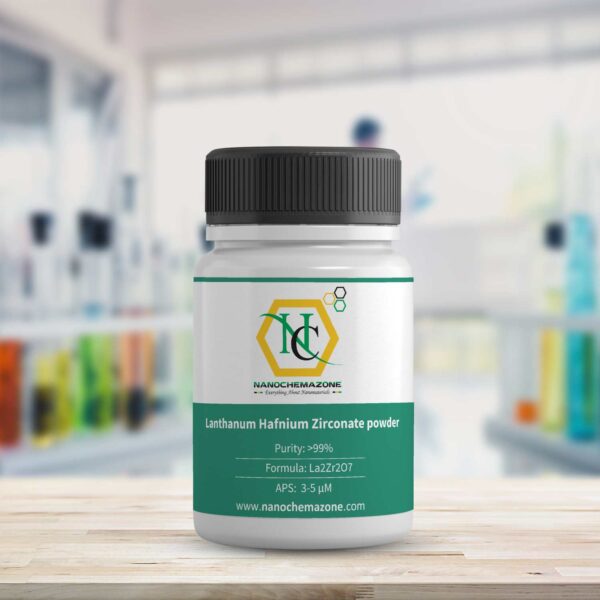
Lanthanum Hafnium Zirconate Powder
Lanthanum Hafnium Zirconate powder
Product Name: Lanthanum Hafnium Zirconate powder (Purity: 99.5%, APS: 30-45µM)
| Product | Lanthanum Hafnium Zirconate powder |
| Cat No | NCZ-MN-258/20 |
| CAS No | 12031-48-0 |
| APS | 1-10 µM, 10-25 µM 25- 45 µM (Customizable) |
| Purity | 99.5% |
| Form | White, odorless Powder |
| Density | 6.05 g/cm3 |
| Melting Point | ~ 2680 deg C |
| Solubility | Insoluble in Water |
| Formula | La2Zr2O7 |
Lanthanum Hafnium Zirconate powder’s COA:
| Hf | 2.2% |
| Fe | 0.01% |
| Na | 0.01% |
| Al | 0.1% |
| Si | 0.1% |
| Ca | 0.005% |
| Sr | 0.02% |
| Pb | 0.001% |
Latest information about the manufacturing techniques of lanthanum zirconate (La2Zr2O7, LZ) Powder and La2Zr2O7 based thermal barrier coatings (TBCs). Lanthanum zirconate is a promising candidate material for TBC applications due to its lower thermal conductivity and higher thermal stability compared to other traditional TBC systems.
We can supply Lanthanum zirconate powder and target materials, welcome contact us!
Lanthanum zirconate ( La2Zr2O7 ), purity 3N5, primary particle size 3um, material XRD pure phase.
Lanthanum zirconate Applications:
Widely used in microelectronics, catalysts, ferroelectric materials, / lithium batteries, semiconductors, and other electronic fields.
Lanthanum zirconate Related Information
Storage Conditions:
Airtight sealed, avoid light and keep dry at room temperature.
Please contact us for customization and price inquiry
Email: contact@nanochemazone.com
Note: We supply different size ranges of Nano and micron as per the client’s requirements and also accept customization in various parameters.
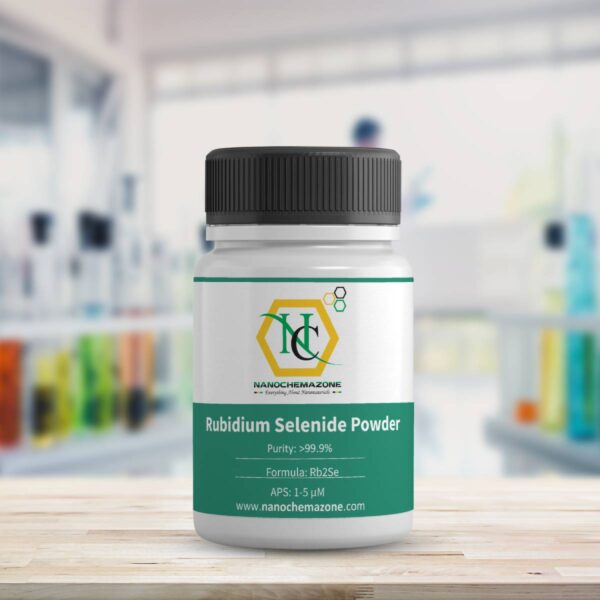
Rubidium Selenide Powder
Rubidium Selenide Powder
Product Name: Rubidium Selenide Powder (Rb2Se, >99%, APS: 40-70µm)
| Product | Rubidium Selenide Powder |
| Cat No | NCZ-NSC816/20 |
| CAS No | 31052-43-4 |
| Purity | >99 % |
| Molecular Formula | Rb2Se |
| Molecular Weight | 249.895 g/mol |
| Form | Powder |
| Density | 3220 kg/m-³ |
| APS | 1-5 µM (Can be customized) |
Rubidium Selenide Related Information
Storage Conditions:
Airtight sealed, avoid light, and keep dry at room temperature.
Please contact us for customization and price inquiry
Email: contact@nanochemazone.com
Note: We supply different size ranges of Nano and micron as per the client’s requirements and also accept customization in various parameters.
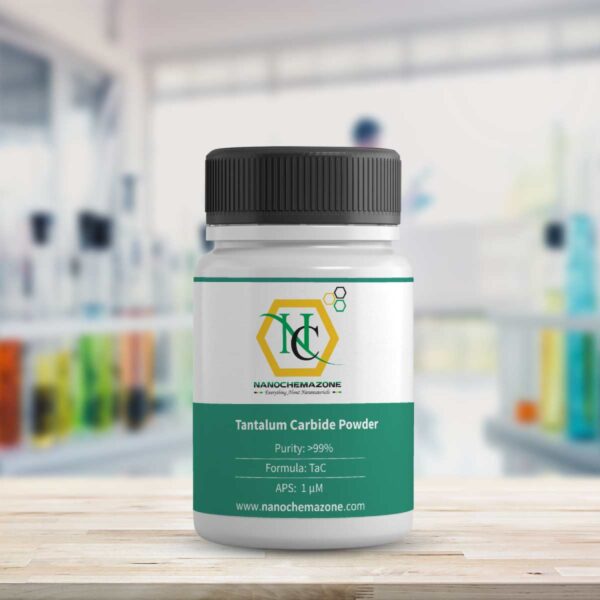
Tantalum Carbide Powder
Tantalum Carbide Powder
Tantalum Carbide Powder (TaC, Purity: 99.9%, APS: 1000 nm, Cubic)
| Product | Tantalum Carbide Powder |
| Cat No | NCZ-MN-260/20 |
| CAS No | 12070-06-3 |
| APS | 1000 nm (customizable) |
| Purity | 99.9% |
| Molecular Formula | TaC |
| Molecular Weight | 192.96 g/mol |
| Form | Powder |
| Color | Gray |
| Density | 14.30 g/cm³ |
| Melting Point | 3,880 °C |
| Boiling Point | 4,780 °C |
| Solubility | Insoluble in water |
They are extremely hard, brittle, refractory ceramic materials with metallic electrical conductivity. They appear as brown-gray powders, which are usually processed by sintering.
Being important cermet materials, tantalum carbides are commercially used in tool bits for cutting applications and are sometimes added to tungsten carbide alloys.
The melting points of tantalum carbides peak at about 3880 °C depending on the purity and measurement conditions; this value is among the highest for binary compounds. Only tantalum hafnium carbide may have a slightly higher melting point of about 3942 °C, whereas the melting point of hafnium carbide is comparable to that of TaC.
Tantalum Carbide Application:
Tantalum Carbide Powder Applications
1. Tantalum carbide is often added to tungsten carbide/cobalt (WC/Co) powder attritions to enhance the physical properties of the sintered structure. It also acts as a grain growth inhibitors preventing the formation of large grains, thus producing materials of optimal hardness.
2. It is also used as a coating for steel molds in the injection molding of aluminum alloys. While providing a hard, wear-resistant surface, it also provides a low friction mold surface.
3. Tantalum carbide is also used in the production of sharp instruments with extreme mechanical resistance and hardness.
4. It is also used in tool bits for cutting tools.
Tantalum carbide is widely used as a sintering additive in ultra-high temperature ceramics (UHTCs) or as a ceramic reinforcement in high-entropy alloys (HEAs) due to its excellent physical properties in melting point, hardness, elastic modulus, thermal conductivity, thermal shock resistance, and chemical stability, which makes it a desirable material for aircraft and rockets in aerospace industries.
Nanochemazone specializes in producing high purity Tantalum Carbide Powder with the smallest possible average grain sizes for use in the preparation of pressed and bonded sputtering targets and in Chemical Vapor Deposition (CVD) and Physical Vapor Deposition (PVD) processes including Thermal and Electron Beam (E-Beam) Evaporation, Low-Temperature Organic Evaporation, Atomic Layer Deposition (ALD), Metallic-Organic and Chemical Vapor Deposition (MOCVD). Powders are also useful in any application where high surface areas are desired such as water treatment and in fuel cell and solar applications. Nanoparticles also produce very high surface areas. Our standard powder particle sizes average in the range of - 325 mesh, - 100 mesh, 10-50 microns, and submicron (< 1 micron). We can also provide many materials in the nanoscale range.
Tantalum Carbide Related Information
Storage Conditions:
Airtight sealed, avoid light and keep dry at room temperature.
Please contact us for customization and price inquiry
Email: contact@nanochemazone.com
Note: We supply different size ranges of Nano and micron as per the client’s requirements and also accept customization in various parameters.
Reviews
There are no reviews yet.