
Iridium Oxide Dihydrate
₹0.00
Iridium Oxide Dihydrate
| Product |
Iridium Oxide Dihydrate |
| Colour | Black |
| Purity | 99% |
| Particle size | 1-10 µM (customizable) |
| Ingredient/MF | IrO2•2H2O |
| Product Code | NCZ-CP-192/20 |
| CAS Number | 30980-84-8 |
Iridium Oxide Dihydrate
Iridium oxide dihydrate is used with other rare oxides in the coating of anode-electrodes for industrial electrolysis and in microelectrodes for electrophysiology research. It is also used for reference electrode, which finds application in various fields biology, food industry, nuclear field, oil, and gas industry. Iridium is a chemical element.
The symbol Ir and atomic number 77. A very hard, brittle, silvery-white transition metal of the platinum group, iridium is considered to be the second-densest metal (after osmium) with a density of 22.56 g/cm3 as defined by experimental X-ray crystallography. However, at room temperature and standard atmospheric pressure, iridium has been calculated to have a density of 22.65 g/cm3, 0.04 g/cm3 higher than osmium measured the same way.
Still, the experimental X-ray crystallography value is considered to be the most accurate, and as such iridium is considered to be the second densest element.[6] It is the most corrosion-resistant metal, even at temperatures as high as 2000 °C. Although only certain molten salts and halogens are corrosive to solid iridium, finely divided iridium dust is much more reactive and can be flammable.
Iridium was discovered in 1803 among insoluble impurities in natural platinum. Smithson Tennant, the primary discoverer, named iridium after the Greek goddess Iris, personification of the rainbow, because of the striking and diverse colors of its salts. Iridium is one of the rarest elements in Earth’s crust, with annual production and consumption of only three tonnes. 191Ir and 193Ir are the only two naturally occurring isotopes of iridium, as well as the only stable isotopes; the latter is the more abundant.
The most important iridium compounds in use are the salts and acids it forms with chlorine, though iridium also forms a number of organometallic compounds used in industrial catalysis, and in research. Iridium metal is employed when high corrosion resistance at high temperatures is needed, as in high-performance spark plugs, crucibles for recrystallization of semiconductors at high temperatures, and electrodes for the production of chlorine in the chloralkali process. Iridium radioisotopes are used in some radioisotope thermoelectric generators.
Iridium is found in meteorites in much higher abundance than in the Earth’s crust. For this reason, the unusually high abundance of iridium in the clay layer at the Cretaceous–Paleogene boundary gave rise to the Alvarez hypothesis that the impact of a massive extraterrestrial object caused the extinction of dinosaurs and many other species 66 million years ago. Similarly, an iridium anomaly in core samples from the Pacific Ocean suggested the Eltanin impact of about 2.5 million years ago.
It is thought that the total amount of iridium in the planet Earth is much higher than that observed in crustal rocks, but as with other platinum-group metals, the high density and tendency of iridium to bond with iron caused most iridium to descend below the crust when the planet was young and still molten.
Related Informaion
Please email us for the customization.
Email: contact@nanochemazone.com
Please contact us for customization and price inquiry
Note: We supply different size ranges of Nano and micron as per the client’s requirements and also accept customization in various parameters.
Note: For pricing & ordering information, please contact us at sales@nanochemazone.com
Please contact us for quotes on Larger Quantities & Customization. E-mail: contact@nanochemazone.com
Customization:
If you are planning to order large quantities for your industrial and academic needs, please note that customization of parameters (such as size, length, purity, functionalities, etc.) are available upon request.
[/vc_column_text][/vc_column][/vc_row]
You must be logged in to post a review.
Related products
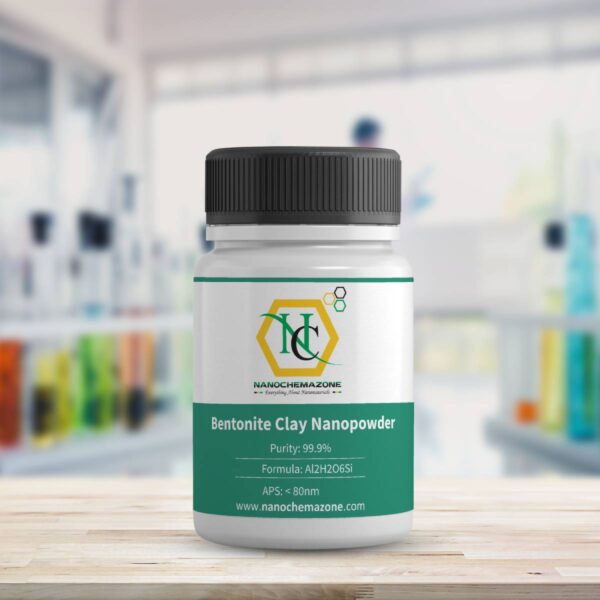
Bentonite Clay Nanopowder
Bentonite Clay Nanopowder
Product Name: Bentonite Clay Nanopowder (Purity: 99.9%, APS: < 80nm)
Product |
Bentonite Clay Nanopowder |
| Cat No | NCZ-MN-113/20 |
| CAS No | 1302-78-9 |
| Purity | 99.9% |
| APS | < 80nm |
| Molecular Weight | 108.1 g/mol |
| Form | Powder |
| Specific Gravity | 2.5(H2O) |
| Melting Point | Decomposes |
| Solubility | Slightly soluble in water Insoluble in methanol |
| Molecular Formula | Al2H2O6Si |
Bentonite Clay Related Information
Storage Conditions:
Airtight sealed, avoid light and keep dry at room temperature.
Please contact us for customization and price inquiry
Email: contact@nanochemazone.com
Note: We supply different size ranges of Nano and micron as per the client’s requirements and also accept customization in various parameters.

Carbon Mesoporous Nanopowder
Carbon Mesoporous Nanopowder
Product Name: Carbon Mesoporous Nanopowder (C, Purity: >99.9%, APS: < 100nm)
| Product | Carbon Mesoporous Nanopowder |
| Cat No | NCZ-MN-160/20 |
| CAS No | 1333-86-4 |
| Purity | >99.9% |
| APS | < 100 nm |
| Molecular Formula | C |
| Molecular Weight | 12.01 |
| Form | Powder |
| Color | Black |
| Density | 1-2.1 g/cm³ |
| Melting Point | 3654 °C |
| Boiling Point | 4827 °C |
| SSA | >500 m2/g (BET) |
| Vapor pressure | 1 mm Hg @ 3586C |
| Solubility | Soluble in Water |
Please email us for the customization.
Email: contact@nanochemazone.com
Please contact us for customization and price inquiry
Note: We supply different size ranges of Nano and micron as per the client’s requirements and also accept customization in various parameters.

Gallium Arsenide Nanopowder
Gallium Arsenide Nanopowder
| Product | Gallium Arsenide Nanopowder |
| Cat No | NCZ-NSC810/20 |
| CAS No | 1303-00-0 |
| Purity | 99.9% |
| APS | 80-100nm |
| Molecular Formula | GaAs |
| Molecular Weight | 144.64g/mol |
| Form | Powder |
| Color | Gray |
| Density | 5.3g/cm3 |
| Melting Point | 1400°C |
| Young Modulus | 85 GPa |
| Thermal Conductivity | 47 W/m-K |
| Solubility in water | Insoluble in water |
Gallium Arsenide Nano powder Description
Gallium Arsenide Nano powder composed of gallium arsenide nanoparticles (average particle size: 4?m) used in various semiconductor and photo optic applications. Gallium arsenide nano powder is hydrophobic and forms clear colloidal sultions in ethanol and non-polar solvents) Nanochemazone produces to many standard grades when applicable, including Mil Spec (military grade); ACS, Reagent and Technical Grade; Food, Agricultural and Pharmaceutical Grade; Optical Grade, USP and EP/BP (European Pharmacopoeia/British Pharmacopoeia) and follows applicable ASTM testing standards. Typical and custom packaging is available, as is additional technical and safety (MSDS) data. Please contact us for information on lead time and pricing above.
Gallium Arsenide Nanopowder Related Information
Storage Conditions:
Airtight sealed, avoid light, and keep dry at room temperature.
Please contact us for customization and price inquiry
Email: contact@nanochemazone.com
Note: We supply different size ranges of Nano and micron as per the client’s requirements and also accept customization in various parameters.
Gallium Arsenide Powder
Gallium Arsenide Powder
| Product | Gallium Arsenide Powder |
| Cat No | NCZ-NSC811/20 |
| CAS No | 1303-00-0 |
| Purity | 99.9% |
| APS | 40-50 µm |
| Density | 5.32 g/cm³ |
| Group Gallium | 13 |
| Group Arsenide | 15 |
| Gallium | 48.2% |
| Arsenic | 51.79 % |
| Molar Mass | 144.645 g/mol |
| Melting Point | 1238 °C |
| Conclusion | The specifications Confirm with enterprise standard |
Gallium Arsenide Description
Gallium Arsenide powder composed of gallium arsenide nanoparticles (average particle size: 4?m) used in various semiconductor and photo optic applications. Gallium arsenide powder is hydrophobic and forms clear colloidal sultions in ethanol and non-polar solvents)
Nanochemazone produces to many standard grades when applicable, including Mil Spec (military grade); ACS, Reagent and Technical Grade; Food, Agricultural and Pharmaceutical Grade; Optical Grade, USP and EP/BP (European Pharmacopoeia/British Pharmacopoeia) and follows applicable ASTM testing standards.
Typical and custom packaging is available, as is additional technical and safety (MSDS) data. Please contact us for information on lead time and pricing above.
Gallium Arsenide Related Information
Storage Conditions:
Airtight sealed, avoid light, and keep dry at room temperature.
Please contact us for customization and price inquiry
Email: contact@nanochemazone.com
Note: We supply different size ranges of Nano and micron as per the client’s requirements and also accept customization in various parameters.
Glassy Carbon Spherical Powder
Glassy Carbon Spherical Powder
Product Name: Glassy Carbon Spherical Powder (C, Purity: 99.9%, APS: 2~12µm)
| Product | Glassy Carbon Spherical Powder |
| Cat No | NCZ-MN-163/20 |
| CAS No | 7440-44-0 |
| Purity | 99.9 % |
| APS | 2~12µm |
| Molecular Formula | C |
| Molecular Weight | 12.01 g/mol |
| Density | 2.267 g/cm³ |
| Appearance | Black solid |
| Melting Point | 3652 - 3697 °C (sublimes) |
| Boiling Point | 4200 °C |
| Thermal Conductivity | 119-165 W/m/K |
| Heat of Vaporization | 128 K-Cal/gm |
| Electronegativity | 2.55 Paulings |
| Solubility | Insoluble in water |
Please email us for the customization.
Email: contact@nanochemazone.com
Please contact us for customization and price inquiry
Note: We supply different size ranges of Nano and micron as per the client’s requirements and also accept customization in various parameters.
Granular Activated Carbon
Granular Activated Carbon
Product Name: Granular Activated Carbon (C, Purity: 99.9%, APS: 50-60µm)
| Product | Granular Activated Carbon |
| Cat No | NCZ-MN-164/20 |
| CAS No | 7440-44-0 |
| Purity | 99.9% |
| APS | 50-60 µm |
| Molecular Weight | 242.62 g/ mol |
| Form | Granules |
| Color | Black |
| PH value | 6-7 |
| SSA | 900-1100 m2/g |
| Bulk Density | 0.45 g/ cm3 |
| Solubility | Insoluble In Water |
Please email us for the customization.
Email: contact@nanochemazone.com
Please contact us for customization and price inquiry
Note: We supply different size ranges of Nano and micron as per the client’s requirements and also accept customization in various parameters.
Silicon Monoxide Powder
Silicon Monoxide (SiO)
Product Name: Silicon Monoxide Powder
| Product Name | Silicon Monoxide |
| Cat No. | NCZ-MN-056/20 |
| CAS No. | 10097-28-6 |
| MF | SiO |
| Purity | >99% |
| APS | 400 nm (Customizable) |
| Appearance | Black Brown Powder |
| Molecular Weight | 44.08 |
| Melting Point | 1702°C |
| Boiling Point | 1880°C |
| Density | 2.13g/cm³ |
| Refractive index | 1.980 |
| Application | Plating of optical equipment such as lens |
| Crushing to submicron level below D50 | 500 nm is also available |
Silicon Monoxide Chemical component (standard value): ppm max
| Fe | <20 ppm |
| Al | <20 ppm |
| Cu | <10 ppm |
| Ti | <10 ppm |
| Ca | <10 ppm |
| Mn | <30 ppm |
Silicon Monoxide Application Fields:
Lithium-ion secondary battery anode material precursors to prepare silicon-based anode material Fine ceramic, synthetic raw materials; such as silicon nitride and silicon carbide Because silicon monoxide fine powder is very active, it can be used as fine ceramic, synthetic raw materials, such as silicon nitride and silicon carbide fine ceramic powder raw materials. Used for the preparation of optical glass and semiconductor materials.
Evaporate it in a vacuum and coat it on the metal mirror surface of the optical instrument as a protective film. Preparation of semiconductor materials.
The hunt is on advanced battery materials with enhanced storage capacity, higher energy density, and better cycle characteristics than traditional lithium-ion batteries. Conventional lithium-ion batteries rely on graphite-based anodes, whose well-established properties aren’t ideal for meeting the growing consumer demand for high-performance electronics, such as smartphones, laptops, and electric vehicles. Current research focuses on developing new alternatives that perform better and are safer than lithium-ion, and Nanochemazone is leading the way.
Silicon monoxide is a promising alternative to graphite because of its high specific gravity, low volume expansion, and small initial surface area. Silicon-based anodes can increase capacity ten times over standard graphite, allowing smaller batteries to produce the same amount of power or increasing the ability of a battery of the same size. This is possible because of the internal channels within the silicon monoxide Nanospheres. These channels allow lithium ions to flow rapidly for quick charging, and they shorten the paths for a boost in power.
Nanochemazone offers a 99.99% pure silicon monoxide powder prepared using chemical vapor deposition, suitable for secondary battery anode material precursors to prepare silicon-based anode materials and fine ceramic, synthetic raw materials. Our silicon monoxide battery material is prized by researchers and innovators around the world for its quality, purity, and consistency.
Silicon Monoxide SiO Related Information
Silicon Monoxide Powder Storage Conditions:
Airtight sealed, avoid light and keep dry at room temperature.
Please contact us for customization and price inquiry
Email: contact@nanochemazone.com
Note: We supply different size ranges of Nano and micron as per the client’s requirements and also accept customization in various parameters.
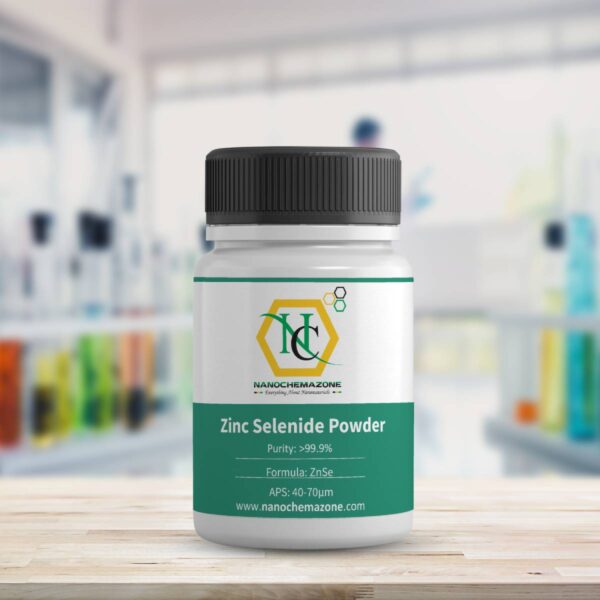
Zinc Selenide Powder
Zinc Selenide Powder
Product Name: Zinc Selenide Powder (ZnSe, >99.9%, APS: 40-70µm)
| Product | Zinc Selenide Powder |
| Cat No | NCZ-NSC817/20 |
| CAS No | 1315-09-9 |
| Purity | >99.9 % |
| APS | 40-70µm (Can be customized) |
| Molecular Formula | ZnSe |
| Molecular Weight | 144.35 g/mol |
| Color | Yellow |
| Density | 5.27 g/cm³ |
| Melting Point | 1525 °C |
| Linear Expansion Coefficient | 7.57x10⁻⁶ @ 20°C |
| Young Modulus | 67.2 GPa |
| Thermal Conductivity | 18 Wm |
| Solubility in water | Insoluble in water |
Zinc Selenide Related Information
Storage Conditions:
Airtight sealed, avoid light, and keep dry at room temperature.
Please contact us for customization and price inquiry
Email: contact@nanochemazone.com
Note: We supply different size ranges of Nano and micron as per the client’s requirements and also accept customization in various parameters.
Reviews
There are no reviews yet.