


Natural Graphite Flaky Powder
₹0.00
Product Name: Natural Graphite Flaky Powder
| Product | Natural Graphite Flaky Powder |
| CAS No | 7782-42-5 |
| Appearance | Black Powder |
| Purity | 99.9% |
| APS | 3um, 5um, 10um, 30um (Can be customized) |
| Product Code | NCZ-NSC338/20 |
| Modulus of Elasticity (GPa) | 8-15 |
| Compressive strength (MPa) | 20-200 |
Description of Super Adsorption Activated Porous Carbon Powder
Solid carbon comes in different forms known as allotropes depending on the type of chemical bond. The two most common are diamond and graphite less common ones include buckminsterfullerene. In diamond the bonds are sp3 and the atoms form tetrahedra with each bound to four nearest neighbors.
In graphite, they are sp2 orbital hybrids and the atoms form in planes with each bound to three nearest neighbors 120 degrees apart.
The individual layers are called graphene. In each layer, the carbon atoms are arranged in a honeycomb lattice with a separation of 0.142 nm, and the distance between planes is 0.335 nm. Atoms in the plane are bonded covalently, with only three of the four potential bonding sites satisfied. The fourth electron is free to migrate in the plane, making graphite electrically conductive. Bonding between layers is via weak van der Waals bonds, which allows layers of graphite to be easily separated, or to slide past each other. Electrical conductivity perpendicular to the layers is consequently about 1000 times lower.
The two known forms of graphite, alpha (hexagonal) and beta (rhombohedral) have very similar physical properties, except that the graphene layers stack slightly differently. The alpha graphite may be either flat or buckled. The alpha form can be converted to the beta form through mechanical treatment and the beta form reverts to the alpha form when it is heated above 1300 °C.
Related Information of Natural Graphite Flaky Powder
Storage Conditions:
Airtight sealed, avoid light, and keep dry at room temperature.
Please contact us for customization and price inquiry
Email: contact@nanochemazone.com
Note: We supply different size ranges of Nano and micron as per the client’s requirements and also accept customization in various parameters.
Note: For pricing & ordering information, please contact us at sales@nanochemazone.com
Please contact us for quotes on Larger Quantities & Customization. E-mail: contact@nanochemazone.com
Customization:
You must be logged in to post a review.
Related products
Chromium Diboride Powder
Chromium Diboride Powder
Product Name: Chromium Diboride Powder
| MF: | CrB2 |
| Chemical Name |
Chromium Diboride Powder |
| Appearance | silver, ceramic material |
| EINECS | 234-499-3 |
| Purity: | 99.9% |
| Density: | 5.20 g/cm3 |
| Product Number: | NCZ-NCD-117/20 |
| Cas Number: | 12007-16-8 |
Copper Nickel Micron Powder
Copper Nickel Micron Powder
Product Name: Copper-Nickel Micron Powder
| Product | Copper Nickel Powder |
| CAS No. | 12357-13-0 |
| Appearance | Black Powder |
| Purity | 99.9% |
| APS | 1 – 5 Microns (Can be customized) |
| Ingredient | Cu-Ni |
| Product Code | NCZ-NSC-193/20 |
Copper Nickel Micron Powder Description:
- powder metallurgy for copper-based or nickel-based alloy
- the surface coating of maritime vessels seawater corrosion-resistant materials
- lubricant wear-resistant, anti-wear additives
- conductive, thermally conductive filler material
Copper Nickel Micron Powder RELATED INFORMATION
Storage Conditions: Airtight sealed, avoid light and keep dry at room temperature. Please contact us for customization and price inquiry Email: contact@nanochemazone.com Note: We supply different size ranges of Nano and micron as per the client’s requirements and also accept customization in various parameters.
Ferrovanadium Nitride Powder
Product Name: Ferrovanadium Nitride Powder
| Product | Ferrovanadium Nitride Powder |
| Colour | Greyish silver |
| Purity | ≥ 99.9% |
| Particle size | 1-10 µM (customizable) |
| Ingredient/MF | FeVN |
| Product Code | NCZ-CN-149/20 |
| CAS Number | 7439-89-6 / 24646-85-3 |
Ferrovanadium Nitride Powder Description:
Ferrovanadium Nitride (Vanadium-Nitrogen alloy) is a composition ferrovanadium nitride. Ferrovanadium nitride is proposed for joint nitrogen and vanadium steel doping. Ferrovanadium Nitride (Vanadium-Nitrogen Alloy) is a new type of alloy additive, It can substitute Ferro Vanadium used in the production of Micro alloying-steel.Ferrovanadium Nitride Powder Application:
- FeVN alloy powder can be used for structural steel, tool steel, pipeline steel, steel, and cast iron.
- It is used for nitrogen-containing steel melting: high- strength low-alloy steel (HSLA), rail steel, quick cutting steel, etc.
- Ferrovanadium Nitride adding to the steel can increase the strength, tough, tactility, anti-thermal fatigue, etc.
- It also can make the steel be able to fulfill solderability to attain the same strength, adding Ferrovanadium Nitride could save 30-40% of Vanadium, thereby saving the cost.
Ferrovanadium Nitride Powder Advantages:
- Low melting point, high-density products, under the condition of the same production, vanadium and nitrogen yield is higher than similar products.
- Low nitrogen vanadium than more reasonable, high strengthening ability.
- Stable high product purity, ingredients, production has smaller fluctuation, the mechanical performance of steel performance has higher reliability.
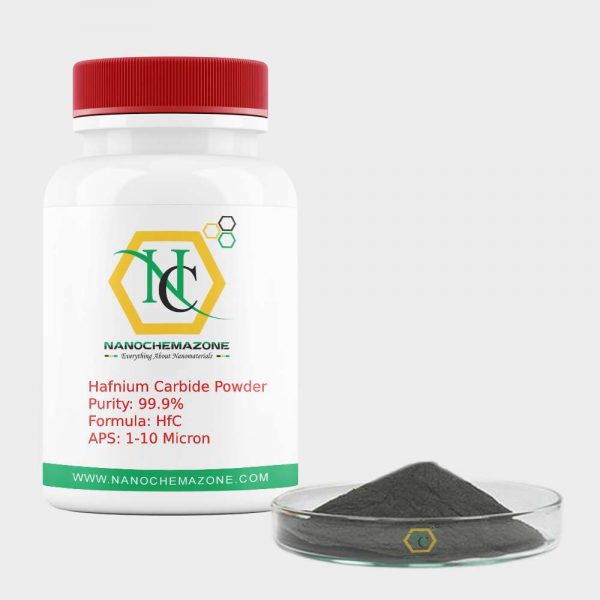
Hafnium Carbide Powder
Product Name: Hafnium Carbide Powder
| Product | Hafnium Carbide Powder |
| Colour | Gray Powder |
| Purity | ≥ 99.9% |
| Particle size | 1-10 µM (customizable) |
| Ingredient/MF | HfC |
| Product Code | NCZ-C-103/20 |
| CAS Number | 12069-85-1 |
Brief Description of Hafnium carbide powder HfC:
Hafnium carbide ( HfC) is a chemical compound of hafnium and carbon With a melting point of about 3900 °C it is one of the most refractory binary compounds known. However, it has low oxidation resistance, with the oxidation starting at temperatures as low as 430 °C Hafnium carbide is usually carbon deficient and therefore its composition is often expressed as HfCx (x = 0.5 to 1.0). It has a cubic (rock-salt) crystal structure at any value of xApplication of Hafnium carbide powder HfC:
- Used for preparation of ultra-high temperature ceramics
- The reactant in the synthesis of hafnium-containing organometallic polymers
- Used as an additive in alloys
- Used in coatings
- Widely used in microelectronics, semiconductor, aerospace high-temperature resistant material, coating materials, ceramic materials, ceramic target material, etc.
Hafnium carbide Powder related Information
Please email us for the customization. Email: contact@nanochemazone.com Please contact us for customization and price inquiry Note: We supply different size ranges of Nano and micron as per the client’s requirements and also accept customization in various parameters.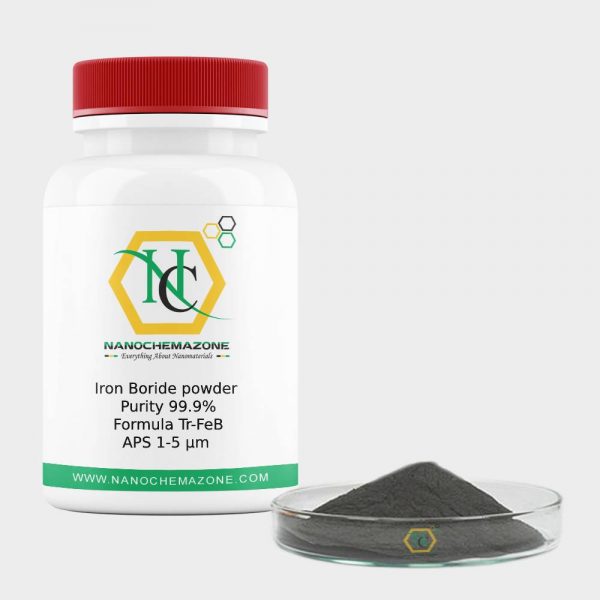
Iron Boride Powder
Product Name: Iron Boride Powder
| MF: | Tr-FeB |
| Chemical Name | Iron Boride Powder |
| Color | Grey Powder |
| EINECS Number: | 234-489-9 |
| Purity: | 99.9% |
| Density | ~7 g/cm3 |
| Product Number: | NCZ-NIB-112/20 |
| Cas Number: | 12006-84-8 |
Iron Boride Powder Description
Iron Boride Powder is often used to improve abrasion resistance, corrosion resistance, wear resistance, and oxidation resistance. It is used in oil and gas refinery, chemical extraction, automotive agricultural, stamping, textile extrusion, and injection molding industries. Iron-based coatings recently gained attention for their mechanical, frictional, and corrosion-resistant properties. As compared to the ceramic or cermet type of materials people have used before, iron-based materials are relatively inexpensive, less strategic, and can be produced economically by various thermal methods with ease of fabrication and machining.
Iron Boride Powder Related Information
Please email us for the customization. Email: contact@nanochemazone.com Please contact us for customization and price inquiry Note: We supply different size ranges of Nano and micron as per the client’s requirements and also accept customization in various parameters.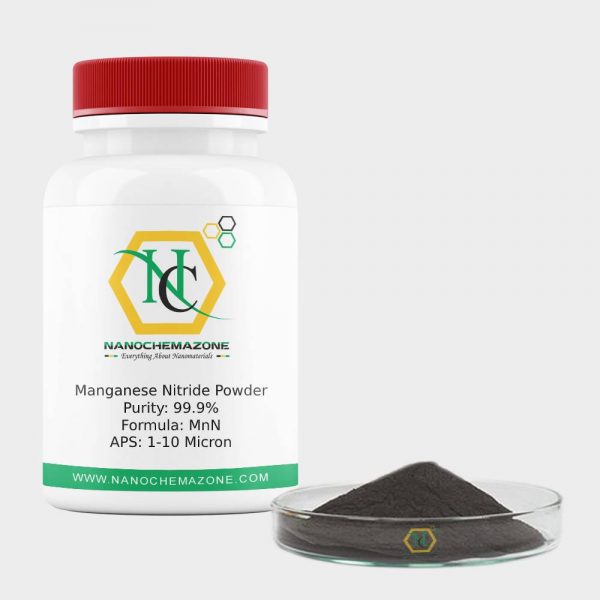
Manganese Nitride Powder
Manganese Nitride Powder
Product Name: Manganese Nitride Powder
| Product | Manganese Nitride Powder |
| Colour | Dark Gray |
| Purity | ≥ 99.9% |
| Particle size | 1-10 µM (customizable) |
| Ingredient/MF | MnN |
| Product Code | NCZ-CN-148/20 |
| CAS Number | 7439-96-5 |
Manganese Nitride Powder Description:
Manganese Nitride Powder is generally immediately available in most volumes. High purity, submicron and nanopowder forms may be considered. Our factory produces too many standard grades when applicable, including Mil Spec (military grade); ACS, Reagent and Technical Grade; Food, Agricultural and Pharmaceutical Grade; Optical Grade
Manganese Nitride in Briquettes, as a kind of Nitrogen and manganese alloy additive, its characteristics are: high content of main elements, low content of harmful impurities, Nitrogen utilization is to be improved after add melt. We adopt the continuous nitride process with unique intellectual property rights in mass production, which has stable quality and uniform nitrogen
Manganese Nitride Powder Application:
- Used for production of special alloy steel, high strength steel, stainless steel, heat-resistant steel products
2. Application in the field of high nitrogen steel smelting
- Used as the steel-making additive and endow many excellent performances to steel grade such as strength, toughness, creep resistance, etc.
- Specialty demonstrated its good market prospects in large diameter steel pipe of transmitting oil and gas strength steel in shipbuilding and automotive.
Basic information of Manganese Nitride Powder
Manganese (atomic symbol: Mn, atomic number: 25) is a Block D, Group 7, Period 4 element with an atomic weight of 54.938045.
In its elemental form, manganese has a silvery metallic appearance.
It is a paramagnetic metal that oxidizes easily in addition to being very hard and brittle.
Manganese is found as a free element in nature and also in the minerals pyrolusite, braunite, psilomelane, and rhodochrosite.
Nitrogen is a Block P, Group 15, Period 2 element.
Nitrogen is an odorless, tasteless, colorless, and mostly inert gas.
It is the seventh most abundant element in the universe, and it constitutes 78.09% (by volume) of Earth’s atmosphere.
Please email us for the customization. Email: contact@nanochemazone.com Please contact us for customization and price inquiry Note: We supply different size ranges of Nano and micron as per the client’s requirements and also accept customization in various parameters.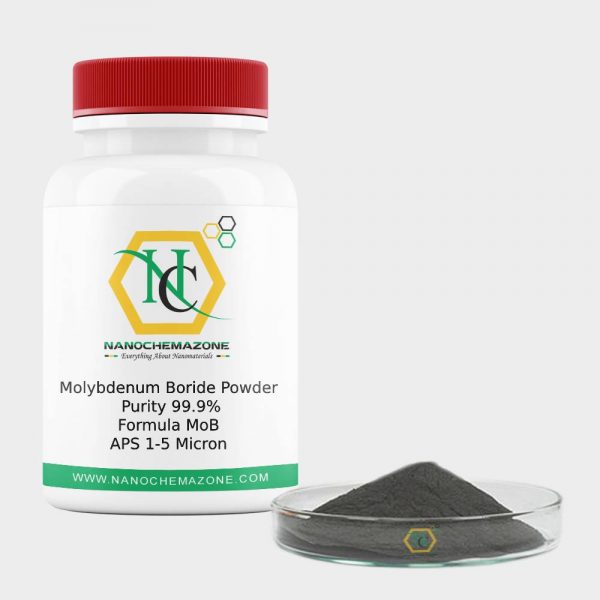
Molybdenum Boride Powder
Molybdenum Boride Powder
Product Name: Molybdenum Boride Powder
| MF: | Tr-MoB2 |
| Chemical Name | Molybdenum Boride Powder |
| Color | Yellow Gray |
| EINECS No.: | 234-502-8 |
| Purity: | 99.9% |
| Density: | 9.26 g/ cm3 |
| Product Number: | NCZ-NMB-112/20 |
| Cas Number: | 12006-99-4 |
Molybdenum Boride Powder
RELATED INFORMATION
It's mainly used as an additive of electronic tungsten, molybdenum alloy, etc., and can also be used in the manufacture of wear semiconductor thin film and coating materials. Please email us for the customization. Email: contact@nanochemazone.com Please contact us for customization and price inquiry Note: We supply different size ranges of Nano and micron as per the client’s requirements and also accept customization in various parameters.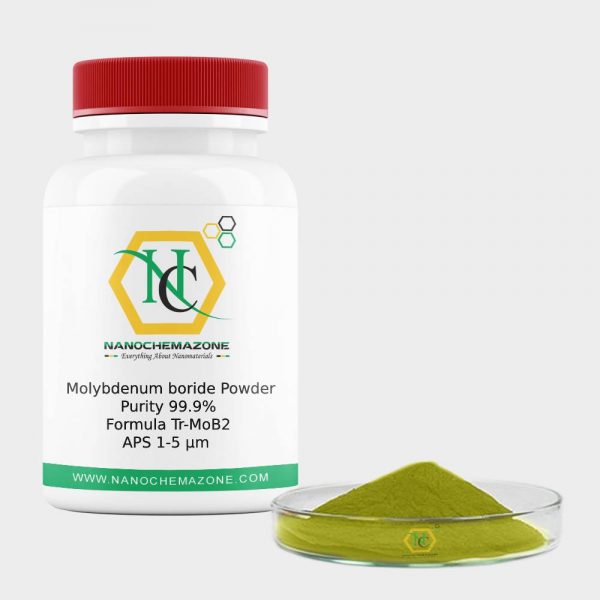
Molybdenum Boride Powder
Molybdenum Boride Powder
Product Name: Molybdenum Boride Powder
| MF: | Tr-MoB2 |
| Chemical Name | Boride Powder |
| Color | Yellow Gray |
| EINECS No.: | 234-502-8 |
| Purity: | 99.9% |
| Density: | 9.26 g/ cm3 |
| Product Number: | NCZ-NMB-112/20 |
| Cas Number: | 12006-99-4 |
Reviews
There are no reviews yet.