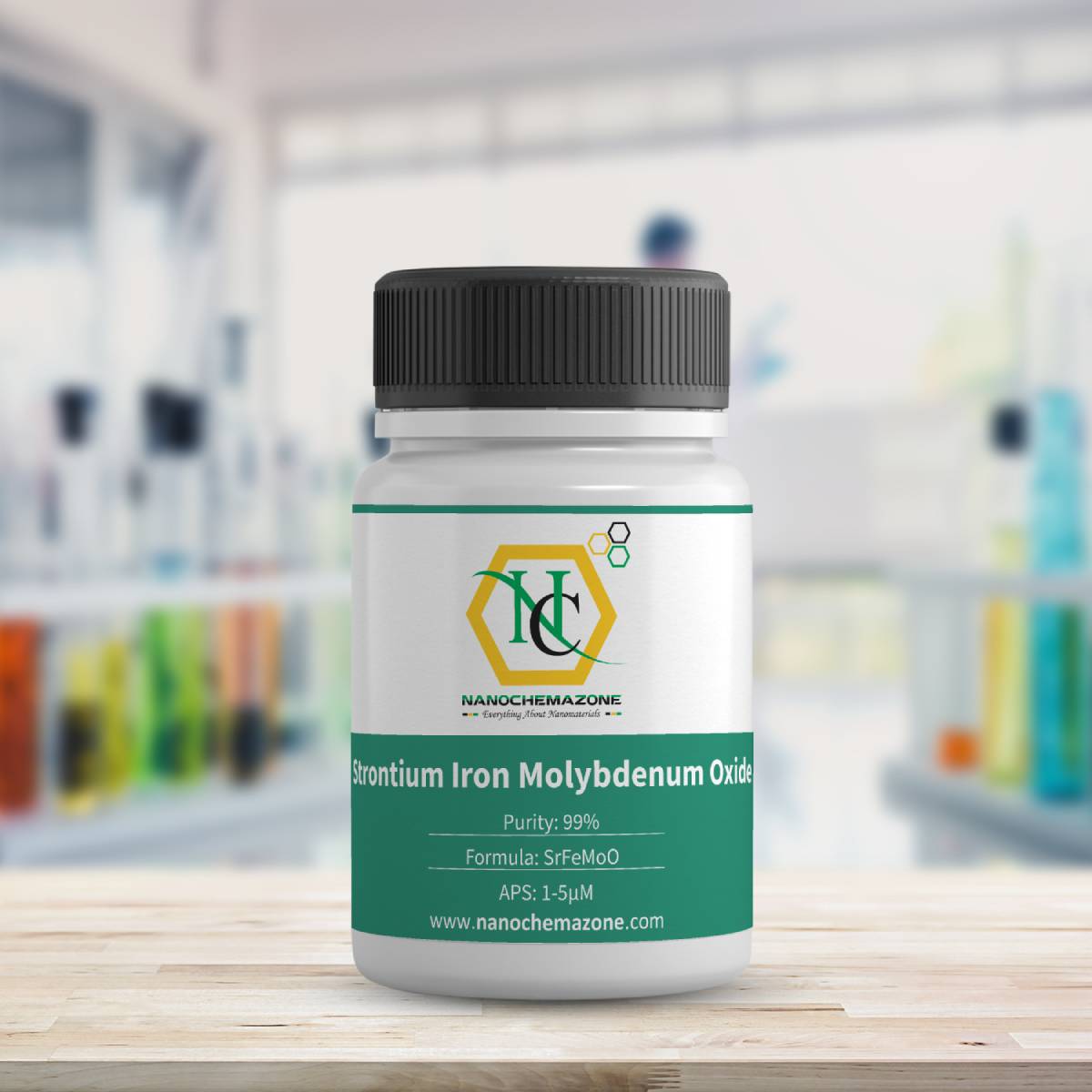


Strontium Iron Molybdenum Oxide
₹0.00
Strontium Iron Molybdenum Oxide
Product |
Strontium Iron Molybdenum Oxide |
| Colour | Crystalline solid |
| Purity | 99% |
| Particle Size | 1-5µM(Customizable) |
| Ingredient/MF | SrFeMoO |
| Product Code | NCZ-CP-381/20 |
| CAS Number | 389082-20-6 |
| Density | N/A |
| Melting point | N/A |
| Boiling Point | N/A |
| Molecular Weight | 255.42 |
| Exact Mass | 257.740872 g/mol |
Strontium Iron Molybdenum Oxide Description
Iron is a Block D, Group 8, Period 4 element with an atomic weight of 55.845. The number of electrons in each of Iron’s shells is 2, 8, 14, 2 and its electron configuration is [Ar] 3d6 4s2.
The iron atom has a radius of 126 pm and a Van der Waals radius of 194 pm. Iron was discovered by humans before 5000 BC. In its elemental form, iron has a lustrous grayish metallic appearance.
Iron is the fourth most common element in the Earth’s crust and the most common element by mass forming the earth as a whole. Iron is rarely found as a free element, since it tends to oxidize easily; it is usually found in minerals such as magnetite, hematite, goethite, limonite, or siderite.
Though pure iron is typically soft, the addition of carbon creates the alloy known as steel, which is significantly stronger.
Molybdenum:
Molybdenum is a Block D, Group 6, Period 5 element with an atomic weight of 95.96. The number of electrons in each of molybdenum’s shells is [2, 8, 18, 13, 1] and its electron configuration is [Kr] 4d5 5s1. The molybdenum atom has a radius of 139 pm and a Van der Waals radius of 209 pm. In its elemental form, molybdenum has a gray metallic appearance. Molybdenum was discovered by Carl Wilhelm in 1778 and first isolated by Peter Jacob Hjelm in 1781. Molybdenum is the 54th most abundant element in the earth’s crust. It has the third highest melting point of any element, exceeded only by tungsten and tantalum. Molybdenum does not occur naturally as a free metal, it is found in various oxidation states in minerals.
The primary commercial source of molybdenum is molybdenite, although it is also recovered as a byproduct of copper and tungsten mining. The origin of the name Molybdenum comes from the Greek word molubdos meaning lead.
Strontium:
Strontium is a Block S, Group 2, Period 5 element with an atomic weight of 87.62 . The number of electrons in each of Strontium’s shells is [2, 8, 18, 8, 2] and its electron configuration is [Kr] 5s2.
The strontium atom has a radius of 215 pm and a Van der Waals radius of 249 pm. Strontium was discovered by William Cruickshank in 1787 and first isolated by Humphry Davy in 1808. In its elemental form, strontium is a soft, silvery white metallic solid that quickly turns yellow when exposed to air.
Cathode ray tubes in televisions are made of strontium, which are becoming increasingly displaced by other display technologies pyrotechnics and fireworks employ strontium salts to achieve a bright red color.
Radioactive isotopes of strontium have been used in radioisotope thermoelectric generators (RTGs) and for certain cancer treatments. In nature, most strontium is found in celestite (as strontium sulfate) and strontianite (as strontium carbonate). Strontium was named after the Scottish town where it was discovered.
Related Information
Please email us for the customization.
Email: contact@nanochemazone.com
Please contact us for customization and price inquiry
Note: We supply different size ranges of Nano and micron as per the client’s requirements and also accept customization in various parameter.
Note: For pricing & ordering information, please contact us at sales@nanochemazone.com
Please contact us for quotes on Larger Quantities & Customization. E-mail: contact@nanochemazone.com
Customization:
If you are planning to order large quantities for your industrial and academic needs, please note that customization of parameters (such as size, length, purity, functionalities, etc.) are available upon request.
You must be logged in to post a review.
Related products
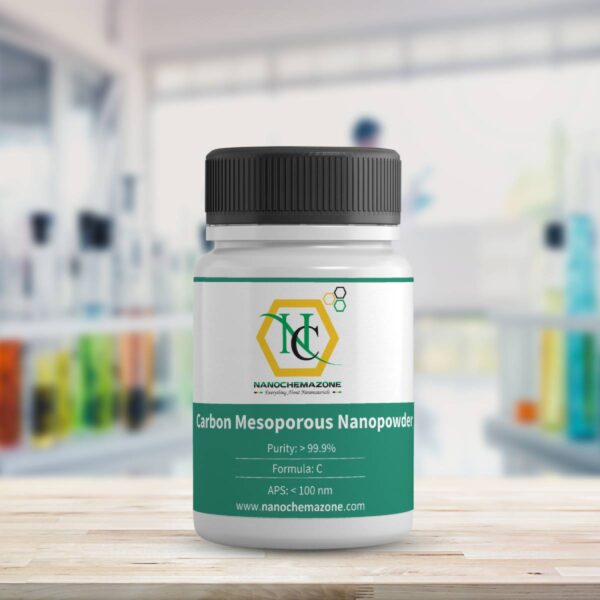
Carbon Mesoporous Nanopowder
Carbon Mesoporous Nanopowder
Product Name: Carbon Mesoporous Nanopowder (C, Purity: >99.9%, APS: < 100nm)
| Product | Carbon Mesoporous Nanopowder |
| Cat No | NCZ-MN-160/20 |
| CAS No | 1333-86-4 |
| Purity | >99.9% |
| APS | < 100 nm |
| Molecular Formula | C |
| Molecular Weight | 12.01 |
| Form | Powder |
| Color | Black |
| Density | 1-2.1 g/cm³ |
| Melting Point | 3654 °C |
| Boiling Point | 4827 °C |
| SSA | >500 m2/g (BET) |
| Vapor pressure | 1 mm Hg @ 3586C |
| Solubility | Soluble in Water |
Please email us for the customization.
Email: contact@nanochemazone.com
Please contact us for customization and price inquiry
Note: We supply different size ranges of Nano and micron as per the client’s requirements and also accept customization in various parameters.
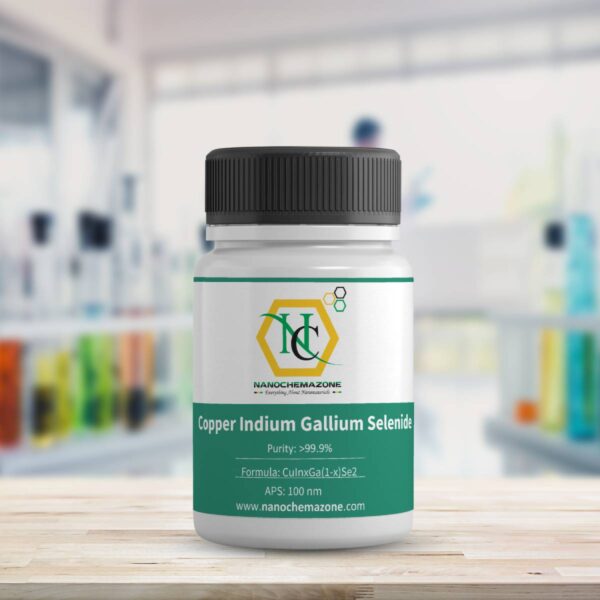
Copper Indium Gallium Selenide
Copper Indium Gallium Selenide
| Product | Copper Indium Gallium Selenide |
| Cat No | NCZ-NSC809/20 |
| CAS No | 12018-95-0 |
| Purity | 99.9% |
| APS | 1-2µm |
| Molecular Formula | CuInxGa(1-x)Se2 |
| Form | Powder |
| Color | Silver |
| Density | 5.7 g/cm3 |
| Melting Point | 990-1070 °C |
Copper Indium Gallium Selenide Description
Copper Indium Gallium Selenide Powder (CIGS) for solar energy applications is a p-type or absorber layer material. CIGS-based photovoltaic cells (PV Cells) for solar energy are fabricated from a positively charged or p-type CIGS layer underneath a negatively charged or n-type layer.
The p-type layer can be produced by thin film deposition of a Gallium doped Copper Indium Selenide (CIGS) Nanopowder sold under the Nanochemazone Solar Energy group. Most CIGS-based PV solar cells are produced from thin film deposition of CIGS using sputtering techniques.
Nanochemazone produces to many standard grades when applicable, including Mil Spec (military grade); ACS, Reagent and Technical Grade; Food, Agricultural and Pharmaceutical Grade; Optical Grade, USP and EP/BP (European Pharmacopoeia/British Pharmacopoeia) and follows applicable ASTM testing standards. Typical and custom packaging is available.
Copper Indium Gallium Selenide Related Information
Storage Conditions:
Airtight sealed, avoid light, and keep dry at room temperature.
Please contact us for customization and price inquiry
Email: contact@nanochemazone.com
Note: We supply different size ranges of Nano and micron as per the client’s requirements and also accept customization in various parameters.

Gallium Arsenide Nanopowder
Gallium Arsenide Nanopowder
| Product | Gallium Arsenide Nanopowder |
| Cat No | NCZ-NSC810/20 |
| CAS No | 1303-00-0 |
| Purity | 99.9% |
| APS | 80-100nm |
| Molecular Formula | GaAs |
| Molecular Weight | 144.64g/mol |
| Form | Powder |
| Color | Gray |
| Density | 5.3g/cm3 |
| Melting Point | 1400°C |
| Young Modulus | 85 GPa |
| Thermal Conductivity | 47 W/m-K |
| Solubility in water | Insoluble in water |
Gallium Arsenide Nano powder Description
Gallium Arsenide Nano powder composed of gallium arsenide nanoparticles (average particle size: 4?m) used in various semiconductor and photo optic applications. Gallium arsenide nano powder is hydrophobic and forms clear colloidal sultions in ethanol and non-polar solvents) Nanochemazone produces to many standard grades when applicable, including Mil Spec (military grade); ACS, Reagent and Technical Grade; Food, Agricultural and Pharmaceutical Grade; Optical Grade, USP and EP/BP (European Pharmacopoeia/British Pharmacopoeia) and follows applicable ASTM testing standards. Typical and custom packaging is available, as is additional technical and safety (MSDS) data. Please contact us for information on lead time and pricing above.
Gallium Arsenide Nanopowder Related Information
Storage Conditions:
Airtight sealed, avoid light, and keep dry at room temperature.
Please contact us for customization and price inquiry
Email: contact@nanochemazone.com
Note: We supply different size ranges of Nano and micron as per the client’s requirements and also accept customization in various parameters.
Gallium Arsenide Powder
Gallium Arsenide Powder
| Product | Gallium Arsenide Powder |
| Cat No | NCZ-NSC811/20 |
| CAS No | 1303-00-0 |
| Purity | 99.9% |
| APS | 40-50 µm |
| Density | 5.32 g/cm³ |
| Group Gallium | 13 |
| Group Arsenide | 15 |
| Gallium | 48.2% |
| Arsenic | 51.79 % |
| Molar Mass | 144.645 g/mol |
| Melting Point | 1238 °C |
| Conclusion | The specifications Confirm with enterprise standard |
Gallium Arsenide Description
Gallium Arsenide powder composed of gallium arsenide nanoparticles (average particle size: 4?m) used in various semiconductor and photo optic applications. Gallium arsenide powder is hydrophobic and forms clear colloidal sultions in ethanol and non-polar solvents)
Nanochemazone produces to many standard grades when applicable, including Mil Spec (military grade); ACS, Reagent and Technical Grade; Food, Agricultural and Pharmaceutical Grade; Optical Grade, USP and EP/BP (European Pharmacopoeia/British Pharmacopoeia) and follows applicable ASTM testing standards.
Typical and custom packaging is available, as is additional technical and safety (MSDS) data. Please contact us for information on lead time and pricing above.
Gallium Arsenide Related Information
Storage Conditions:
Airtight sealed, avoid light, and keep dry at room temperature.
Please contact us for customization and price inquiry
Email: contact@nanochemazone.com
Note: We supply different size ranges of Nano and micron as per the client’s requirements and also accept customization in various parameters.
Glassy Carbon Spherical Powder
Glassy Carbon Spherical Powder
Product Name: Glassy Carbon Spherical Powder (C, Purity: 99.9%, APS: 2~12µm)
| Product | Glassy Carbon Spherical Powder |
| Cat No | NCZ-MN-163/20 |
| CAS No | 7440-44-0 |
| Purity | 99.9 % |
| APS | 2~12µm |
| Molecular Formula | C |
| Molecular Weight | 12.01 g/mol |
| Density | 2.267 g/cm³ |
| Appearance | Black solid |
| Melting Point | 3652 - 3697 °C (sublimes) |
| Boiling Point | 4200 °C |
| Thermal Conductivity | 119-165 W/m/K |
| Heat of Vaporization | 128 K-Cal/gm |
| Electronegativity | 2.55 Paulings |
| Solubility | Insoluble in water |
Please email us for the customization.
Email: contact@nanochemazone.com
Please contact us for customization and price inquiry
Note: We supply different size ranges of Nano and micron as per the client’s requirements and also accept customization in various parameters.
Indium Arsenide Powder
Indium Arsenide Powder
Product Name: Indium Arsenide Powder (InAs, Purity: 99.9%, APS: 40-50 µm)
| Product | Indium Arsenide Powder |
| Cat No | NCZ-NSC813/20 |
| CAS No | 1303-11-3 |
| Purity | 99.9% |
| APS | 40-50µm |
| Molecular Formula | InAs |
| Molecular Weight | 189.740g/mol |
| Form | Powder |
| Color | Gray |
| Density | 5.67g/cm3 |
| Melting Point | 942°C |
| Refractive Index | 3.51 |
| Dielectric Constant | 15.15 |
| Electrton Mobility | 40000(cm2/(V*s)) |
| Storage | Normal Room Temperature |
| Thermal Conductivity | 0.27(300K (W/cm•K)) |
| Specific Heat Capacity | 47.8 J•mol-1•K-1 |
| Solubility in water | Insoluble in water |
Indium Arsenide Powder Related Information
Storage Conditions:
Airtight sealed, avoid light, and keep dry at room temperature.
Please contact us for customization and price inquiry
Email: contact@nanochemazone.com
Note: We supply different size ranges of Nano and micron as per the client’s requirements and also accept customization in various parameters.
Indium Gallium Arsenide Nanopowder
Indium Gallium Arsenide Nanopowder
Product Name: Indium Gallium Arsenide Nanopowder (InGaAs, Purity: 99.9%, APS: < 100 nm)
| Product | Indium Gallium Arsenide Nanopowder |
| Cat No | NCZ-NSC814/20 |
| CAS No | 106097-59-0 |
| Purity | 99.9% |
| APS | < 100 nm |
| Molecular Formula | InGaAs |
| Molecular Weight | 259.46 g/mol |
| Form | Crystalline Powder |
| Color | White |
| Density | 5.68 g/cm³ |
| Melting Point | 844 °C |
| Conclusion | The specifications Confirm with enterprise standard |
Indium Gallium Arsenide Related Information
Storage Conditions:
Airtight sealed, avoid light, and keep dry at room temperature.
Please contact us for customization and price inquiry
Email: contact@nanochemazone.com
Note: We supply different size ranges of Nano and micron as per the client’s requirements and also accept customization in various parameters.
Tungsten Hexacarbonyl Nanopowder
Tungsten Hexacarbonyl Nanopowder
Product Name: Tungsten Hexacarbonyl Nanopowder (W, Purity: 99.9%, APS: 80-100 nm)
| Product | Tungsten Hexacarbonyl Nanopowder |
| Cat No | NCZ-MN-170/20 |
| CAS No | 14040-11-0 |
| Purity | 99.9% |
| APS | 80-100nm |
| Linear Formula | W(CO)6 |
| Form | Solid |
| Density | 2.65 g/mL at 25 °C (lit) |
| Melting Point | 150 °C (lit) |
| Vapor Density | 12.1 (vs air) |
| Vapor Pressure | 1.2 mmHg (67 °C) |
| Impurities | < 1 % Mo |
Please email us for the customization.
Email: contact@nanochemazone.com
Please contact us for customization and price inquiry
Note: We supply different size ranges of Nano and micron as per the client’s requirements and also accept customization in various parameters.
Reviews
There are no reviews yet.