


Tantalum Niobium Carbide Powder
₹0.00
Tantalum Niobium Carbide Powder
Product Name: Tantalum Niobium Carbide Powder
| Product | Tantalum Niobium Carbide Powder |
| CAS No. | 12070-06-3 |
| Appearance | Gray Powder |
| Purity | 99.9% |
| APS | 100 mm (Can be customized) |
| Ingredient | TaC:NbC |
| Product Code | NCZ-NSC327/20 |
Tantalum Niobium Carbide Powder Description :
Tantalum Niobium Carbide Powder is a chemical element with the symbol Ta and atomic number. Previously known as tantalum, it is named after Tantalus, a villain from Greek mythology.
Tantalum is a rare, hard, blue-gray, lustrous transition metal that is highly corrosion-resistant. It is part of the refractory metals group, which are widely used as minor components in alloys.
The chemical inertness of tantalum makes it a valuable substance for laboratory equipment, and as a substitute for platinum.
Its main use today is in tantalum capacitors in electronic equipment such as mobile phones, DVD players, video game systems, and computers. Tantalum, always together with the chemically similar niobium, occurs in the mineral groups tantalite, columbite, and coltan (a mix of columbite and tantalite, though not recognized as a separate mineral species.
Tantalum is considered a technology-critical element. Tantalum is dark dense, ductile, very hard, easily fabricated, and highly conductive of heat and electricity. The metal is renowned for its resistance to corrosion by acids; in fact, at temperatures below 150 °C tantalum is almost completely immune to attack by the normally aggressive aqua regia.
It can be dissolved with hydrofluoric acid or acidic solutions containing the fluoride ion and sulfur trioxide, as well as with a solution of potassium hydroxide.
Tantalum’s high melting point of 3017 °C (boiling point 5458 °C) is exceeded among the elements only by tungsten, rhenium, and osmium for metals, and carbon. Tantalum exists in two crystalline phases, alpha, and beta.
The alpha phase is relatively ductile and soft; it has a body-centered cubic structure (space group Im3m, lattice constant a = 0.33058 nm), Knoop hardness 200–400 HN and electrical resistivity 15–60. The beta phase is hard and brittle; its crystal symmetry is tetragonal (space group P42/mnm, a = 1.0194 nm, c = 0.5313 nm), Knoop hardness is 1000–1300 HN and electrical resistivity is relative.
The beta phase is metastable and converts to the alpha phase upon heating to 750–775 °C. Bulk tantalum is almost entirely alpha phase, and the beta phase usually exists as thin films obtained by magnetron sputtering, chemical vapor deposition or electrochemical deposition from a eutectic molten salt solution
Tantalum Niobium Carbide Powder Related Information:
Storage Conditions:
Airtight sealed, avoid light and keep dry at room temperature.
Please contact us for customization and price inquiry
Email: contact@nanochemazone.com
Note: We supply different size ranges of Nano and micron as per the client’s requirements and also accept customization in various parameters.
Note: For pricing & ordering information, please contact us at sales@nanochemazone.com
Please contact us for quotes on Larger Quantities & Customization. E-mail: contact@nanochemazone.com
Customization:
You must be logged in to post a review.
Related products
Chromium Diboride Powder
Chromium Diboride Powder
Product Name: Chromium Diboride Powder
| MF: | CrB2 |
| Chemical Name |
Chromium Diboride Powder |
| Appearance | silver, ceramic material |
| EINECS | 234-499-3 |
| Purity: | 99.9% |
| Density: | 5.20 g/cm3 |
| Product Number: | NCZ-NCD-117/20 |
| Cas Number: | 12007-16-8 |
CoCrW Alloy Powder
Product Name: CoCrW Alloy Powder
| Product |
CoCrW Alloy Powder |
| CAS No. | 7440-50-8/7440-47-3 |
| Appearance | Grey |
| Purity | 99.9% |
| APS | 1 – 5 Microns (Can be customized) |
| Ingredient | CoCrW |
| Product Code | NCZ-NSC-164/20 |
Description:
| 3D printing metal Powder Powder metallurgy(PM), injection molding(MIM), spray painting(SP) etc. |
Ferro Manganese Nitride Powder
Product Name: Ferro Manganese Nitride Powder
| Product | Ferro Manganese Nitride Powder |
| Colour | Gray |
| Purity | ≥ 99.9% |
| Particle size | 1-10 µM (customizable) |
| Ingredient/MF | FeMnN |
| Product Code | NCZ-CN-150/20 |
| CAS Number | 7439-89-6 / 7439-96-5 |
Ferro Manganese Nitride Powder Application:
Mainly used for steel production ferromanganese nitride nitrogen additive, which can improve the mechanical properties, such as the strength of steel, refined grains, and stabilize austenite. Mainly used for special alloy steel high strength stainless steel heat-resistant steel production. Please email us for the customization. Email: contact@nanochemazone.com Please contact us for customization and price inquiry Note: We supply different size ranges of Nano and micron as per the client’s requirements and also accept customization in various parameters.
Ferro Titanium Carbide Powder
Product Name: Ferro Titanium Carbide Powder
| Product | Ferro Titanium Carbide Powder |
| Colour | Gray Powder |
| Purity | ≥ 99.9% |
| Particle size | 1-10 µM (customizable) |
| Ingredient/MF | FeTiC |
| Product Code | NCZ-C-102/20 |
| CAS Number | 12604-56-7 |
Application of Ferro Titanium carbide powder:
In the present study, Fe-based hardfacing coating reinforced by TiC particles was obtained by manual shielded metal arc welding (SMAW) in which H08A bare electrode was coated with fluxes, to which different measures of ferrotitanium, rutile, graphite, calcium carbonate, and calcium fluoride had been added.
The microstructure and wear properties of the hardfacing coating were studied through scanning electron microscopy (SEM), transmission electron microscopy (TEM), an X-ray diffractometer (XRD), and a wear test.
The results indicate that TiC particles are produced by a direct metallurgical reaction between ferrotitanium and graphite during welding.
TiC particles are uniformly dispersed in the matrix of lath martensite and retained austenite with particle sizes in the range of 3–5 μm. Fe-based hardfacing coating reinforced by TiC particles is found to possess better wear resistance and a lower coefficient of friction than that of the AISI 1045 steel substrate.
Please email us for the customization. Email: contact@nanochemazone.com Please contact us for customization and price inquiry Note: We supply different size ranges of Nano and micron as per the client’s requirements and also accept customization in various parameters.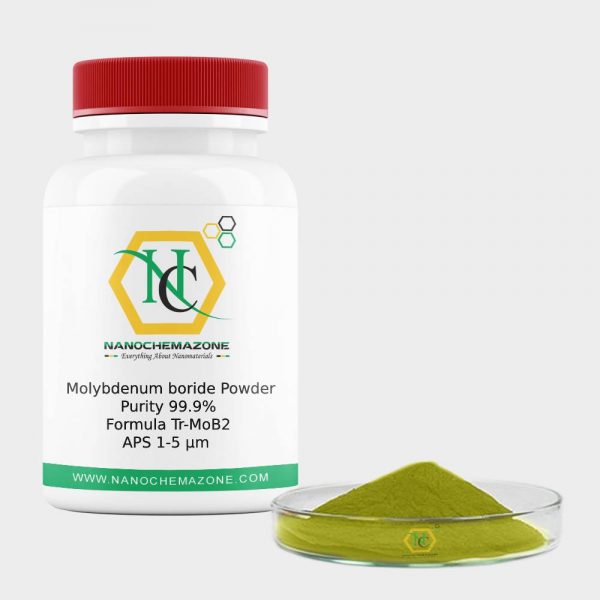
Molybdenum Boride Powder
Molybdenum Boride Powder
Product Name: Molybdenum Boride Powder
| MF: | Tr-MoB2 |
| Chemical Name | Boride Powder |
| Color | Yellow Gray |
| EINECS No.: | 234-502-8 |
| Purity: | 99.9% |
| Density: | 9.26 g/ cm3 |
| Product Number: | NCZ-NMB-112/20 |
| Cas Number: | 12006-99-4 |
RELATED INFORMATION
It's mainly used as an additive of electronic tungsten, molybdenum alloy, etc., and can also be used in the manufacture of wear semiconductor thin film and coating materials. Please email us for the customization. Email: contact@nanochemazone.com Please contact us for customization and price inquiry Note: We supply different size ranges of Nano and micron as per the client’s requirements and also accept customization in various parameters.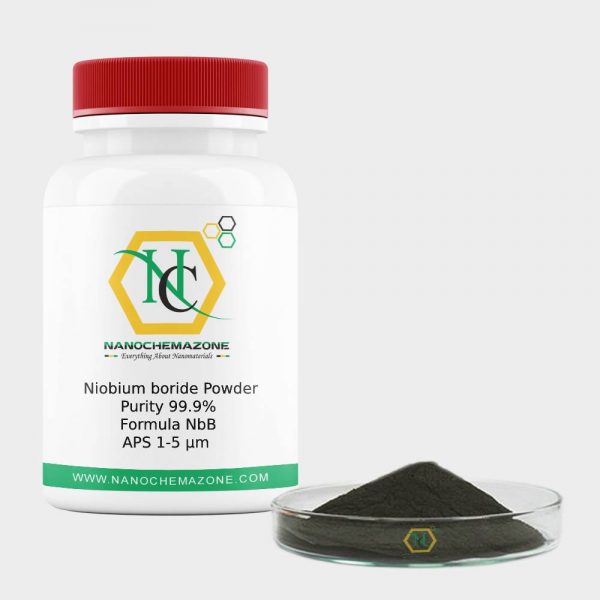
Niobium Boride Powder
Niobium Boride Powder
Product Name: Niobium Boride Powder
| MF | NbB |
| Chemical Name | Niobium Boride Powder |
| EINECS | 235-723-2 |
| Purity | 99.9% |
| Molecular weight | 103.72 |
| Product Number | NCZ-SC-112/20 |
| Cas Number | 12007-29-3 |
| Density | 7.39g/ml |
Niobium Boride Powder
Niobium boride Powders having NbB, NbB2, and Nb3B4 phases in various amounts and single-phase NbB powders were successfully synthesized by using powder metallurgy methods from related metal oxide raw materials in the presence of a strong reducing agent. Nb2O5, B2O3, and Mg powder blends were milled at room temperature by a high-energy ball mill for a different time. Subsequently, an undesired MgO phase was removed from the milled powders by HCl leaching to constitute NbB–NbB2–Nb3B4 as final products, and they were subjected to an annealing process at 1500 °C for 4 h to observe probable boride transformation. Characterization was carried out by XRD, DSC, PSA, SEM/EDX, TEM, and VSM.
The effects of milling time (up to 9 h) on the formation, microstructure, and thermal behavior of the final products were investigated. The reduction reaction took place after milling stoichiometric powder blends for 2 h. Nano-sized NbB–NbB2–Nb3B4 powders in high purity were obtained in the absence of any secondary phase and any impurity via mechanochemistry by milling for 5 h and leaching with 4 mol/L HCl. After annealing, pure and nano-sized NbB–NbB2–Nb3B4 powders transformed to a single NbB phase without leaving behind NbB2 and Nb3B4 phases.
RELATED INFORMATION Please email us for the customization. Email: contact@nanochemazone.com Please contact us for customization and price inquiry Note: We supply different size ranges of Nano and micron as per the client’s requirements and also accept customization in various parameters.
Niobium Boride Powder
Niobium Boride Powder
Product Name: Niobium Boride Powder
| MF: | NbB |
| Chemical Name | Niobium Boride Powder |
| EINECS: | 235-723-2 |
| Purity: | 99.9% |
| Molecular weight: | 103.72 |
| Product Number: | NCZ-SC-112/20 |
| Cas Number: | 12619-90-8 |
| Density | 7.39g/ml |
Niobium Boride Powder Related Information
Niobium boride powders having NbB, NbB2 and Nb3B4 phases in various amounts and single phase NbB powders were successfully synthesized by using powder metallurgy methods from related metal oxide raw materials in the presence of a strong reducing agent. Nb2O5, B2O3 and Mg powder blends were milled at room temperature
A high-energy ball mill for different time. Subsequently, an undesired MgO phase was removed from the milled powders by HCl leaching to constitute NbB–NbB2–Nb3B4 as final products, and they were subjected to an annealing process at 1500 °C for 4 h to observe probable boride transformation. Characterization was carried out by XRD, DSC, PSA, SEM/EDX, TEM, and VSM. The effects of milling time (up to 9 h) on the formation, microstructure, and thermal behavior of the final products were investigated.
The reduction reaction took place after milling stoichiometric powder blends for 2 h. Nano-sized NbB–NbB2–Nb3B4 powders in high purity were obtained in the absence of any secondary phase and any impurity via mechanochemistry by milling for 5 h and leaching with 4 mol/L HCl. After annealing, pure and nano-sized NbB–NbB2–Nb3B4 powders transformed into a single NbB phase without leaving behind NbB2 and Nb3B4 phases.
Please email us for the customization. Email: contact@nanochemazone.com Please contact us for customization and price inquiry Note: We supply different size ranges of Nano and micron as per the client’s requirements and also accept customization in various parameters.
Titanium Carbide Powder
Titanium Carbide Powder
Product Name: Titanium Carbide Powder
| Product | Titanium Carbide Powder |
| Colour | Grey |
| Purity | ≥ 99.9% |
| Particle size | 1-10 µM (customizable) |
| Ingredient/MF | TiC |
| Product Code | NCZ-C-106/20 |
| CAS Number | 12070-08-5 |
Titanium Carbide Powder Description :
Titanium Carbide (TIC) is a Gray metallic powder with a cubic system structure. With high-wear resistance, perfect corrosion resistance and high-temperature resistance, As hardness material, it’s widely used as the thermal spray coating powder material, the welding material, the flinty membranous material, the military aviation material, the hard alloy, and the cermet. Titanium carbide, TiC, is an extremely hard (Mohs 9-9.5) refractory ceramic material, similar to tungsten carbide. It has the appearance of black powder with the sodium chloride (face-centered cubic) crystal structure. Also, the product has good conductivity and chemical inert ability to steel and ironApplication of Titanium Carbide TiC:
1. The carbide is mainly used in the manufacturing of cermet, heat-resistant alloy, and cemented carbide due to its high melting point, high hardness, and good chemical stability.- Applies in the spray coating material, the welding material, the flinty membranous material, the military aviation material, the hard alloy, and the cermet.
- Used in the preparation of cermets, which are frequently used to machine steel materials at high cutting speed.
- Used as an abrasion-resistant surface coating on metal parts, such as tool bits and watch mechanisms.
- Used as a heat shield coating for atmospheric reentry of spacecraft.
Reviews
There are no reviews yet.