
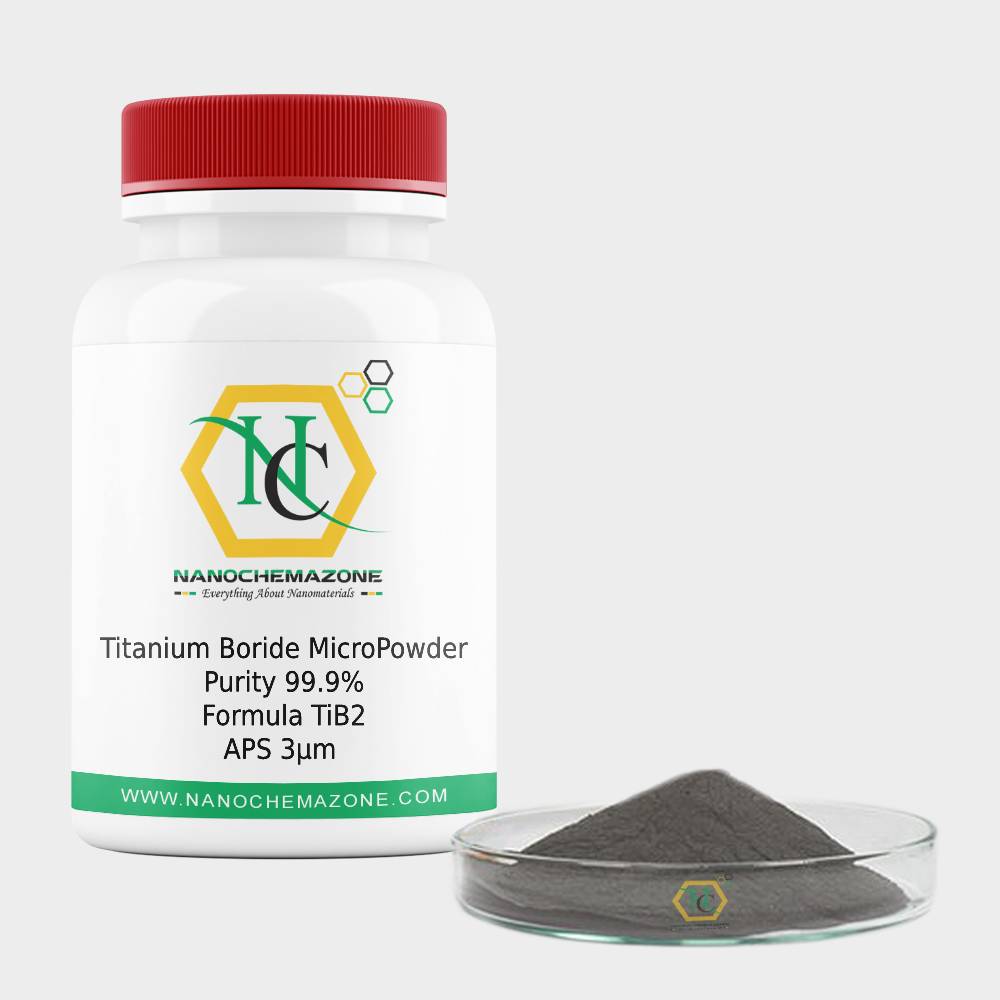

Titanium Boride Micro Powder
₹0.00
Product Name: Titanium Boride Micro Powder
| Product Name | Titanium Boride Micro Powder |
| Catalog No. | NCZ-NSC307/20 |
| CAS No. | 12045-63-5 |
| Purity | 99.9% |
| APS | 3µm, 500µm (Customizable) |
| Molecular Formula | TiB2 |
| Appearance | Powder |
| Color | Gray Powder |
| Density | 4.52 g/mL |
| Melting Point | 2980 °C |
Titanium Boride Micro Powder Description:
Titanium Boride Micro is electrical conductivity composite materials–Electrical conduction boron nitride named evaporation boat made by titanium diboride and boron nitride is the primary member for vacuum aluminizing equipment; Ceramic cutting tools and their components–Titanium diboride ceramic is used for metal wortles, extrusion dies, sandblasting nozzles, potted components and cutting tools; Composite ceramic materials–It could be used as multi-element composite materials’ important constituent element.
It can be made up of cutting tools’ composite materials with TIC, TIN, or SIC. And it is as a component to make armor protection materials.
It is the best materials for thermostability components and function devices; Aluminium electrolysis’ cathode materials–Because of the good wet ability of TIB2 and metal aluminum liquid.
It makes the electrolytic aluminum’s power consumption low, then the electrolytic bath’s life will belong.
It may also make up PIC exothermic materials and flexibility PIC materials, and it is the intensify reagent of the metal materials such as Al, Fe, and Cu. Products Performance:
It is a new ceramic material. And it has excellent physical and chemical performance. Such as a high melting point ( 2980 °C), high hardness ( 34 GPa), and its density is 4.52 g/cm3.
It could stand wear and tear, also resist acid-alkali. Its electric performance is good (P=14.4μΩ.cm), heat-conducting property is strong (25J/m.s.k).
And it has excellent chemical stability and thermal shock resistant performance.
Titanium diboride and its composite materials are innovative and high technology materials that were widely concerned and putative that have promotional value and application prospects.
Titanium Boride Micro Powder Related Information:
Airtight sealed, avoid light and keep dry at room temperature.
Please contact us for customization and price inquiry Email: contact@nanochemazone.com
Note: We supply different size ranges of Nano and micron as per the client’s requirements and also accept customization in various parameters.
Note: For pricing & ordering information, please contact us at sales@nanochemazone.com
Please contact us for quotes on Larger Quantities & Customization. E-mail: contact@nanochemazone.com
Customization:
You must be logged in to post a review.
Related products
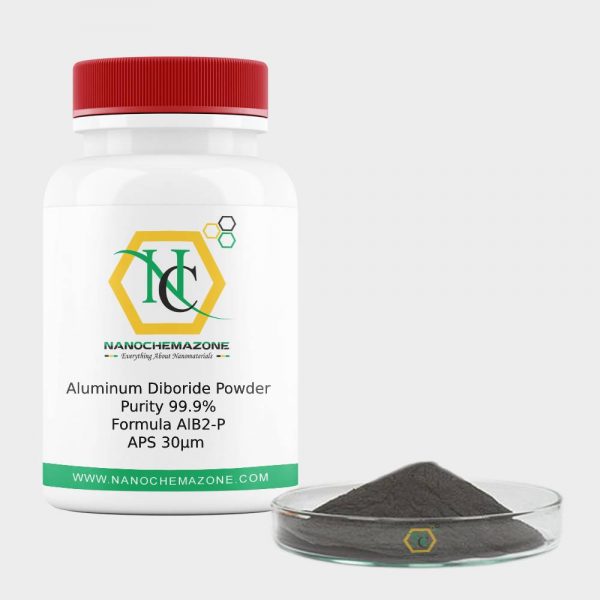
Aluminum Diboride Powder
Aluminum Diboride Powder
Product Name: Aluminum Diboride Powder
| MF: | AlB2-P |
| Chemical Name | Aluminum Diboride |
| Color | Gray Black |
| EINECS | 234-923-7 |
| Purity: | 99.9% |
| Particle size | 30 µm (Customizable) |
| Product Number: | NCZ-SC-113/20 |
| Cas Number: | 12041-50-8 |
Aluminum Diboride Powder RELATED INFORMATION
Aluminum boride is an ionic compound, with a hexagonal crystal structure. Aluminum boride at an absolute temperature slightly 40K (equivalent to -233 ℃) will be transformed into a superconductor. And its actual operating temperature is 20 ~ 30K. To reach this temperature, we can use liquid neon, liquid hydrogen, or closed-cycle refrigerator to finish cooling. Compared to the current industry using liquid helium to cool the niobium alloy (4K), these methods are simpler and more economical. Once it is doped with carbon or other impurities, magnesium diboride in a magnetic field, or there is a current passing, the ability to maintain the superconducting is as much as niobium alloys, or even better.
Please email us for the customization. Email: contact@nanochemazone.com Please contact us for customization and price inquiry Note: We supply different size ranges of nano and micron size powder as per the client’s requirements and also accept customization in various parameters.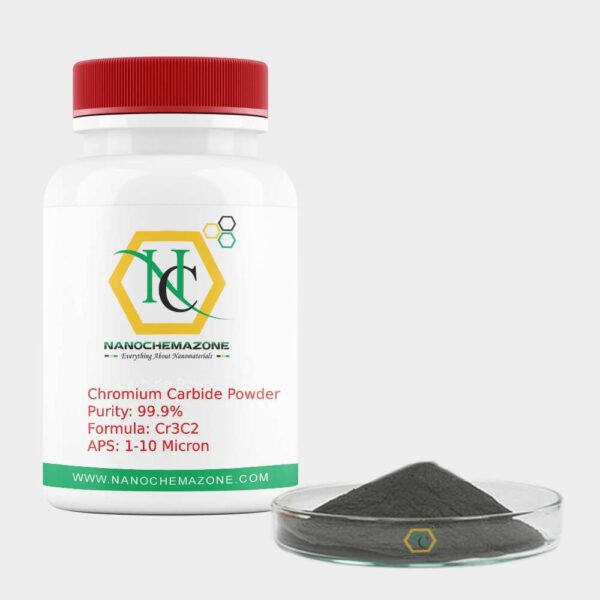
Chromium Carbide Cr3C2 Powder
Product Name: Chromium Carbide Cr3C2 Powder
| Product | Chromium Carbide |
| Colour | Gray Powder |
| Purity | ≥ 99.9% |
| Particle size | 1-10 µM (customizable) |
| Ingredient/MF | Cr3C2 |
| Product Code | NCZ-C-101/20 |
| CAS Number | 12012-35-0 |
Chromium Carbide Cr3C2 Powder APPLICATION FIELDS
Chromium Carbide Cr3C2 Powder is a ceramic compound that exists in several different chemical compositions: Cr3C2, Cr7C3, and Cr23C6. At standard conditions, it exists as a gray solid. It is extremely hard and corrosion-resistant. It is also a refractory compound, which means that it retains its strength at high temperatures as well. These properties make use as an additive to metal alloys. When chromium carbide crystals are integrated into the surface of a metal it improves the wear resistance and corrosion resistance of the metal and maintains these properties at elevated temperatures. Cr3C2 powder is mixed with solid nickel-chromium. This mixture is then heated to very high temperatures and sprayed onto the object being coated where it forms a protective layer. This layer is essentially its own metal matrix composite, consisting of hard ceramic Cr3C2 particles embedded in a nickel-chromium matrix. Cr3C2 prevents large grains from forming in the composite, which results in a fine-grained structure of superior toughness.Chromium Carbide Cr3C2 Application:
- Used as high temperature resistant and wear-resistant surface materials
- Used for welding and flux-cored wire
- Chromium carbide is useful in the surface treatment of metal components.
- Chromium carbide is used to coat the surface of another metal in a technique known as thermal spraying.
- Chromium carbide is used as an additive in cutting tools in order to improve toughness by preventing the growth of large grains.
Chromium Carbide Cr3C2 Properties:
There are three different crystal structures for chromium carbide corresponding to the three different chemical compositions. Cr23C6 has a cubic crystal structure and a Vickers hardness of 976 kg/mm2. Cr7C3 has a hexagonal crystal structure and a microhardness of 1336 kg/mm2. Cr3C2 is the most durable of the three compositions and has an orthorhombic crystal structure with a microhardness of 2280 kg/mm2. For this reason, Cr3C2 is the primary form of chromium carbide used in surface treatment. Please email us for the customization. Email: contact@nanochemazone.com Please contact us for customization and price inquiry Note: We supply different size ranges of Nano and micron as per the client’s requirements and also accept customization in various parameters.
Chromium Diboride Powder
Chromium Diboride Powder
Product Name: Chromium Diboride Powder
| MF: | CrB2 |
| Chemical Name |
Chromium Diboride Powder |
| Appearance | silver, ceramic material |
| EINECS | 234-499-3 |
| Purity: | 99.9% |
| Density: | 5.20 g/cm3 |
| Product Number: | NCZ-NCD-117/20 |
| Cas Number: | 12007-16-8 |
CoCrW Alloy Powder
Product Name: CoCrW Alloy Powder
| Product |
CoCrW Alloy Powder |
| CAS No. | 7440-50-8/7440-47-3 |
| Appearance | Grey |
| Purity | 99.9% |
| APS | 1 – 5 Microns (Can be customized) |
| Ingredient | CoCrW |
| Product Code | NCZ-NSC-164/20 |
Description:
| 3D printing metal Powder Powder metallurgy(PM), injection molding(MIM), spray painting(SP) etc. |
Hafnium Carbide Powder
Product Name: Hafnium Carbide Powder
| Product | Hafnium Carbide Powder |
| Colour | Gray Powder |
| Purity | ≥ 99.9% |
| Particle size | 1-10 µM (customizable) |
| Ingredient/MF | HfC |
| Product Code | NCZ-C-103/20 |
| CAS Number | 12069-85-1 |
Brief Description of Hafnium carbide powder HfC:
Hafnium carbide ( HfC) is a chemical compound of hafnium and carbon With a melting point of about 3900 °C it is one of the most refractory binary compounds known. However, it has low oxidation resistance, with the oxidation starting at temperatures as low as 430 °C Hafnium carbide is usually carbon deficient and therefore its composition is often expressed as HfCx (x = 0.5 to 1.0). It has a cubic (rock-salt) crystal structure at any value of xApplication of Hafnium carbide powder HfC:
- Used for preparation of ultra-high temperature ceramics
- The reactant in the synthesis of hafnium-containing organometallic polymers
- Used as an additive in alloys
- Used in coatings
- Widely used in microelectronics, semiconductor, aerospace high-temperature resistant material, coating materials, ceramic materials, ceramic target material, etc.
Hafnium carbide Powder related Information
Please email us for the customization. Email: contact@nanochemazone.com Please contact us for customization and price inquiry Note: We supply different size ranges of Nano and micron as per the client’s requirements and also accept customization in various parameters.
Iron Boride Powder
Product Name: Iron Boride Powder
| MF: | Tr-FeB |
| Chemical Name | Iron Boride Powder |
| Color | Grey Powder |
| EINECS Number: | 234-489-9 |
| Purity: | 99.9% |
| Density | ~7 g/cm3 |
| Product Number: | NCZ-NIB-112/20 |
| Cas Number: | 12006-84-8 |
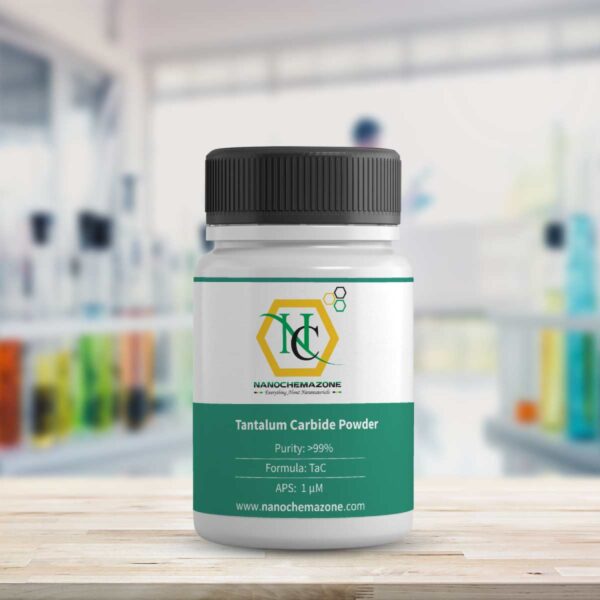
Tantalum carbide Powder
Product Name: Tantalum Carbide Powder
| Product | Tantalum Carbide Powder |
| Colour | Brown-Gray |
| Purity | ≥ 99.9% |
| Particle size | 1-10 µM (customizable) |
| Ingredient/MF | TaC |
| Product Code | NCZ-C-105/20 |
| CAS Number | 12070-06-3 |
Tantalum carbide Powder Description:
Tantalum carbides form a family of binary chemical compounds of tantalum and carbon with the empirical formula TaCx, where usually varies between 0.4 and 1. They are extremely hard, brittle, refractory ceramic materials with metallic electrical conductivity. They appear as brown-Gray powders, which are usually processed by sintering. Being important cermet materials, tantalum carbides are commercially used in tool bits for cutting applications and are sometimes added to tungsten carbide alloys.Properties of TaC Tantalum carbide powder:
Tantalum carbides have metallic electrical conductivity, both in terms of its magnitude and temperature dependence. TaC is a superconductor with a relatively high transition temperature of TC = 10.35 K. Application of TaC Tantalum carbide powder- Widely used in the production of microwave absorbing materials, metal powder injection
- Used as all kinds of superhard material and powder metallurgy products additives etc.
- Used as a cutting tool.
- Used for delicate Ceramics.
- Hard wear-resistant alloy tools, tools, molds, and wear-resistant corrosion-resistant structural components additive, improve the toughness of the alloy.
- Tantalum carbide sintered shown in gold, watches can be made decorations.
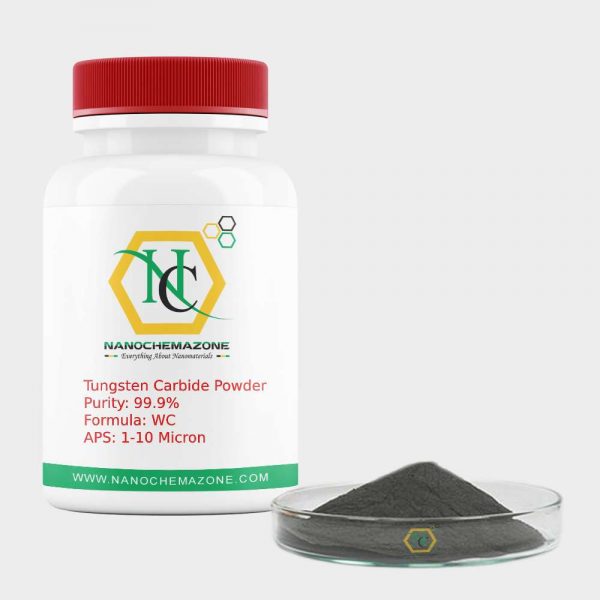
Tungsten Carbide Powder
Tungsten Carbide Powder
Product Name: Tungsten Carbide Powder
| Product | Tungsten Carbide Powder |
| Colour | Grey |
| Purity | ≥ 99.9% |
| Particle size | 1-10 µM (customizable) |
| Ingredient/MF | WC |
| Product Code | NCZ-C-109/20 |
| CAS Number | 12070-12-1 |
Brief Description of WC Tungsten Carbide Powder
Tungsten carbide powder (chemical formula: WC ) is a chemical compound (specifically, a carbide ) containing equal parts of tungsten and carbon atoms. In its most basic form, tungsten carbide is a fine Gray powder, but it can be pressed and formed into shapes for use in industrial machinery, cutting tools, abrasives, armor-piercing rounds, other tools and instruments, and jewelry. Physical Properties of WC Tungsten Carbide Powder Tungsten carbide has a high melting point at 2,870 °C (5,200 °F), a boiling point of 6,000 °C (10,830 °F) when under a pressure equivalent to 1 standard atmosphere (100 kPa), the thermal conductivity of 110 W·m−1·K−1, and a coefficient of thermal expansion of 5.5 µm·m−1·K−1. Tungsten carbide is extremely hard, ranking about 9 on Mohs scale, and with a Vickers number of around 2600. It has Young’s modulus of approximately 530–700 GPa, a bulk modulus of 630–655 GPa, and a shear modulus of 274 GPa. It has an ultimate tensile strength of 344 MPa, the ultimate compression strength of about 2.7 GPa and a Poisson’s ratio of 0.31. Chemical Properties of WC Tungsten Carbide Powder There are two well-characterized compounds of tungsten and carbon, WC and tungsten semi abide, W2C. Both compounds may be present in coatings and the proportions can depend on the coating method. At high temperatures, WC decomposes to tungsten and carbon and this can occur during high-temperature thermal spray, e.g., in high-velocity oxygen fuel (HVOF) and high energy plasma (HEP) methods.Application of WC Tungsten Carbide Powder
1 Used for Producing high capability nano-crystalline or superfine horniness alloy, hard-face abrasion-resistant spraying and petrochemical cracking catalyst;- Used for chipless forming tools; Cutting tools; Mining tolls; Nano-composites (for enhanced hardness, strength, and wear resistance);
- Used for erosion-resistant coatings; wear-resistance coatings; Corrosion-resistant coatings; Wear-resistant parts
- To produce hard carbide.
Reviews
There are no reviews yet.