

Titanium Nitride Powder
₹0.00
Titanium Nitride Powder
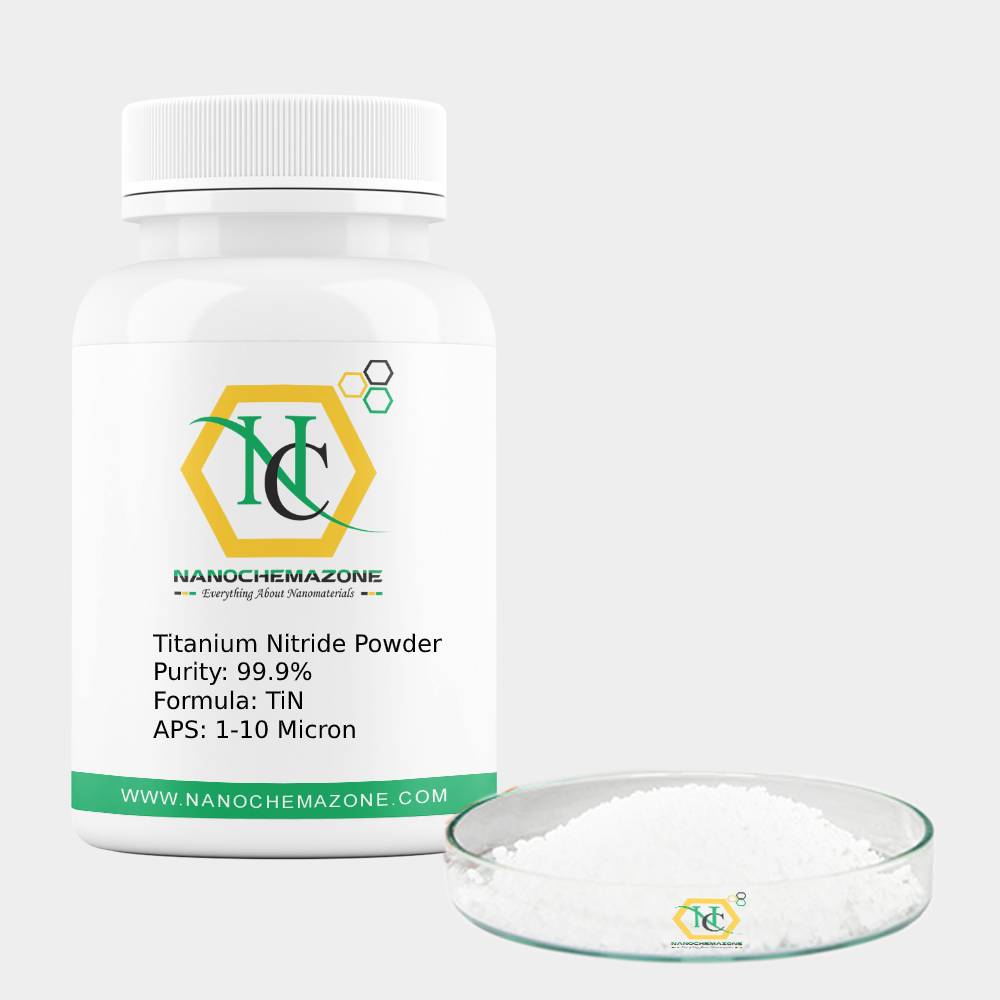
Product Name: Titanium Nitride Powder
| Product | Titanium Nitride Powder |
| Colour | White |
| Purity | ≥ 99.9% |
| Particle size | 1-10 µM (customizable) |
| Ingredient/MF | TiN |
| Product Code | NCZ-CN-145/20 |
| CAS Number | 7440-31-5 |
Titanium Nitride Powder Description:
Depending on the substrate material and surface finish, TiN will have a coefficient of friction ranging from 0.4 to 0.9 against another TiN surface (non-lubricated).
Titanium nitride is also produced intentionally within some steels by the judicious addition of titanium to the alloy. TiN forms at very high temperatures because of its very low enthalpy of formation, and even nucleates directly from the melt in secondary steelmaking.
It forms discrete, micrometre-sized cubic particles at grain boundaries and triple points, and prevents grain growth by Ostwald ripening up to very high homologous temperatures, Titanium nitride has the lowest solubility product of any metal nitride or carbide in austenite, a useful attribute in micro-alloyed steel formulas.
Titanium Nitride Powder Application:
- Used as diamond tools, metal-ceramic, high-temperature alloy additives.
2 Titanium nitrides is an extremely hard ceramic material, often used as a coating on titanium alloys, steel, carbide, and aluminum components to improve the substrate’s surface properties.
- Applied as a thin coating, TiN is used to harden and protect cutting and sliding surfaces, for decorative purposes (due to its golden appearance), and as a non-toxic exterior for medical implants. In most applications a coating of less than 5 micrometres (0.00020 in) is applied.
- Though less visible, thin films of TiN are also used in microelectronics.
- Due to their high biostability, TiN layers may also be used as electrodes in bioelectronic applications like in intelligent implants or in-vivo biosensors that have to withstand the severe corrosion caused by body fluids.
- TiN electrodes have already been applied in the subretinal prosthesis project as well as in biomedical microelectromechanical systems.
Please email us for the customization.
Email: contact@nanochemazone.com
Please contact us for customization and price inquiry
Note: We supply different size ranges of Nano and micron as per the client’s requirements and also accept customization in various parameters.
Note: For pricing & ordering information, please contact us at sales@nanochemazone.com
Please contact us for quotes on Larger Quantities & Customization. E-mail: contact@nanochemazone.com
Customization:
If you are planning to order large quantities for your industrial and academic needs, please note that customization of parameters (such as size, length, purity, functionalities, etc.) are available upon request.
You must be logged in to post a review.
Related products
Aluminum Diboride Powder
Aluminum Diboride Powder
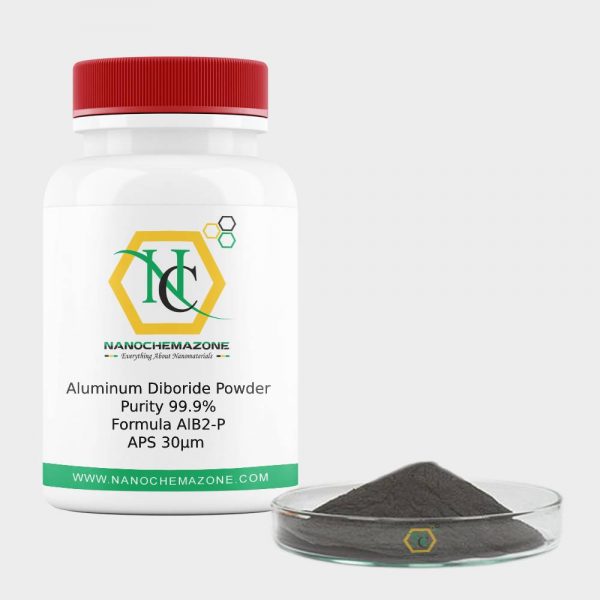
Product Name: Aluminum Diboride Powder
| MF: | AlB2-P |
| Chemical Name | Aluminum Diboride |
| Color | Gray Black |
| EINECS | 234-923-7 |
| Purity: | 99.9% |
| Particle size | 30 µm (Customizable) |
| Product Number: | NCZ-SC-113/20 |
| Cas Number: | 12041-50-8 |
Aluminum Diboride Powder RELATED INFORMATION
Aluminum boride is an ionic compound, with a hexagonal crystal structure. Aluminum boride at an absolute temperature slightly 40K (equivalent to -233 ℃) will be transformed into a superconductor. And its actual operating temperature is 20 ~ 30K. To reach this temperature, we can use liquid neon, liquid hydrogen, or closed-cycle refrigerator to finish cooling. Compared to the current industry using liquid helium to cool the niobium alloy (4K), these methods are simpler and more economical. Once it is doped with carbon or other impurities, magnesium diboride in a magnetic field, or there is a current passing, the ability to maintain the superconducting is as much as niobium alloys, or even better.
Please email us for the customization.
Email: contact@nanochemazone.com
Please contact us for customization and price inquiry
Note: We supply different size ranges of nano and micron size powder as per the client’s requirements and also accept customization in various parameters.
CoCrW Alloy Powder
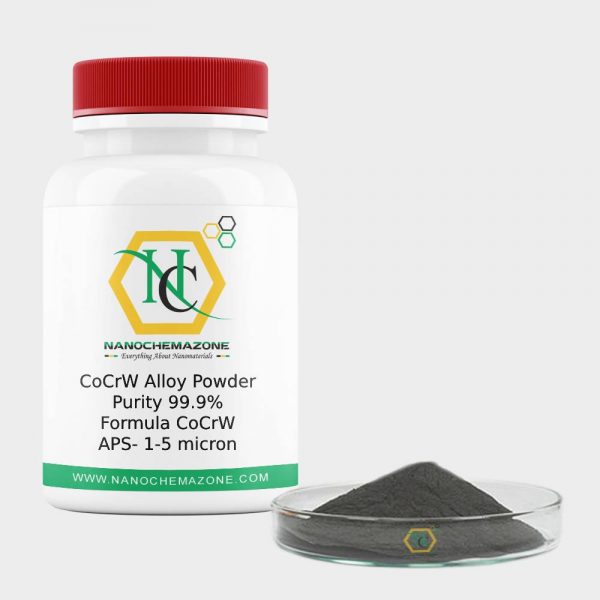
Product Name: CoCrW Alloy Powder
| Product |
CoCrW Alloy Powder |
| CAS No. | 7440-50-8/7440-47-3 |
| Appearance | Grey |
| Purity | 99.9% |
| APS | 1 – 5 Microns (Can be customized) |
| Ingredient | CoCrW |
| Product Code | NCZ-NSC-164/20 |
Description:
| 3D printing metal Powder
Powder metallurgy(PM), injection molding(MIM), spray painting(SP) etc. |
RELATED INFORMATION
Storage Conditions:
Airtight sealed, avoid light, and keep dry at room temperature.
Please email us for the customization.
Email: contact@nanochemazone.com
Note: We supply different size ranges of Nano and micron as per the client’s requirements and also accept customization in various parameters.
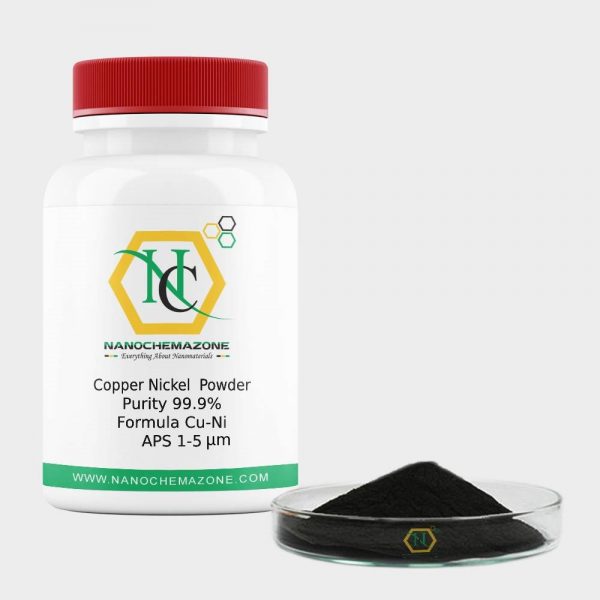
Copper Nickel Micron Powder
Copper Nickel Micron Powder
Product Name: Copper-Nickel Micron Powder
| Product | Copper Nickel Powder |
| CAS No. | 12357-13-0 |
| Appearance | Black Powder |
| Purity | 99.9% |
| APS | 1 – 5 Microns (Can be customized) |
| Ingredient | Cu-Ni |
| Product Code | NCZ-NSC-193/20 |
Copper Nickel Micron Powder Description:
- powder metallurgy for copper-based or nickel-based alloy
- the surface coating of maritime vessels seawater corrosion-resistant materials
- lubricant wear-resistant, anti-wear additives
- conductive, thermally conductive filler material
Copper Nickel Micron Powder RELATED INFORMATION
Storage Conditions:
Airtight sealed, avoid light and keep dry at room temperature.
Please contact us for customization and price inquiry
Email: contact@nanochemazone.com
Note: We supply different size ranges of Nano and micron as per the client’s requirements and also accept customization in various parameters.
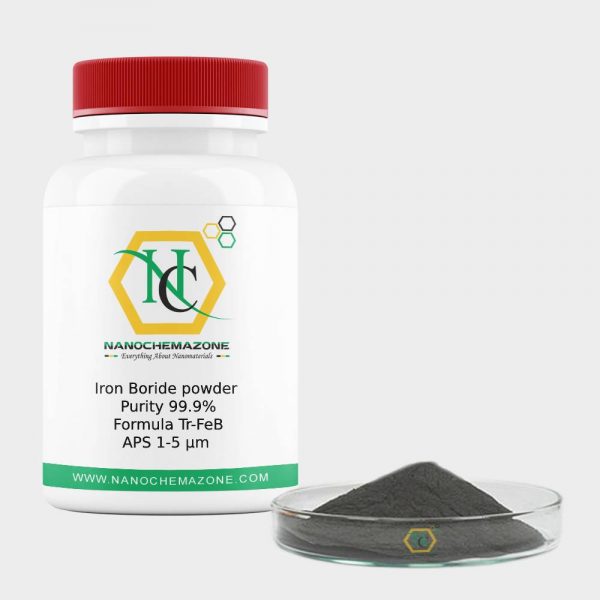
Iron Boride Powder
Product Name: Iron Boride Powder
| MF: | Tr-FeB |
| Chemical Name | Iron Boride Powder |
| Color | Grey Powder |
| EINECS Number: | 234-489-9 |
| Purity: | 99.9% |
| Density | ~7 g/cm3 |
| Product Number: | NCZ-NIB-112/20 |
| Cas Number: | 12006-84-8 |
RELATED INFORMATION
Boriding is often used to improve abrasion resistance, corrosion resistance, wear resistance, and oxidation resistance. It is used in oil and gas refinery, chemical extraction, automotive agricultural, stamping, textile extrusion, and injection molding industries. Iron-based coatings recently gained attention for their mechanical, frictional, and corrosion-resistant properties. As compared to the ceramic or cermet type of materials people have used before, iron-based materials are relatively inexpensive, less strategic, and can be produced economically by various thermal methods with ease of fabrication and machining.
Please email us for the customization.
Email: contact@nanochemazone.com
Please contact us for customization and price inquiry
Note: We supply different size ranges of Nano and micron as per the client’s requirements and also accept customization in various parameters.
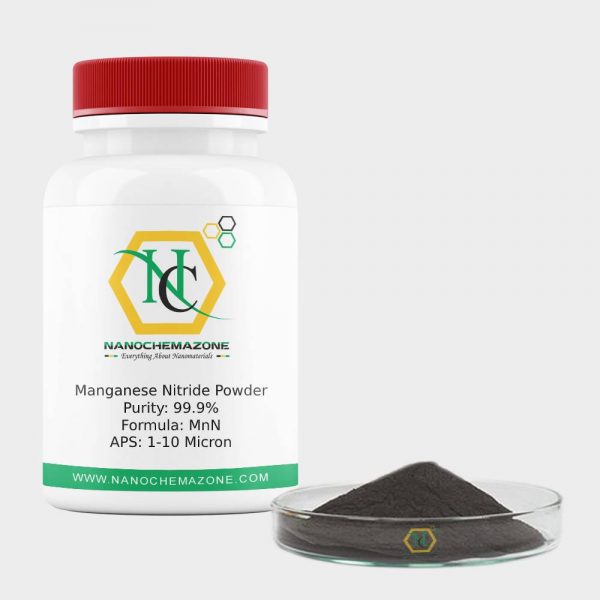
Manganese Nitride Powder
Manganese Nitride Powder
Product Name: Manganese Nitride Powder
| Product | Manganese Nitride Powder |
| Colour | Dark Gray |
| Purity | ≥ 99.9% |
| Particle size | 1-10 µM (customizable) |
| Ingredient/MF | MnN |
| Product Code | NCZ-CN-148/20 |
| CAS Number | 7439-96-5 |
Manganese Nitride Powder Description:
Manganese Nitride Powder is generally immediately available in most volumes. High purity, submicron and nanopowder forms may be considered. Our factory produces too many standard grades when applicable, including Mil Spec (military grade); ACS, Reagent and Technical Grade; Food, Agricultural and Pharmaceutical Grade; Optical Grade
Manganese Nitride in Briquettes, as a kind of Nitrogen and manganese alloy additive, its characteristics are: high content of main elements, low content of harmful impurities, Nitrogen utilization is to be improved after add melt. We adopt the continuous nitride process with unique intellectual property rights in mass production, which has stable quality and uniform nitrogen
Manganese Nitride Powder Application:
- Used for production of special alloy steel, high strength steel, stainless steel, heat-resistant steel products
2. Application in the field of high nitrogen steel smelting
- Used as the steel-making additive and endow many excellent performances to steel grade such as strength, toughness, creep resistance, etc.
- Specialty demonstrated its good market prospects in large diameter steel pipe of transmitting oil and gas strength steel in shipbuilding and automotive.
Basic information of Manganese Nitride Powder
Manganese (atomic symbol: Mn, atomic number: 25) is a Block D, Group 7, Period 4 element with an atomic weight of 54.938045.
In its elemental form, manganese has a silvery metallic appearance.
It is a paramagnetic metal that oxidizes easily in addition to being very hard and brittle.
Manganese is found as a free element in nature and also in the minerals pyrolusite, braunite, psilomelane, and rhodochrosite.
Nitrogen is a Block P, Group 15, Period 2 element.
Nitrogen is an odorless, tasteless, colorless, and mostly inert gas.
It is the seventh most abundant element in the universe, and it constitutes 78.09% (by volume) of Earth’s atmosphere.
Please email us for the customization.
Email: contact@nanochemazone.com
Please contact us for customization and price inquiry
Note: We supply different size ranges of Nano and micron as per the client’s requirements and also accept customization in various parameters.
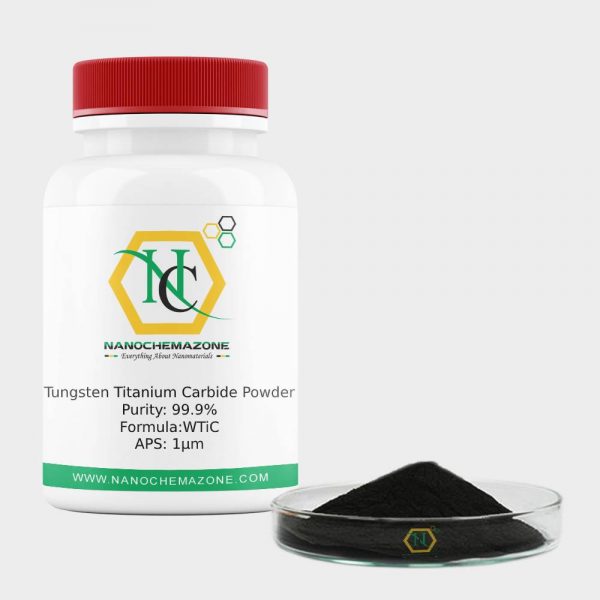
Titanium Carbide Powder
Titanium Carbide Powder
Product Name: Titanium Carbide Powder
| Product | Titanium Carbide Powder |
| Colour | Grey |
| Purity | ≥ 99.9% |
| Particle size | 1-10 µM (customizable) |
| Ingredient/MF | TiC |
| Product Code | NCZ-C-106/20 |
| CAS Number | 12070-08-5 |
Titanium Carbide Powder Description :
Titanium Carbide (TIC) is a Gray metallic powder with a cubic system structure.
With high-wear resistance, perfect corrosion resistance and high-temperature resistance,
As hardness material, it’s widely used as the thermal spray coating powder material, the welding material, the flinty membranous material, the military aviation material, the hard alloy, and the cermet.
Titanium carbide, TiC, is an extremely hard (Mohs 9-9.5) refractory ceramic material, similar to tungsten carbide.
It has the appearance of black powder with the sodium chloride (face-centered cubic) crystal structure.
Also, the product has good conductivity and chemical inert ability to steel and iron
Application of Titanium Carbide TiC:
1. The carbide is mainly used in the manufacturing of cermet, heat-resistant alloy, and cemented carbide due to its high melting point, high hardness, and good chemical stability.
- Applies in the spray coating material, the welding material, the flinty membranous material, the military aviation material, the hard alloy, and the cermet.
3.Used as welding and flux-cored wire
- Used in the preparation of cermets, which are frequently used to machine steel materials at high cutting speed.
- Used as an abrasion-resistant surface coating on metal parts, such as tool bits and watch mechanisms.
- Used as a heat shield coating for atmospheric reentry of spacecraft.
7. TiC is used in manufacturing wear-resistant materials, cutting tools, etc
Please email us for the customization.
Email: contact@nanochemazone.com
Please contact us for customization and price inquiry
Note: We supply different size ranges of Nano and micron as per the client’s requirements and also accept customization in various parameters.
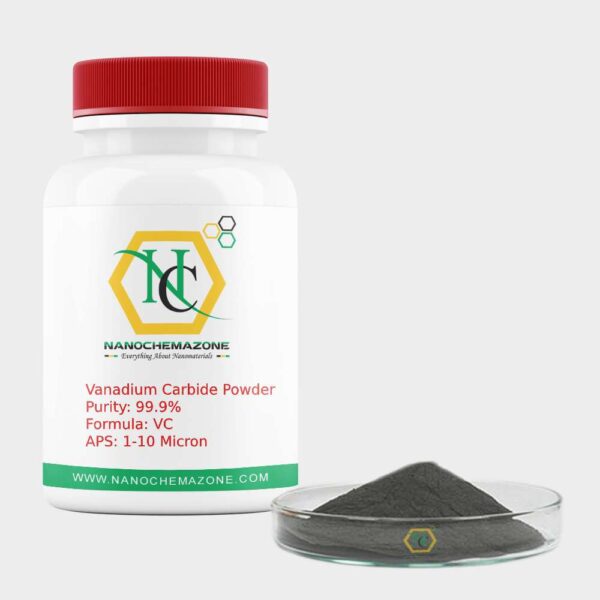
Vanadium Carbide Powder
Vanadium Carbide Powder
Product Name: Vanadium Carbide Powder
| Product | Vanadium Carbide Powder |
| Colour | Grey Powder |
| Purity | ≥ 99.9% |
| Particle size | 1-10 µM (customizable) |
| Ingredient/MF | VC |
| Product Code | NCZ-C-108/20 |
| CAS Number | 12070-10-9 |
Vanadium Carbide Description:
Vanadium carbide is the inorganic compound with the formula VC.
It is an extremely hard refractory ceramic material. With a hardness of 9-9.5 Mohs, it is possibly the hardest metal-carbide known.
It is of interest because it is prevalent in vanadium metal and alloys.
Vanadium carbide is Gray metallic powder with a cubic system structure of NaCl type, the crystalline constant is 4.182A.
The carbide is chemically stable and has excellent high-temperature property.
Application:
- Used in mechanical lapping
- Used as engineering ceramic materials
- Used for metallurgy refractory
- Used for temperature hot accidentally
- Used in faraday shield
- Applies in flinty domains and so on thin film, target material, welding material, hard alloy, cermet, aerospace
- May improve the hard alloy as the hard alloy and cermet’s chemical additive each performance.
- It can be used in cutting tool and steel industry,
- also can be used as an additive to fine the WC cemented carbide crystal to improve the property of alloy. 3. Used for erosion-resistant coatings; wear-resistance coatings; Corrosion-resistant coatings; Wear-resistant parts……
Vanadium Carbide Related Information
Please email us for the customization.
Email: contact@nanochemazone.com
Please contact us for customization and price inquiry
Note: We supply different size ranges of Nano and micron as per the client’s requirements and also accept customization in various parameters.
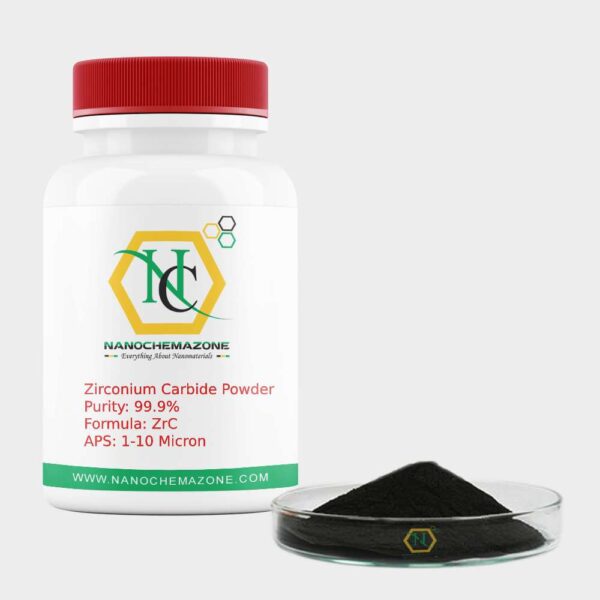
Zirconium Carbide Powder
Zirconium Carbide Powder
Product Name: Zirconium Carbide Powder
| Product | Zirconium Carbide Powder |
| Colour | Black |
| Purity | ≥ 99.9% |
| Particle size | 1-10 µM (customizable) |
| Ingredient/MF | ZrC |
| Product Code | NCZ-C-110/20 |
| CAS Number | 12070-14-3 |
Zirconium Carbide Powder Description:
Like most carbides of refractory metals, zirconium carbide is sub-stoichiometric, i.e., it contains carbon vacancies.
At carbon contents higher than approximately ZrC0.98 the material contains free carbon.
ZrC reacts with water and acids and is pyrophoric.
It becomes readily oxidized in the air when exposed to elevated temperatures.
It shows a high amount of corrosion resistance property and contains carbon vacancies.
It reacts with water as well as acids.
Application:
1.Used as an abrasive, in metal cladding, in cermet, incandescent filaments, and cutting tools.
2. The mixture of zirconium carbide and tantalum carbide is an important cermet material.
3. Hafnium-free zirconium carbide and niobium carbide can be used as refractory coatings in nuclear reactors.
4. Zirconium carbide is used extensively as a coating of uranium dioxide and thorium dioxide particles of nuclear fuel.
5. The coating is usually deposited by thermal chemical vapor deposition in a fluidized bed reactor.
6. High-temperature wear-resistant surface materials
Please email us for the customization.
Email: contact@nanochemazone.com
Please contact us for customization and price inquiry
Note: We supply different size ranges of Nano and micron as per the client’s requirements and also accept customization in various parameters.
Reviews
There are no reviews yet.