
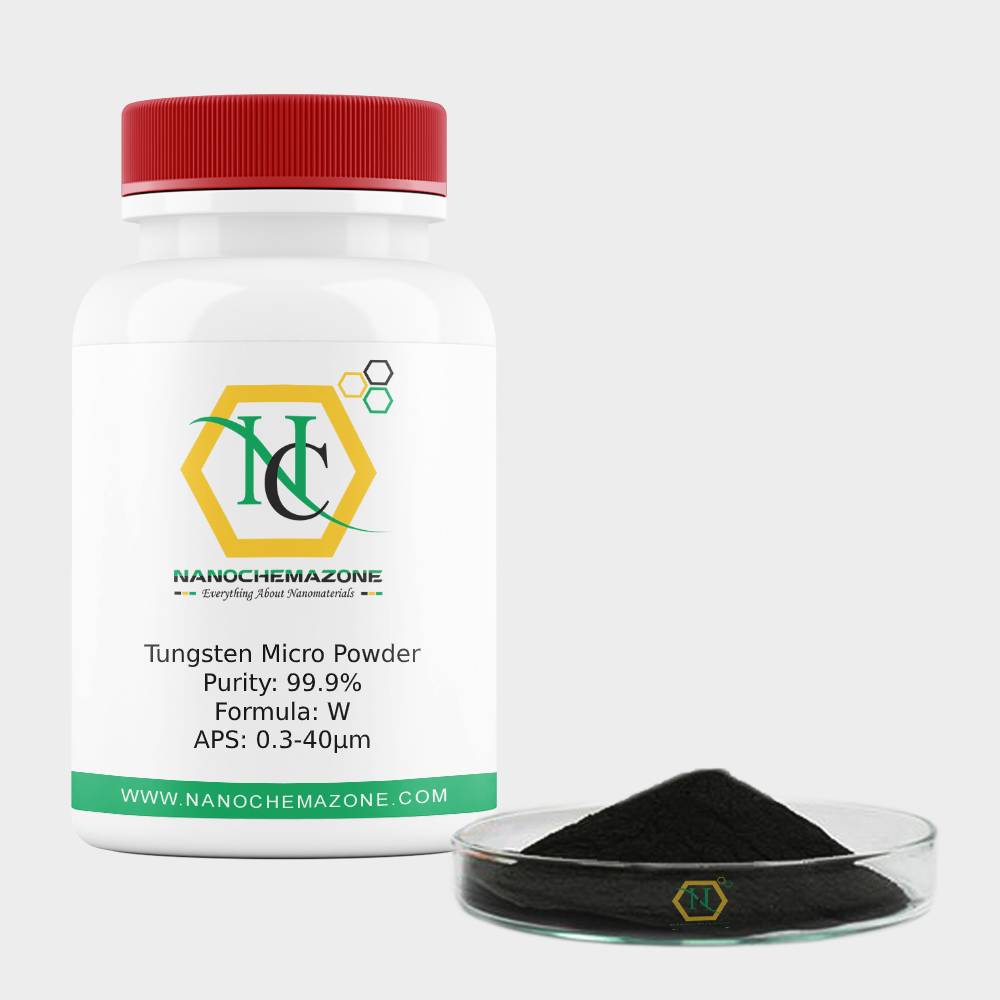

Tungsten Micro Powder
₹0.00
Tungsten Micro Powder
| Product |
Tungsten Micro Powder |
| CAS No. | 7440-33-7 |
| Appearance | Black Powder |
| Purity | 99.9% |
| APS | 0.3 to 40µm (Can be customized) |
| Iodine Adsorption | 1350 mg/g |
| Formula | W |
| Product Code | NCZ-NSC330/20 |
| Desnity | 19.3 g/cm3 |
Tungsten Micro Powder Description :
Tungsten micro Alloy Powder for the electronic package; Alloys for heat sinks; Anti-armor alloys Circuit breakers; Contacts and electrode materials; Contacts in a protective atmosphere; Electrodes for gas sensors; Microelectronics films; Penetrators; Protective coatings; Sintering additives; Switchgear; Thermal management; Transformer tap changer; Vacuum contactors; Vacuum load switches Tungsten, or wolfram, is a chemical element with the symbol W and atomic.
The name tungsten comes from the former Swedish name for the tungstate mineral scheelite, tungsten which means heavy stone.
Tungsten is a rare metal found naturally on Earth almost exclusively combined with other elements in chemical compounds rather than alone.
Its important ores include wolframite and scheelite. The free element is remarkable for its robustness, especially the fact that it has the highest melting point of all the elements discovered, melting at 3,422 °C.
It also has the highest boiling point, at 5,930 °C. Its density is times that of water, comparable with that of uranium and gold, and much higher than that of lead.
Polycrystalline tungsten is an intrinsically brittle and hard material (under standard conditions, when uncombined), making it difficult to work.
However, pure single-crystalline tungsten is more ductile and can be cut with a hard-steel hacksaw. Tungsten’s many alloys have numerous applications, including incandescent light bulb filaments, X-ray tubes as both the filament and target), electrodes in gas tungsten arc welding, superalloys, and radiation shielding.
Tungsten’s hardness and high density give it military applications in penetrating projectiles. Tungsten compounds are also often used as industrial catalysts.
Tungsten is the only metal from the third transition series that is known to occur in biomolecules that are found in a few species of bacteria and archaea. It is the heaviest element known to be essential to any living organism.
However, tungsten interferes with molybdenum and copper metabolism and is somewhat toxic to more familiar forms of animal life.
Tungsten Micro Powder Related Information
Storage Conditions:
Airtight sealed, avoid light and keep dry at room temperature.
Please contact us for customization and price inquiry
Email: contact@nanochemazone.com
Note: We supply different size ranges of Nano and micron as per the client’s requirements and also accept customization in various parameters.
Note: For pricing & ordering information, please contact us at sales@nanochemazone.com
Please contact us for quotes on Larger Quantities & Customization. E-mail: contact@nanochemazone.com
Customization:
You must be logged in to post a review.
Related products
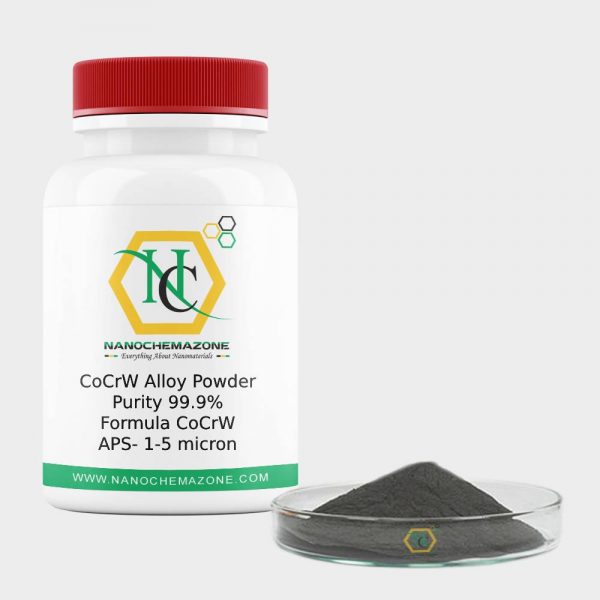
CoCrW Alloy Powder
Product Name: CoCrW Alloy Powder
| Product |
CoCrW Alloy Powder |
| CAS No. | 7440-50-8/7440-47-3 |
| Appearance | Grey |
| Purity | 99.9% |
| APS | 1 – 5 Microns (Can be customized) |
| Ingredient | CoCrW |
| Product Code | NCZ-NSC-164/20 |
Description:
| 3D printing metal Powder
Powder metallurgy(PM), injection molding(MIM), spray painting(SP) etc. |
RELATED INFORMATION
Storage Conditions:
Airtight sealed, avoid light, and keep dry at room temperature.
Please email us for the customization.
Email: contact@nanochemazone.com
Note: We supply different size ranges of Nano and micron as per the client’s requirements and also accept customization in various parameters.
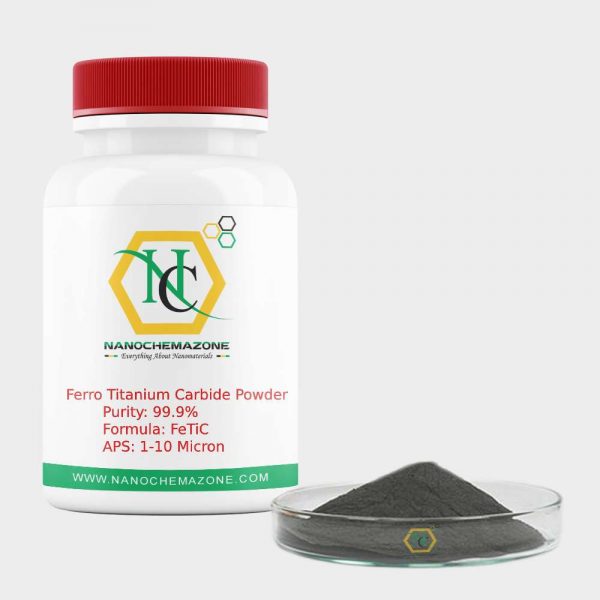
Ferro Titanium Carbide Powder
Product Name: Ferro Titanium Carbide Powder
| Product | Ferro Titanium Carbide Powder |
| Colour | Gray Powder |
| Purity | ≥ 99.9% |
| Particle size | 1-10 µM (customizable) |
| Ingredient/MF | FeTiC |
| Product Code | NCZ-C-102/20 |
| CAS Number | 12604-56-7 |
Ferro Titanium Carbide Powder Applications Fields:
Ferro Titanium Carbide Powder is a ferroalloy, an alloy of iron and titanium with between 10–20% iron and 45–75% titanium and sometimes a small amount of carbon. Ferrotitanium can be manufactured by mixing titanium sponge and scrap with iron and melting them together in an induction furnace.
During steelmaking, titanium is usually introduced as ferrotitanium because of its relatively low melting temperature and high density.
Ferrotitanium is usually produced by induction melting of titanium scrap with iron or steel; however, it also is produced directly from titanium mineral concentrates.
Application of Ferro Titanium carbide powder:
In the present study, Fe-based hardfacing coating reinforced by TiC particles was obtained by manual shielded metal arc welding (SMAW) in which H08A bare electrode was coated with fluxes, to which different measures of ferrotitanium, rutile, graphite, calcium carbonate, and calcium fluoride had been added.
The microstructure and wear properties of the hardfacing coating were studied through scanning electron microscopy (SEM), transmission electron microscopy (TEM), an X-ray diffractometer (XRD), and a wear test.
The results indicate that TiC particles are produced by a direct metallurgical reaction between ferrotitanium and graphite during welding.
TiC particles are uniformly dispersed in the matrix of lath martensite and retained austenite with particle sizes in the range of 3–5 μm. Fe-based hardfacing coating reinforced by TiC particles is found to possess better wear resistance and a lower coefficient of friction than that of the AISI 1045 steel substrate.
Please email us for the customization.
Email: contact@nanochemazone.com
Please contact us for customization and price inquiry
Note: We supply different size ranges of Nano and micron as per the client’s requirements and also accept customization in various parameters.
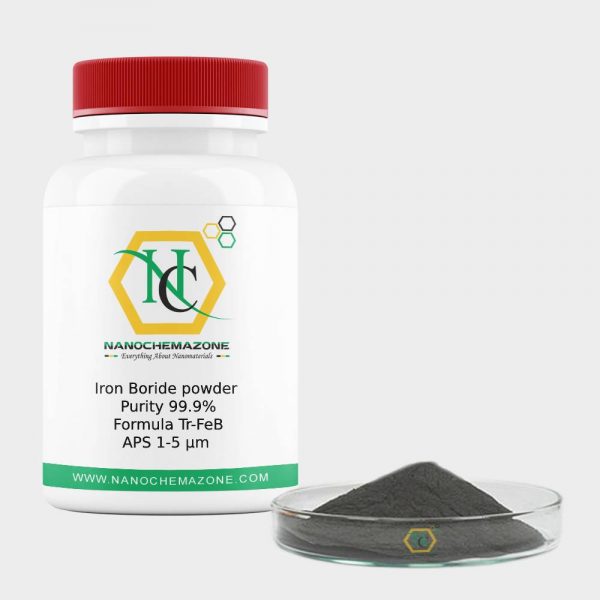
Iron Boride Powder
Product Name: Iron Boride Powder
| MF: | Tr-FeB |
| Chemical Name | Iron Boride Powder |
| Color | Grey Powder |
| EINECS Number: | 234-489-9 |
| Purity: | 99.9% |
| Density | ~7 g/cm3 |
| Product Number: | NCZ-NIB-112/20 |
| Cas Number: | 12006-84-8 |
Iron Boride Powder Description
Iron Boride Powder is often used to improve abrasion resistance, corrosion resistance, wear resistance, and oxidation resistance. It is used in oil and gas refinery, chemical extraction, automotive agricultural, stamping, textile extrusion, and injection molding industries. Iron-based coatings recently gained attention for their mechanical, frictional, and corrosion-resistant properties. As compared to the ceramic or cermet type of materials people have used before, iron-based materials are relatively inexpensive, less strategic, and can be produced economically by various thermal methods with ease of fabrication and machining.
Iron Boride Powder Related Information
Please email us for the customization.
Email: contact@nanochemazone.com
Please contact us for customization and price inquiry
Note: We supply different size ranges of Nano and micron as per the client’s requirements and also accept customization in various parameters.
Iron Boride Powder
Product Name: Iron Boride Powder
| MF: | Tr-FeB |
| Chemical Name | Iron Boride Powder |
| Color | Grey Powder |
| EINECS Number: | 234-489-9 |
| Purity: | 99.9% |
| Density | ~7 g/cm3 |
| Product Number: | NCZ-NIB-112/20 |
| Cas Number: | 12006-84-8 |
RELATED INFORMATION
Boriding is often used to improve abrasion resistance, corrosion resistance, wear resistance, and oxidation resistance. It is used in oil and gas refinery, chemical extraction, automotive agricultural, stamping, textile extrusion, and injection molding industries. Iron-based coatings recently gained attention for their mechanical, frictional, and corrosion-resistant properties. As compared to the ceramic or cermet type of materials people have used before, iron-based materials are relatively inexpensive, less strategic, and can be produced economically by various thermal methods with ease of fabrication and machining.
Please email us for the customization.
Email: contact@nanochemazone.com
Please contact us for customization and price inquiry
Note: We supply different size ranges of Nano and micron as per the client’s requirements and also accept customization in various parameters.
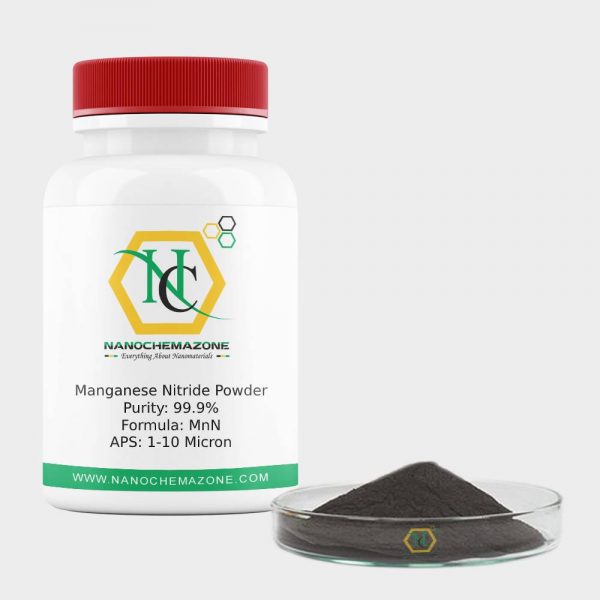
Manganese Nitride Powder
Manganese Nitride Powder
Product Name: Manganese Nitride Powder
| Product | Manganese Nitride Powder |
| Colour | Dark Gray |
| Purity | ≥ 99.9% |
| Particle size | 1-10 µM (customizable) |
| Ingredient/MF | MnN |
| Product Code | NCZ-CN-148/20 |
| CAS Number | 7439-96-5 |
Manganese Nitride Powder Description:
Manganese Nitride Powder is generally immediately available in most volumes. High purity, submicron and nanopowder forms may be considered. Our factory produces too many standard grades when applicable, including Mil Spec (military grade); ACS, Reagent and Technical Grade; Food, Agricultural and Pharmaceutical Grade; Optical Grade
Manganese Nitride in Briquettes, as a kind of Nitrogen and manganese alloy additive, its characteristics are: high content of main elements, low content of harmful impurities, Nitrogen utilization is to be improved after add melt. We adopt the continuous nitride process with unique intellectual property rights in mass production, which has stable quality and uniform nitrogen
Manganese Nitride Powder Application:
- Used for production of special alloy steel, high strength steel, stainless steel, heat-resistant steel products
2. Application in the field of high nitrogen steel smelting
- Used as the steel-making additive and endow many excellent performances to steel grade such as strength, toughness, creep resistance, etc.
- Specialty demonstrated its good market prospects in large diameter steel pipe of transmitting oil and gas strength steel in shipbuilding and automotive.
Basic information of Manganese Nitride Powder
Manganese (atomic symbol: Mn, atomic number: 25) is a Block D, Group 7, Period 4 element with an atomic weight of 54.938045.
In its elemental form, manganese has a silvery metallic appearance.
It is a paramagnetic metal that oxidizes easily in addition to being very hard and brittle.
Manganese is found as a free element in nature and also in the minerals pyrolusite, braunite, psilomelane, and rhodochrosite.
Nitrogen is a Block P, Group 15, Period 2 element.
Nitrogen is an odorless, tasteless, colorless, and mostly inert gas.
It is the seventh most abundant element in the universe, and it constitutes 78.09% (by volume) of Earth’s atmosphere.
Please email us for the customization.
Email: contact@nanochemazone.com
Please contact us for customization and price inquiry
Note: We supply different size ranges of Nano and micron as per the client’s requirements and also accept customization in various parameters.
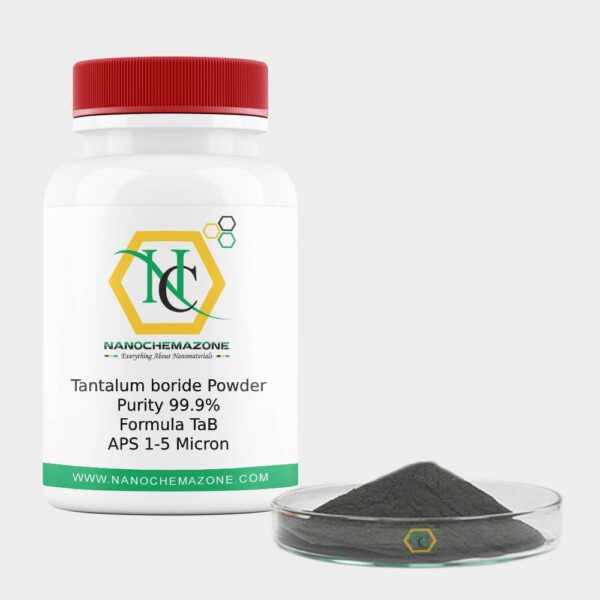
Tantalum boride Powder
Product Name: Tantalum boride Powder
| MF: | TaB |
| Chemical Name |
Tantalum boride Powder |
| Color | Gray |
| EINECS | 234-496-7 |
| Purity: | 99.9% |
| Molecular weight: | 191.76 |
| Product Number: | NCZ-SC-116/20 |
| Cas Number: | 12045-19-1 |
| Density: | 14.2 g/cm3 |
Tantalum boride Powder RELATED INFORMATION
Please email us for the customization.
Email: contact@nanochemazone.com
Please contact us for customization and price inquiry
Note: We supply different size ranges of Nano and micron as per the client’s requirements and also accept customization in various parameters.
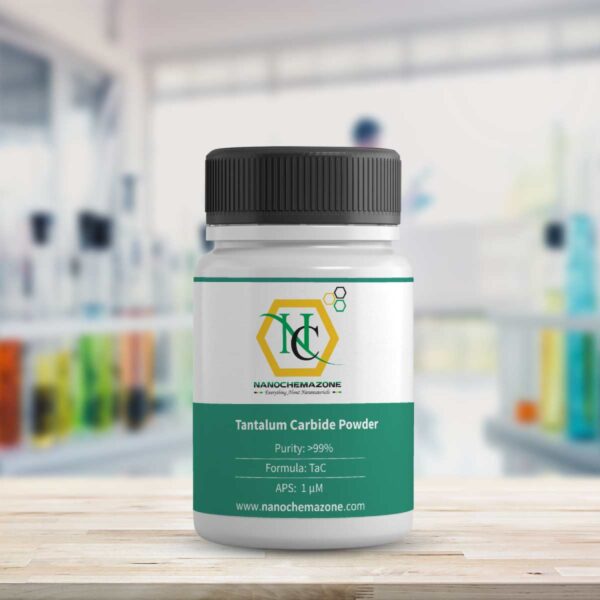
Tantalum carbide Powder
Product Name: Tantalum Carbide Powder
| Product | Tantalum Carbide Powder |
| Colour | Brown-Gray |
| Purity | ≥ 99.9% |
| Particle size | 1-10 µM (customizable) |
| Ingredient/MF | TaC |
| Product Code | NCZ-C-105/20 |
| CAS Number | 12070-06-3 |
Tantalum carbide Powder Description:
Tantalum carbides form a family of binary chemical compounds of tantalum and carbon with the empirical formula TaCx, where usually varies between 0.4 and 1.
They are extremely hard, brittle, refractory ceramic materials with metallic electrical conductivity.
They appear as brown-Gray powders, which are usually processed by sintering.
Being important cermet materials, tantalum carbides are commercially used in tool bits for cutting applications and are sometimes added to tungsten carbide alloys.
Properties of TaC Tantalum carbide powder:
Tantalum carbides have metallic electrical conductivity, both in terms of its magnitude and temperature dependence.
TaC is a superconductor with a relatively high transition temperature of TC = 10.35 K.
Application of TaC Tantalum carbide powder
- Widely used in the production of microwave absorbing materials, metal powder injection
molding material technology field.
- Used as all kinds of superhard material and powder metallurgy products additives etc.
- Used as a cutting tool.
- Used for delicate Ceramics.
- Hard wear-resistant alloy tools, tools, molds, and wear-resistant corrosion-resistant structural components additive, improve the toughness of the alloy.
- Tantalum carbide sintered shown in gold, watches can be made decorations.
Please email us for the customization.
Email: contact@nanochemazone.com
Please contact us for customization and price inquiry
Note: We supply different size ranges of Nano and micron as per the client’s requirements and also accept customization in various parameters.
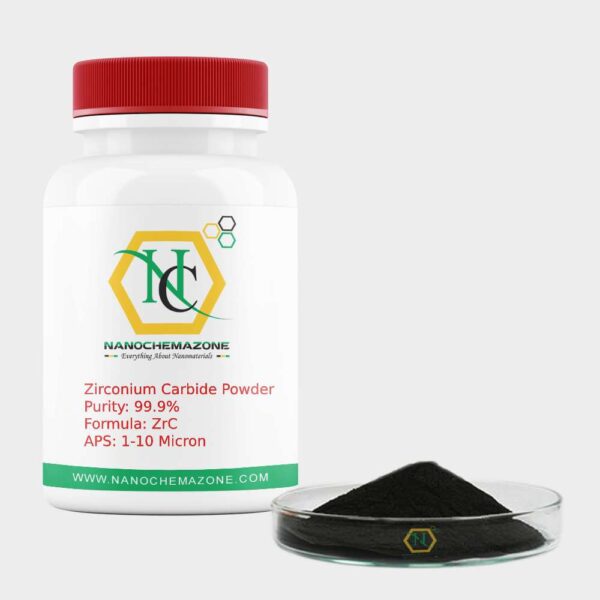
Zirconium Carbide Powder
Zirconium Carbide Powder
Product Name: Zirconium Carbide Powder
| Product | Zirconium Carbide Powder |
| Colour | Black |
| Purity | ≥ 99.9% |
| Particle size | 1-10 µM (customizable) |
| Ingredient/MF | ZrC |
| Product Code | NCZ-C-110/20 |
| CAS Number | 12070-14-3 |
Zirconium Carbide Powder Description:
Like most carbides of refractory metals, zirconium carbide is sub-stoichiometric, i.e., it contains carbon vacancies.
At carbon contents higher than approximately ZrC0.98 the material contains free carbon.
ZrC reacts with water and acids and is pyrophoric.
It becomes readily oxidized in the air when exposed to elevated temperatures.
It shows a high amount of corrosion resistance property and contains carbon vacancies.
It reacts with water as well as acids.
Application:
1.Used as an abrasive, in metal cladding, in cermet, incandescent filaments, and cutting tools.
2. The mixture of zirconium carbide and tantalum carbide is an important cermet material.
3. Hafnium-free zirconium carbide and niobium carbide can be used as refractory coatings in nuclear reactors.
4. Zirconium carbide is used extensively as a coating of uranium dioxide and thorium dioxide particles of nuclear fuel.
5. The coating is usually deposited by thermal chemical vapor deposition in a fluidized bed reactor.
6. High-temperature wear-resistant surface materials
Please email us for the customization.
Email: contact@nanochemazone.com
Please contact us for customization and price inquiry
Note: We supply different size ranges of Nano and micron as per the client’s requirements and also accept customization in various parameters.
Reviews
There are no reviews yet.