

Lithium Nickel Cobalt Aluminum Oxide
₹0.00
Lithium Nickel Cobalt Aluminum Oxide
| Product |
Lithium Nickel Cobalt Aluminum Oxide |
| Colour | Black powder |
| Purity | 99% |
| Particle Size | 1-5 µm (Customizable) |
| Ingredient/MF | LiNi0.8Co0.15Al0.05O2 |
| Product Code | NCZ-CP-401/20 |
| CAS Number | 193214-24-3 |
| Density | 4.45 g/cm3 |
| Melting point | >1000 °C |
| Boiling Point | N/A |
| Molecular Weight | N/A |
| Exact Mass | N/A |
Lithium Nickel Cobalt Aluminum Oxide Description:
Aluminum is a Block P, Group 13, Period 3 element with an atomic weight of 26.9815386. It is the third most abundant element in the earth’s crust and the most abundant metallic element. Aluminum’s name is derived from alumina, the mineral from which Sir Humphrey Davy attempted to refine it from in 1812.
It was not until 1825 that Aluminum was first isolated by Hans Christian Oersted. Aluminum is a silvery gray metal that possesses many desirable characteristics. It is light, nonmagnetic, and non-sparking. It stands second among metals in the scale of malleability, and sixth in ductility.
It is extensively used in many industrial applications where a strong, light, easily constructed material is needed. Although it has only 60% of the electrical conductivity of copper, it is used in electrical transmission lines because of its light weight. Pure aluminum is soft and lacks strength, but alloyed with small amounts of copper, magnesium, silicon, manganese, or other elements it imparts a variety of useful properties. Aluminum was first predicted by Antoine Lavoisier in 1787 and first isolated by Friedrich Wohler in 1827.
Cobalt:
Cobalt is a Block D, Group 9, Period 4 element with an atomic weight of 58.933195. The number of electrons in each of cobalt’s shells is 2, 8, 15, 2 and its electron configuration is [Ar] 3d7 4s2The cobalt atom has a radius of 125 pm and a Van der Waals radius of 192 pm. Cobalt was first discovered by George Brandt in 1732. In its elemental form, cobalt has a lustrous gray appearance. Cobalt is found in cobaltite, erythrite, glaucodot and skutterudite ores.
Cobalt produces brilliant blue pigments which have been used since ancient times to color paint and glass. Cobalt is a ferromagnetic metal and is used primarily in the production of magnetic and high-strength superalloys. Co-60, a commercially important radioisotope, is useful as a radioactive tracer and gamma ray source. The origin of the word Cobalt comes from the German word “Kobalt” or “Kobold,” which translates as “goblin,” “elf” or “evil spirit.”
Lithium:
Lithium is a Block S, Group 1, Period 2 element with an atomic weight of 6.94. The number of electrons in each of Lithium’s shells is [2, 1] and its electron configuration is [He] 2s1. The lithium atom has a radius of 152 pm and a Van der Waals radius of 181 pm.
Lithium was discovered by Johann Arvedson in 1817 and first isolated by William Thomas Brande in 1821. The origin of the name Lithium comes from the Greek wordlithose which means “stone.” Lithium is a member of the alkali group of metals. It has the highest specific heat and electrochemical potential of any element on the period table and the lowest density of any elements that are solid at room temperature. Compared to other metals, it has one of the lowest boiling points.
In its elemental form, lithium is soft enough to cut with a knife its silvery white appearance quickly darkens when exposed to air. Because of its high reactivity, elemental lithium does not occur in nature. Lithium is the key component of lithium-ion battery technology, which is becoming increasingly more prevalent in electronics.
Nickel:
Nickel is a Block D, Group 4, Period 4 element with an atomic weight of 58.6934. The number of electrons in each of nickel’s shells is [2, 8, 16, 2] and its electron configuration is [Ar]3d8 4s2. Nickel was first discovered by Alex Constedt in 1751. The nickel atom has a radius of 124 pm and a Van der Waals radius of 184 pm. In its elemental form, nickel has a lustrous metallic silver appearance. Nickel is a hard and ductile transition metal that is considered corrosion-resistant because of its slow rate of oxidation.
It is one of four elements that are ferromagnetic and is used in the production of various type of magnets for commercial use. Nickel is sometimes found free in nature but is more commonly found in ores. The bulk of mined nickel comes from laterite and magmatic sulfide ores. The name originates from the German word kupfernickel, which means “false copper” from the illusory copper color of the ore.
Lithium Nickel Cobalt Aluminum Oxide Related Information
Please email us for the customization.
Email: contact@nanochemazone.com
Please contact us for customization and price inquiry
Note: We supply different size ranges of Nano and micron as per the client’s requirements and also accept customization in various parameters.
Note: For pricing & ordering information, please contact us at sales@nanochemazone.com
Please contact us for quotes on Larger Quantities & Customization. E-mail: contact@nanochemazone.com
Customization:
If you are planning to order large quantities for your industrial and academic needs, please note that customization of parameters (such as size, length, purity, functionalities, etc.) are available upon request.
You must be logged in to post a review.
Related products
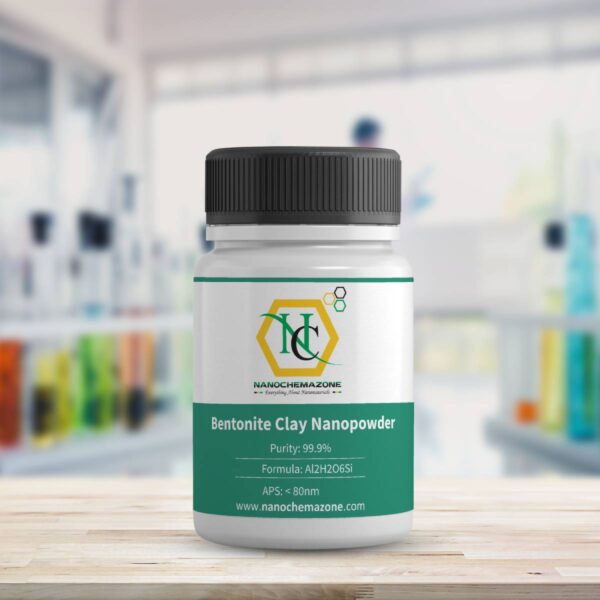
Bentonite Clay Nanopowder
Bentonite Clay Nanopowder
Product Name: Bentonite Clay Nanopowder (Purity: 99.9%, APS: < 80nm)
Product |
Bentonite Clay Nanopowder |
| Cat No | NCZ-MN-113/20 |
| CAS No | 1302-78-9 |
| Purity | 99.9% |
| APS | < 80nm |
| Molecular Weight | 108.1 g/mol |
| Form | Powder |
| Specific Gravity | 2.5(H2O) |
| Melting Point | Decomposes |
| Solubility | Slightly soluble in water Insoluble in methanol |
| Molecular Formula | Al2H2O6Si |
Bentonite Clay Related Information
Storage Conditions:
Airtight sealed, avoid light and keep dry at room temperature.
Please contact us for customization and price inquiry
Email: contact@nanochemazone.com
Note: We supply different size ranges of Nano and micron as per the client’s requirements and also accept customization in various parameters.
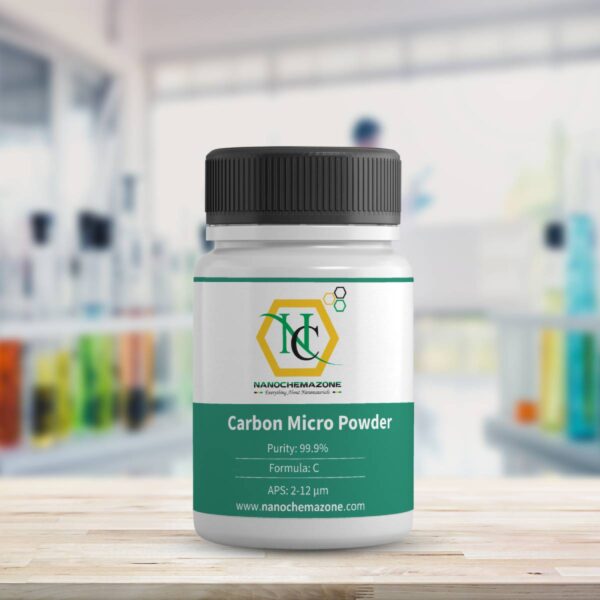
Carbon Micro Powder
Carbon Micro Powder
Product Name: Carbon Micro Powder (C, Purity: 99.9%, APS: 2-12 µm)
| Product | Carbon Micro Powder |
| Cat No | NCZ-MN-161/20 |
| CAS No | 7440-44-0 |
| Purity | 99.9% |
| APS | 2-12µm |
| Molecular Formula | C |
| Molecular Weight | 12.01g/mol |
| Form | Powder |
| Color | Black |
| Density | 2.2g/cm³ |
| Melting Point | 3652-3697 ºC |
| Boiling Point | 4200 ºC |
| Thermal Conductivity | 119-165 W/m/ |
| Solubility | Soluble in Water |
Please email us for the customization.
Email: contact@nanochemazone.com
Please contact us for customization and price inquiry
Note: We supply different size ranges of Nano and micron as per the client’s requirements and also accept customization in various parameters.
Charcoal Powder
Charcoal Powder
Product Name: Charcoal Powder (C, APS: 60-70µm, Purity: 99.9%)
| Product | Charcoal Powder |
| Cat No | NCZ-MN-162/20 |
| CAS No | 7440-44-0 |
| Purity | 99.9% |
| APS | 60-70µm |
| Molecular Formula | C |
| Form | Powder |
| Color | Black |
| Bulk Density | 0.34g/ml |
Please email us for the customization.
Email: contact@nanochemazone.com
Please contact us for customization and price inquiry
Note: We supply different size ranges of Nano and micron as per the client’s requirements and also accept customization in various parameters.
Copper Indium Gallium Selenide
Copper Indium Gallium Selenide
| Product | Copper Indium Gallium Selenide |
| Cat No | NCZ-NSC809/20 |
| CAS No | 12018-95-0 |
| Purity | 99.9% |
| APS | 1-2µm |
| Molecular Formula | CuInxGa(1-x)Se2 |
| Form | Powder |
| Color | Silver |
| Density | 5.7 g/cm3 |
| Melting Point | 990-1070 °C |
Copper Indium Gallium Selenide Description
Copper Indium Gallium Selenide Powder (CIGS) for solar energy applications is a p-type or absorber layer material. CIGS-based photovoltaic cells (PV Cells) for solar energy are fabricated from a positively charged or p-type CIGS layer underneath a negatively charged or n-type layer.
The p-type layer can be produced by thin film deposition of a Gallium doped Copper Indium Selenide (CIGS) Nanopowder sold under the Nanochemazone Solar Energy group. Most CIGS-based PV solar cells are produced from thin film deposition of CIGS using sputtering techniques.
Nanochemazone produces to many standard grades when applicable, including Mil Spec (military grade); ACS, Reagent and Technical Grade; Food, Agricultural and Pharmaceutical Grade; Optical Grade, USP and EP/BP (European Pharmacopoeia/British Pharmacopoeia) and follows applicable ASTM testing standards. Typical and custom packaging is available.
Copper Indium Gallium Selenide Related Information
Storage Conditions:
Airtight sealed, avoid light, and keep dry at room temperature.
Please contact us for customization and price inquiry
Email: contact@nanochemazone.com
Note: We supply different size ranges of Nano and micron as per the client’s requirements and also accept customization in various parameters.
Glassy Carbon Spherical Powder
Glassy Carbon Spherical Powder
Product Name: Glassy Carbon Spherical Powder (C, Purity: 99.9%, APS: 2~12µm)
| Product | Glassy Carbon Spherical Powder |
| Cat No | NCZ-MN-163/20 |
| CAS No | 7440-44-0 |
| Purity | 99.9 % |
| APS | 2~12µm |
| Molecular Formula | C |
| Molecular Weight | 12.01 g/mol |
| Density | 2.267 g/cm³ |
| Appearance | Black solid |
| Melting Point | 3652 - 3697 °C (sublimes) |
| Boiling Point | 4200 °C |
| Thermal Conductivity | 119-165 W/m/K |
| Heat of Vaporization | 128 K-Cal/gm |
| Electronegativity | 2.55 Paulings |
| Solubility | Insoluble in water |
Please email us for the customization.
Email: contact@nanochemazone.com
Please contact us for customization and price inquiry
Note: We supply different size ranges of Nano and micron as per the client’s requirements and also accept customization in various parameters.
Indium Gallium Arsenide Nanopowder
Indium Gallium Arsenide Nanopowder
Product Name: Indium Gallium Arsenide Nanopowder (InGaAs, Purity: 99.9%, APS: < 100 nm)
| Product | Indium Gallium Arsenide Nanopowder |
| Cat No | NCZ-NSC814/20 |
| CAS No | 106097-59-0 |
| Purity | 99.9% |
| APS | < 100 nm |
| Molecular Formula | InGaAs |
| Molecular Weight | 259.46 g/mol |
| Form | Crystalline Powder |
| Color | White |
| Density | 5.68 g/cm³ |
| Melting Point | 844 °C |
| Conclusion | The specifications Confirm with enterprise standard |
Indium Gallium Arsenide Related Information
Storage Conditions:
Airtight sealed, avoid light, and keep dry at room temperature.
Please contact us for customization and price inquiry
Email: contact@nanochemazone.com
Note: We supply different size ranges of Nano and micron as per the client’s requirements and also accept customization in various parameters.
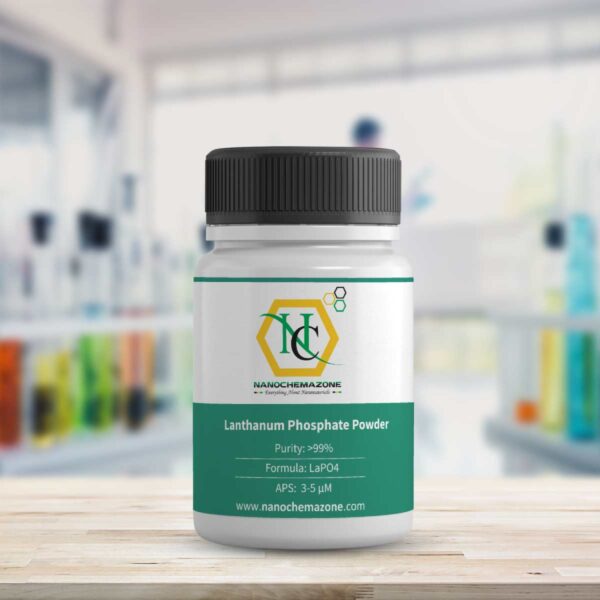
Lanthanum (III) Phosphate, Anhydrous Powder
Lanthanum Phosphate or Lanthanum (III) Phosphate, Anhydrous Powder
Product Name: Lanthanum (III) Phosphate, Anhydrous
| Product Name | Lanthanum (III) Phosphate, Anhydrous |
| Cat No | NCZ-MN-259/20 |
| CAS No | 13778-59-1 |
| Purity | 99.9% |
| APS | 40-50 µm |
| MF | LaPO4 |
| Molecular Weight | 233.875 g/mol |
| Appearance | White powder or chunks |
| Form | Powder |
| Non-Rare Earth Impurities | %Max. | %Max. | %Max. |
| Fe2O3 | 0.005 | 0.01 | 0.01 |
| SiO2 | 0.01 | 0.02 | 0.03 |
| CaO | 0.01 | 0.01 | 0.03 |
| Cl- | 0.005 | 0.01 | 0.05 |
| SO4- | 0.01 | 0.01 | 0.03 |
| K2O | 0.01 | 0.01 | 0.01 |
| Na2O | 0.005 | 0.01 | 0.01 |
Lanthanum (III) phosphate Applications:
Lanthanum Phosphate Widely used in microelectronics, catalysts, ferroelectric materials, lithium batteries, semiconductors, and other electronic fields.
Lanthanum (III) phosphate Related Information
Storage Conditions:
Airtight sealed, avoid light and keep dry at room temperature.
Please contact us for customization and price inquiry
Email: contact@nanochemazone.com
Note: We supply different size ranges of Nano and micron as per the client’s requirements and also accept customization in various parameters.
Also available as Lanthanum (III) phosphate hydrate form powder
Lanthanum (III) Phosphate Hydrate
Lanthanum Phosphate or Lanthanum (III) Phosphate Hydrate is highly insoluble in water and converts to the oxide when heated (calcined). Anhydrous Lanthanum (III) Phosphate is generally immediately available in most volumes. High purity, submicron, and nanopowder forms may be considered. Nanochemazone produces too many standard grades when applicable, including Mil Spec (military grade); ACS, Reagent and Technical Grade; Food, Agricultural and Pharmaceutical Grade; Optical Grade, USP and EP/BP (European Pharmacopoeia/British Pharmacopoeia) and follows applicable ASTM testing standards. Typical and custom packaging is available. Additional technical, research, and safety (MSDS) information are available. Please request a quote above to receive pricing information based on your specifications.
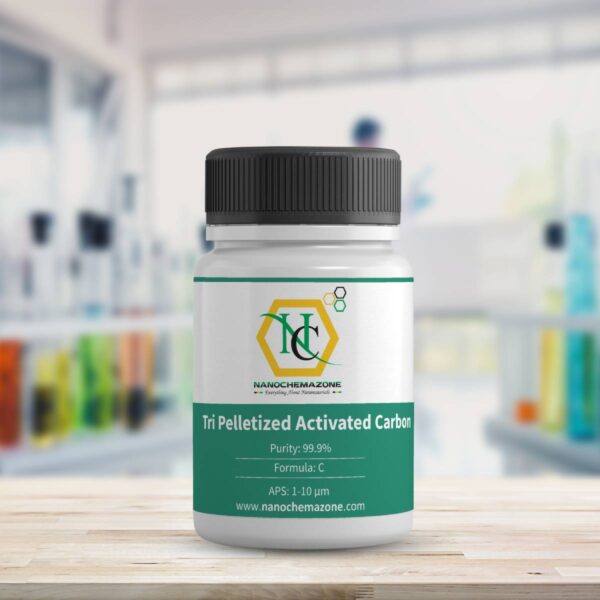
Tri Pelletized Activated Carbon
Tri Pelletized Activated Carbon
Product Name: Tri Pelletized Activated Carbon (c, APS: 1-10µm Purity: 99.9%)
| Product | Tri Pelletized Activated Carbon |
| Cat No | NCZ-MN-169/20 |
| CAS No | 7440-44-0 |
| Purity | 99.9% |
| APS | 1-10μm |
| Molecular Formula | C |
| Molecular Weight | 12-01g/mol |
| Form | Powder |
| Color | Black |
| Melting Point | 3550°C |
| Boiling Point | Sublimes |
| PH value | 5.0-10.0 |
| Vapor Density | 0.4 |
| Vapor pressure | 1 @ 3586C (6487F) |
| Solubility | Insoluble in water |
Please email us for the customization.
Email: contact@nanochemazone.com
Please contact us for customization and price inquiry
Note: We supply different size ranges of Nano and micron as per the client’s requirements and also accept customization in various parameters.
Reviews
There are no reviews yet.