
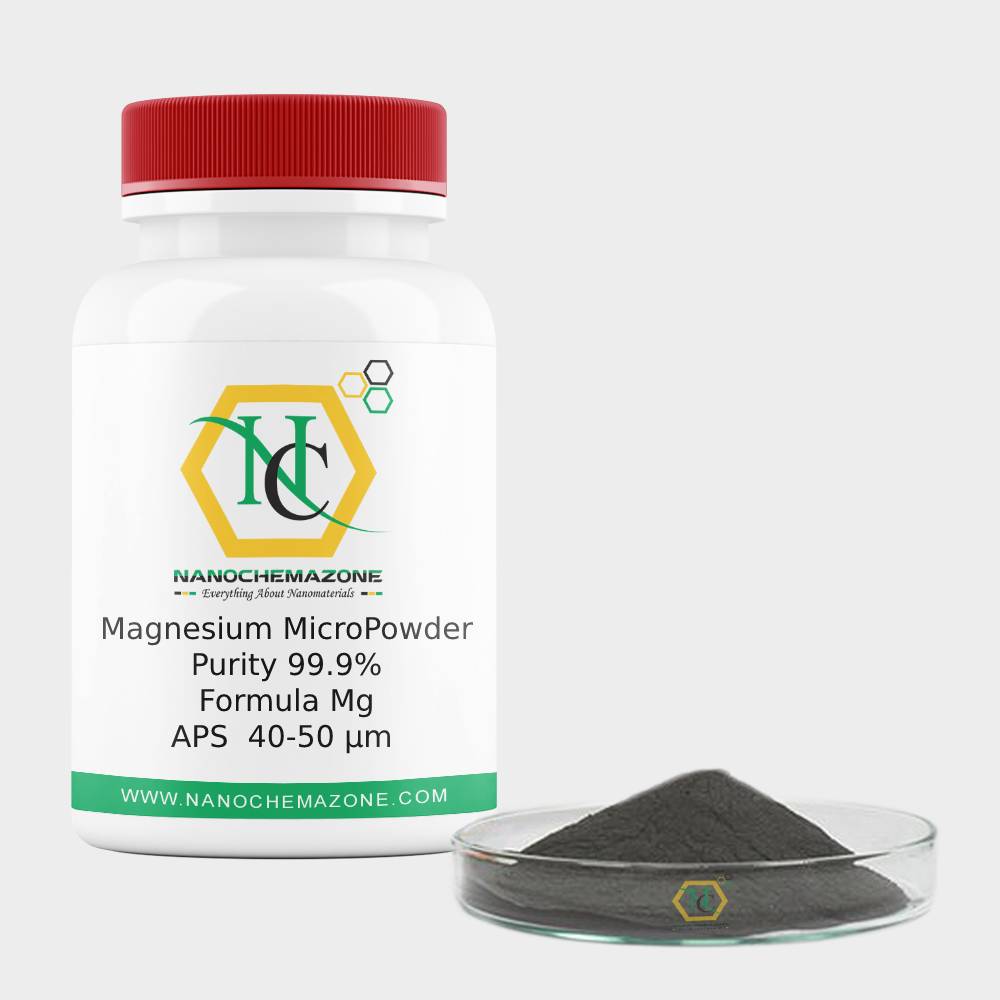

Magnesium Micro Powder
₹0.00
Magnesium Micro Powder
Product Name: Magnesium Micro Powder
| Product | Magnesium Micro Powder |
| CAS No. | 7439-95-4 |
| Appearance | Gray Powder |
| Purity | 99.9% |
| APS | 40-50 µm (Can be customized) |
| Ingredient | Mg |
| Product Code | NCZ-NSC338/20 |
Magnesium Micro Powder Description
Magnesium Micro Powder is a chemical element with the symbol Mg and atomic number. It is a shiny gray solid which bears a close physical resemblance to the other five elements in the second column or alkaline earth metals of the periodic table:
all group elements have the same electron configuration in the outer electron shell and a similar crystal structure. Magnesium is the ninth most abundant element in the universe. It is produced in large, aging stars from the sequential addition of three helium nuclei to a carbon nucleus. When such stars explode as supernovas, much of the magnesium is expelled into the interstellar medium where it may recycle into new star systems.
Magnesium is the eighth-most abundant element in the Earth’s crust and the fourth most common element in the Earth (after iron, oxygen, and silicon), making up 13% of the planet’s mass and a large fraction of the planet’s mantle. It is the third most abundant element dissolved in seawater, after sodium and chlorine. Magnesium occurs naturally only in combination with other elements, where it invariably has a +2 oxidation state. The free element (metal) can be produced artificially and is highly reactive (though in the atmosphere, it is soon coated in a thin layer of oxide that partly inhibits reactivity – see passivation). The free metal burns with a characteristic brilliant-white light.
The metal is now obtained mainly by electrolysis of magnesium salts obtained from brine and is used primarily as a component in aluminum-magnesium alloys, sometimes called magnalium or magnelium. Magnesium is less dense than aluminum, and the alloy is prized for its combination of lightness and strength. Magnesium is the eleventh most abundant element by mass in the human body and is essential to all cells and some 300 enzymes. Magnesium ions interact with polyphosphate compounds such as ATP, DNA, and RNA. Hundreds of enzymes require magnesium ions to function. Magnesium compounds are used medicinally as common laxatives, antacids e.g., milk of magnesia, and to stabilize abnormal nerve excitation or blood vessel spasm in such conditions as eclampsia.
Related Information of Magnesium Micro Powder
Storage Conditions:
Airtight sealed, avoid light and keep dry at room temperature.
Please contact us for customization and price inquiry
Email: contact@nanochemazone.com
Note: We supply different size ranges of Nano and micron as per the client’s requirements and also accept customization in various parameters.
Note: For pricing & ordering information, please contact us at sales@nanochemazone.com
Please contact us for quotes on Larger Quantities & Customization. E-mail: contact@nanochemazone.com
Customization:
You must be logged in to post a review.
Related products
Ferro Titanium Carbide Powder
Product Name: Ferro Titanium Carbide Powder
| Product | Ferro Titanium Carbide Powder |
| Colour | Gray Powder |
| Purity | ≥ 99.9% |
| Particle size | 1-10 µM (customizable) |
| Ingredient/MF | FeTiC |
| Product Code | NCZ-C-102/20 |
| CAS Number | 12604-56-7 |
Ferro Titanium Carbide Powder Applications Fields:
Ferro Titanium Carbide Powder is a ferroalloy, an alloy of iron and titanium with between 10–20% iron and 45–75% titanium and sometimes a small amount of carbon. Ferrotitanium can be manufactured by mixing titanium sponge and scrap with iron and melting them together in an induction furnace.
During steelmaking, titanium is usually introduced as ferrotitanium because of its relatively low melting temperature and high density.
Ferrotitanium is usually produced by induction melting of titanium scrap with iron or steel; however, it also is produced directly from titanium mineral concentrates.
Application of Ferro Titanium carbide powder:
In the present study, Fe-based hardfacing coating reinforced by TiC particles was obtained by manual shielded metal arc welding (SMAW) in which H08A bare electrode was coated with fluxes, to which different measures of ferrotitanium, rutile, graphite, calcium carbonate, and calcium fluoride had been added.
The microstructure and wear properties of the hardfacing coating were studied through scanning electron microscopy (SEM), transmission electron microscopy (TEM), an X-ray diffractometer (XRD), and a wear test.
The results indicate that TiC particles are produced by a direct metallurgical reaction between ferrotitanium and graphite during welding.
TiC particles are uniformly dispersed in the matrix of lath martensite and retained austenite with particle sizes in the range of 3–5 μm. Fe-based hardfacing coating reinforced by TiC particles is found to possess better wear resistance and a lower coefficient of friction than that of the AISI 1045 steel substrate.
Please email us for the customization.
Email: contact@nanochemazone.com
Please contact us for customization and price inquiry
Note: We supply different size ranges of Nano and micron as per the client’s requirements and also accept customization in various parameters.
Ferrochrome Nitride Powder
Ferrochrome Nitride Powder
Product Name: Ferrochrome Nitride Powder
| Product | Ferrochrome Nitride Powder |
| Colour | Black Powder |
| Purity | ≥ 99.9% |
| Particle size | 1-10 µM (customizable) |
| Ingredient/MF | FeCrN |
| Product Code | NCZ-CN-151/20 |
| CAS Number | 7439-89-6, / 24094-93-7 |
Ferrochrome Nitride Powder Description:
Ferrochrome nitride is widely used in electric furnace and oxygen converter smelting nitrogen steel. Nitrogen is an element of austenite formation,
It is used as a component to add chromium manganese and chromium manganese nickel stainless steel to replace the shortage of nickel.
Ferrochrome Nitride Powder Application:
Ferrochrome, or ferrochromium (FeCr) is a type of ferroalloy, that is, an alloy of chromium and iron, generally containing 50 to 70% chromium by weight.
Ferrochrome is produced by electric arc carbothermic reduction of chromite. Most of the global output is produced in and India, which have large domestic chromite resources. Increasing amounts are coming from Russia and China.
Production of steel, especially that of stainless steel with a chromium content of 10 to 20%, is the largest consumer and the main application of ferrochrome.
Ferrochrome production is essentially a carbothermic reduction operation taking place at high temperatures. Chromium ore (an oxide of Cr and Fe) is reduced by coal and coke to form the iron-chromium alloy.
The heat for this reaction can come from several forms, but typically from the electric arc formed between the tips of electrodes at the bottom of the furnace and the furnace hearth.
This arc creates temperatures of about 2,800 °C (5,070 °F). In the process of smelting, huge amounts of electricity are consumed, making production very expensive in countries where power costs are high.
The tapping of the material from the furnace takes place intermittently. When enough smelted ferrochrome has accumulated in the furnace hearth.
The tap hole is drilled open and a stream of molten metal and slag rushes down a trough into a chill or ladle. Ferrochrome solidifies in large castings that are crushed for sale or further processed.
Ferrochrome is generally classified by the amount of carbon and chrome it contains.
The vast majority of FeCr produced is "charge chrome" from South Africa, with high carbon being the second largest segment followed by the smaller sectors of low carbon and intermediate carbon material.
Ferrochrome Nitride Powder Related Information
Please email us for the customization.
Email: contact@nanochemazone.com
Please contact us for customization and price inquiry
Note: We supply different size ranges of Nano and micron as per the client’s requirements and also accept customization in various parameters.
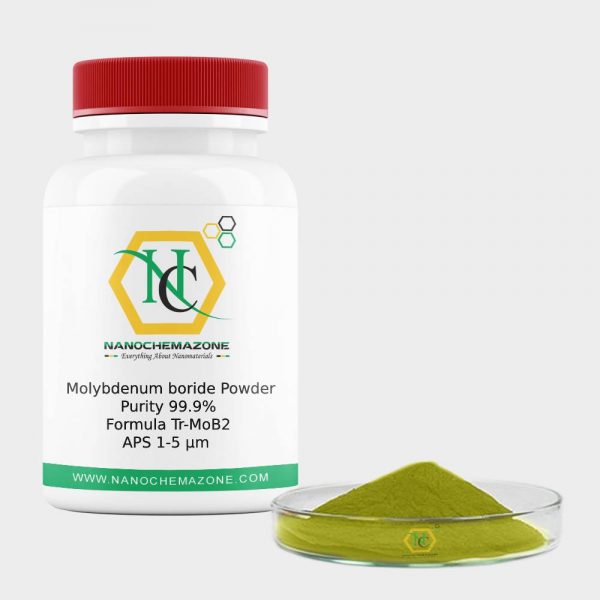
Molybdenum Boride Powder
Molybdenum Boride Powder
Product Name: Molybdenum Boride Powder
| MF: | Tr-MoB2 |
| Chemical Name | Boride Powder |
| Color | Yellow Gray |
| EINECS No.: | 234-502-8 |
| Purity: | 99.9% |
| Density: | 9.26 g/ cm3 |
| Product Number: | NCZ-NMB-112/20 |
| Cas Number: | 12006-99-4 |
RELATED INFORMATION
It's mainly used as an additive of electronic tungsten, molybdenum alloy, etc., and can also be used in the manufacture of wear semiconductor thin film and coating materials.
Please email us for the customization.
Email: contact@nanochemazone.com
Please contact us for customization and price inquiry
Note: We supply different size ranges of Nano and micron as per the client’s requirements and also accept customization in various parameters.
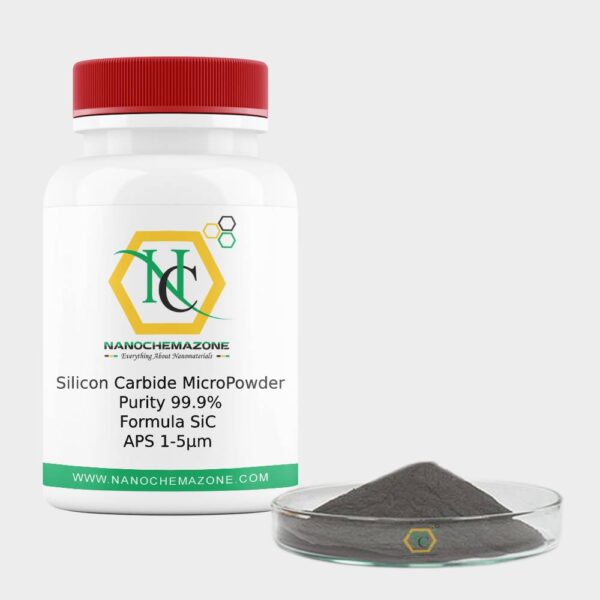
Silicon Carbide Powder
Product Name: Silicon Carbide Powder
| Product | Silicon Carbide Powder |
| Colour | Black Powder |
| Purity | ≥ 99.9% |
| Particle size | 1-10 µM (customizable) |
| Ingredient/MF | SiC |
| Product Code | NCZ-C-104/20 |
| CAS Number | 409-21-2 |
Silicon Carbide Powder Description:
Silicon carbide is produced in the same way as Black silicon Carbide except for some differences in the raw material. Its crystallization has higher purity and hardness. Green silicon carbide is suitable for processing hard alloy, metallic and non-metallic materials with hard and brittle features such as copper, brass, Aluminum, magnesium, jewel, optical glass, ceramics, etc.
Silicon Carbide Applications:
- One of the best properties of silicon carbide is that it is resistant to alkali and acids.
- It retains strength when applied at high temperatures.
- It shows good electrical conductivity and shock resistance capacity and for this reason, it is preferred for applying in an electric furnace to heat elements.
- It is compatible to apply under extreme conditions of applications.
- Apart from that, this chemical component also shows considerable thermal expansion and conductivity.
- It is an ideal component for applications requiring good flexural strength.
- We provide this product after evaluating the properties, ingredients, and applicability to cover a wide range of industrial usages.
Advantages:
- Large melting furnace, longer melting time, lead to more crystallization, bigger crystals, higher purity, and fewer impurities.
- Beckman coulter particle size distribution instrument.
- The laboratory is registered at the government Import and Export Inspection Bureau.
Silicon Carbide Powder Related Information
Please email us for the customization.
Email: contact@nanochemazone.com
Please contact us for customization and price inquiry
Note: We supply different size ranges of Nano and micron as per the client’s requirements and also accept customization in various parameters.
Tantalum carbide Powder
Product Name: Tantalum Carbide Powder
| Product | Tantalum Carbide Powder |
| Colour | Brown-Gray |
| Purity | ≥ 99.9% |
| Particle size | 1-10 µM (customizable) |
| Ingredient/MF | TaC |
| Product Code | NCZ-C-105/20 |
| CAS Number | 12070-06-3 |
Tantalum carbide Powder Description:
Tantalum carbides form a family of binary chemical compounds of tantalum and carbon with the empirical formula TaCx, where usually varies between 0.4 and 1.
They are extremely hard, brittle, refractory ceramic materials with metallic electrical conductivity.
They appear as brown-Gray powders, which are usually processed by sintering.
Being important cermet materials, tantalum carbides are commercially used in tool bits for cutting applications and are sometimes added to tungsten carbide alloys.
Properties of TaC Tantalum carbide powder:
Tantalum carbides have metallic electrical conductivity, both in terms of its magnitude and temperature dependence.
TaC is a superconductor with a relatively high transition temperature of TC = 10.35 K.
Application of TaC Tantalum carbide powder
- Widely used in the production of microwave absorbing materials, metal powder injection
molding material technology field.
- Used as all kinds of superhard material and powder metallurgy products additives etc.
- Used as a cutting tool.
- Used for delicate Ceramics.
- Hard wear-resistant alloy tools, tools, molds, and wear-resistant corrosion-resistant structural components additive, improve the toughness of the alloy.
- Tantalum carbide sintered shown in gold, watches can be made decorations.
Please email us for the customization.
Email: contact@nanochemazone.com
Please contact us for customization and price inquiry
Note: We supply different size ranges of Nano and micron as per the client’s requirements and also accept customization in various parameters.
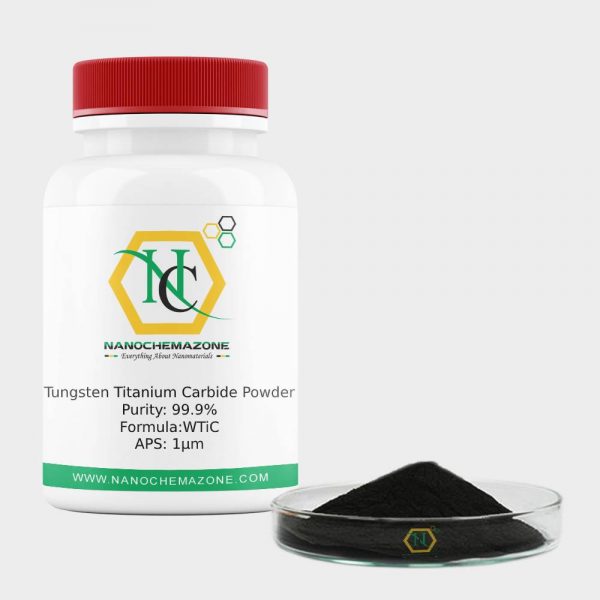
Titanium Carbide Powder
Titanium Carbide Powder
Product Name: Titanium Carbide Powder
| Product | Titanium Carbide Powder |
| Colour | Grey |
| Purity | ≥ 99.9% |
| Particle size | 1-10 µM (customizable) |
| Ingredient/MF | TiC |
| Product Code | NCZ-C-106/20 |
| CAS Number | 12070-08-5 |
Titanium Carbide Powder Description :
Titanium Carbide (TIC) is a Gray metallic powder with a cubic system structure.
With high-wear resistance, perfect corrosion resistance and high-temperature resistance,
As hardness material, it’s widely used as the thermal spray coating powder material, the welding material, the flinty membranous material, the military aviation material, the hard alloy, and the cermet.
Titanium carbide, TiC, is an extremely hard (Mohs 9-9.5) refractory ceramic material, similar to tungsten carbide.
It has the appearance of black powder with the sodium chloride (face-centered cubic) crystal structure.
Also, the product has good conductivity and chemical inert ability to steel and iron
Application of Titanium Carbide TiC:
1. The carbide is mainly used in the manufacturing of cermet, heat-resistant alloy, and cemented carbide due to its high melting point, high hardness, and good chemical stability.
- Applies in the spray coating material, the welding material, the flinty membranous material, the military aviation material, the hard alloy, and the cermet.
3.Used as welding and flux-cored wire
- Used in the preparation of cermets, which are frequently used to machine steel materials at high cutting speed.
- Used as an abrasion-resistant surface coating on metal parts, such as tool bits and watch mechanisms.
- Used as a heat shield coating for atmospheric reentry of spacecraft.
7. TiC is used in manufacturing wear-resistant materials, cutting tools, etc
Please email us for the customization.
Email: contact@nanochemazone.com
Please contact us for customization and price inquiry
Note: We supply different size ranges of Nano and micron as per the client’s requirements and also accept customization in various parameters.
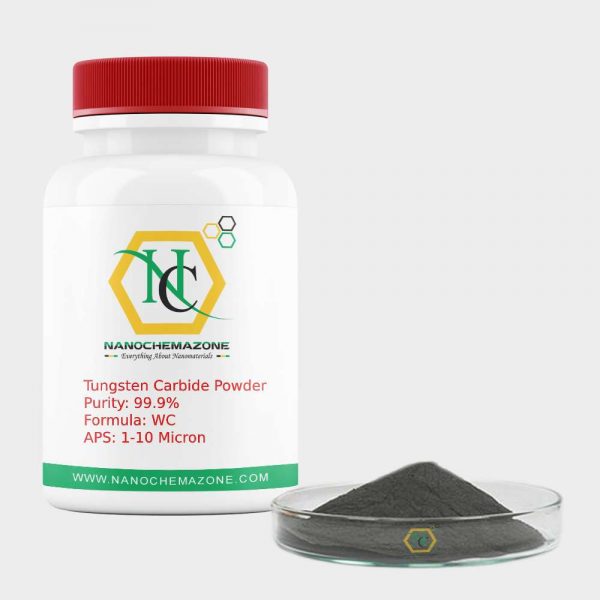
Tungsten Carbide Powder
Tungsten Carbide Powder
Product Name: Tungsten Carbide Powder
| Product | Tungsten Carbide Powder |
| Colour | Grey |
| Purity | ≥ 99.9% |
| Particle size | 1-10 µM (customizable) |
| Ingredient/MF | WC |
| Product Code | NCZ-C-109/20 |
| CAS Number | 12070-12-1 |
Brief Description of WC Tungsten Carbide Powder
Tungsten carbide powder (chemical formula: WC ) is a chemical compound (specifically, a carbide ) containing equal parts of tungsten and carbon atoms.
In its most basic form, tungsten carbide is a fine Gray powder, but it can be pressed and formed into shapes for use in industrial machinery, cutting tools, abrasives, armor-piercing rounds, other tools and instruments, and jewelry.
Physical Properties of WC Tungsten Carbide Powder
Tungsten carbide has a high melting point at 2,870 °C (5,200 °F), a boiling point of 6,000 °C (10,830 °F) when under a pressure equivalent to 1 standard atmosphere (100 kPa), the thermal conductivity of 110 W·m−1·K−1, and a coefficient of thermal expansion of 5.5 µm·m−1·K−1.
Tungsten carbide is extremely hard, ranking about 9 on Mohs scale, and with a Vickers number of around 2600.
It has Young’s modulus of approximately 530–700 GPa, a bulk modulus of 630–655 GPa, and a shear modulus of 274 GPa.
It has an ultimate tensile strength of 344 MPa, the ultimate compression strength of about 2.7 GPa and a Poisson’s ratio of 0.31.
Chemical Properties of WC Tungsten Carbide Powder
There are two well-characterized compounds of tungsten and carbon, WC and tungsten semi abide, W2C.
Both compounds may be present in coatings and the proportions can depend on the coating method.
At high temperatures, WC decomposes to tungsten and carbon and this can occur during high-temperature thermal spray, e.g., in high-velocity oxygen fuel (HVOF) and high energy plasma (HEP) methods.
Application of WC Tungsten Carbide Powder
1 Used for Producing high capability nano-crystalline or superfine horniness alloy, hard-face abrasion-resistant spraying and petrochemical cracking catalyst;
- Used for chipless forming tools; Cutting tools; Mining tolls; Nano-composites (for enhanced hardness, strength, and wear resistance);
- Used for erosion-resistant coatings; wear-resistance coatings; Corrosion-resistant coatings; Wear-resistant parts
- To produce hard carbide.
Please email us for the customization.
Email: contact@nanochemazone.com
Please contact us for customization and price inquiry
Note: We supply different size ranges of Nano and micron as per the client’s requirements and also accept customization in various parameters.
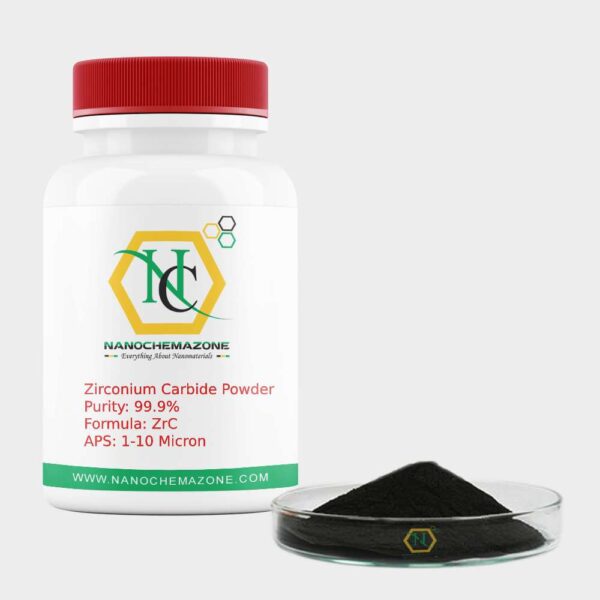
Zirconium Carbide Powder
Zirconium Carbide Powder
Product Name: Zirconium Carbide Powder
| Product | Zirconium Carbide Powder |
| Colour | Black |
| Purity | ≥ 99.9% |
| Particle size | 1-10 µM (customizable) |
| Ingredient/MF | ZrC |
| Product Code | NCZ-C-110/20 |
| CAS Number | 12070-14-3 |
Zirconium Carbide Powder Description:
Like most carbides of refractory metals, zirconium carbide is sub-stoichiometric, i.e., it contains carbon vacancies.
At carbon contents higher than approximately ZrC0.98 the material contains free carbon.
ZrC reacts with water and acids and is pyrophoric.
It becomes readily oxidized in the air when exposed to elevated temperatures.
It shows a high amount of corrosion resistance property and contains carbon vacancies.
It reacts with water as well as acids.
Application:
1.Used as an abrasive, in metal cladding, in cermet, incandescent filaments, and cutting tools.
2. The mixture of zirconium carbide and tantalum carbide is an important cermet material.
3. Hafnium-free zirconium carbide and niobium carbide can be used as refractory coatings in nuclear reactors.
4. Zirconium carbide is used extensively as a coating of uranium dioxide and thorium dioxide particles of nuclear fuel.
5. The coating is usually deposited by thermal chemical vapor deposition in a fluidized bed reactor.
6. High-temperature wear-resistant surface materials
Please email us for the customization.
Email: contact@nanochemazone.com
Please contact us for customization and price inquiry
Note: We supply different size ranges of Nano and micron as per the client’s requirements and also accept customization in various parameters.
Reviews
There are no reviews yet.