


Phthalocyanine Nano Powder
₹0.00
Phthalocyanine Nano Powder
Product Name: Phthalocyanine Nano Powder
| Product Name | Phthalocyanine Nano Powder |
| Stock No | NCZ-NSC299-/20 |
| CAS No | 574-93-6 |
| Purity | 99.9% |
| APS | 500nm (0.5um) (Can be customized) |
| Molecular Formula | C32H18N8 |
| Form | Powder |
| Color | Blue Powder |
| Molar mass | 514.552 g·mol−1 |
Phthalocyanine Nano Powder Description
Phthalocyanine Nano Powder is a large, aromatic, macrocyclic, organic compound with the and is of theoretical or specialized interest. It is composed of four isoindole units linked by nitrogen atoms. H2Pc has a two-dimensional geometry and a ring system consisting of 18 π-electrons. The extensive delocalization of the π-electrons affords the molecule useful properties, lending itself to applications in dyes and pigments. Metal complexes derived from Pc2.The conjugate base of H2Pc, are valuable in catalysis, organic solar cells, and photodynamic therapy. Phthalocyanine and derived metal complexes (MPc) tend to aggregate and, thus, have low solubility in common solvents. Benzene at 40 °C dissolves less than a milligram of H 2Pc or CuPc per liter. H 2Pc and CuPc dissolve easily in sulfuric acid due to the protonation of the nitrogen atoms bridging the pyrrole rings. Many phthalocyanine compounds are, thermally, very stable, and do not melt but can be sublimed. CuPc sublimes at above 500 °C under inert gases nitrogen, CO Substituted phthalocyanine complexes often have much higher solubility. They are less thermally stable and often can not be sublimed. Unsubstituted phthalocyanines strongly absorb light between 600 and 700 nm, thus these materials are blue or green. Substitution can shift the absorption towards longer wavelengths, changing color from pure blue to green to colorless (when the absorption is in the near-infrared). There are many derivatives of the parent phthalocyanine, where either carbon atoms of the macrocycle are exchanged for nitrogen atoms or the peripheral hydrogen atoms are substituted by functional groups like halogens, hydroxyl, amino, alkyl, aryl, thiol, alkoxy and nitrosyl groups. These modifications allow for the tuning of the electrochemical properties of the molecule such as absorption and emission wavelengths and conductance.
Phthalocyanine Nano Powder Related Information
Storage Conditions:
Airtight sealed, avoid light, and keep dry at room temperature.
Please contact us for customization and price inquiry
Email: contact@nanochemazone.com
Note: We supply different size ranges of Nano and micron as per the client’s requirements and also accept customization in various parameters.
Note: For pricing & ordering information, please contact us at sales@nanochemazone.com
Please contact us for quotes on Larger Quantities & Customization. E-mail: contact@nanochemazone.com
Customization:
You must be logged in to post a review.
Related products
Aluminum Diboride Powder
Aluminum Diboride Powder
Product Name: Aluminum Diboride Powder
| MF: | AlB2-P |
| Chemical Name | Aluminum Diboride |
| Color | Gray Black |
| EINECS | 234-923-7 |
| Purity: | 99.9% |
| Particle size | 30 µm (Customizable) |
| Product Number: | NCZ-SC-113/20 |
| Cas Number: | 12041-50-8 |
Aluminum Diboride Powder RELATED INFORMATION
Aluminum boride is an ionic compound, with a hexagonal crystal structure. Aluminum boride at an absolute temperature slightly 40K (equivalent to -233 ℃) will be transformed into a superconductor. And its actual operating temperature is 20 ~ 30K. To reach this temperature, we can use liquid neon, liquid hydrogen, or closed-cycle refrigerator to finish cooling. Compared to the current industry using liquid helium to cool the niobium alloy (4K), these methods are simpler and more economical. Once it is doped with carbon or other impurities, magnesium diboride in a magnetic field, or there is a current passing, the ability to maintain the superconducting is as much as niobium alloys, or even better.
Please email us for the customization. Email: contact@nanochemazone.com Please contact us for customization and price inquiry Note: We supply different size ranges of nano and micron size powder as per the client’s requirements and also accept customization in various parameters.
Chromium Carbide Cr3C2 Powder
Product Name: Chromium Carbide Cr3C2 Powder
| Product | Chromium Carbide |
| Colour | Gray Powder |
| Purity | ≥ 99.9% |
| Particle size | 1-10 µM (customizable) |
| Ingredient/MF | Cr3C2 |
| Product Code | NCZ-C-101/20 |
| CAS Number | 12012-35-0 |
Chromium Carbide Cr3C2 Powder APPLICATION FIELDS
Chromium Carbide Cr3C2 Powder is a ceramic compound that exists in several different chemical compositions: Cr3C2, Cr7C3, and Cr23C6. At standard conditions, it exists as a gray solid. It is extremely hard and corrosion-resistant. It is also a refractory compound, which means that it retains its strength at high temperatures as well. These properties make use as an additive to metal alloys. When chromium carbide crystals are integrated into the surface of a metal it improves the wear resistance and corrosion resistance of the metal and maintains these properties at elevated temperatures. Cr3C2 powder is mixed with solid nickel-chromium. This mixture is then heated to very high temperatures and sprayed onto the object being coated where it forms a protective layer. This layer is essentially its own metal matrix composite, consisting of hard ceramic Cr3C2 particles embedded in a nickel-chromium matrix. Cr3C2 prevents large grains from forming in the composite, which results in a fine-grained structure of superior toughness.Chromium Carbide Cr3C2 Application:
- Used as high temperature resistant and wear-resistant surface materials
- Used for welding and flux-cored wire
- Chromium carbide is useful in the surface treatment of metal components.
- Chromium carbide is used to coat the surface of another metal in a technique known as thermal spraying.
- Chromium carbide is used as an additive in cutting tools in order to improve toughness by preventing the growth of large grains.
Chromium Carbide Cr3C2 Properties:
There are three different crystal structures for chromium carbide corresponding to the three different chemical compositions. Cr23C6 has a cubic crystal structure and a Vickers hardness of 976 kg/mm2. Cr7C3 has a hexagonal crystal structure and a microhardness of 1336 kg/mm2. Cr3C2 is the most durable of the three compositions and has an orthorhombic crystal structure with a microhardness of 2280 kg/mm2. For this reason, Cr3C2 is the primary form of chromium carbide used in surface treatment. Please email us for the customization. Email: contact@nanochemazone.com Please contact us for customization and price inquiry Note: We supply different size ranges of Nano and micron as per the client’s requirements and also accept customization in various parameters.
Ferro Titanium Carbide Powder
Product Name: Ferro Titanium Carbide Powder
| Product | Ferro Titanium Carbide Powder |
| Colour | Gray Powder |
| Purity | ≥ 99.9% |
| Particle size | 1-10 µM (customizable) |
| Ingredient/MF | FeTiC |
| Product Code | NCZ-C-102/20 |
| CAS Number | 12604-56-7 |
Application of Ferro Titanium carbide powder:
In the present study, Fe-based hardfacing coating reinforced by TiC particles was obtained by manual shielded metal arc welding (SMAW) in which H08A bare electrode was coated with fluxes, to which different measures of ferrotitanium, rutile, graphite, calcium carbonate, and calcium fluoride had been added.
The microstructure and wear properties of the hardfacing coating were studied through scanning electron microscopy (SEM), transmission electron microscopy (TEM), an X-ray diffractometer (XRD), and a wear test.
The results indicate that TiC particles are produced by a direct metallurgical reaction between ferrotitanium and graphite during welding.
TiC particles are uniformly dispersed in the matrix of lath martensite and retained austenite with particle sizes in the range of 3–5 μm. Fe-based hardfacing coating reinforced by TiC particles is found to possess better wear resistance and a lower coefficient of friction than that of the AISI 1045 steel substrate.
Please email us for the customization. Email: contact@nanochemazone.com Please contact us for customization and price inquiry Note: We supply different size ranges of Nano and micron as per the client’s requirements and also accept customization in various parameters.
Ferrochrome Nitride Powder
| Product | Ferrochrome Nitride Powder |
| Colour | Black |
| Purity | ≥ 99.9% |
| Particle size | 1-10 µM (customizable) |
| Ingredient/MF | FeCrN |
| Product Code | NCZ-CN-151/20 |
| CAS Number | 7439-89-6, / 24094-93-7 |
- Widely used in stainless steel, heat resistant steel, corrosion-resistant steel, alloy steel, and other special steel smelting production
- Used in steelmaking industrial, casting foundry
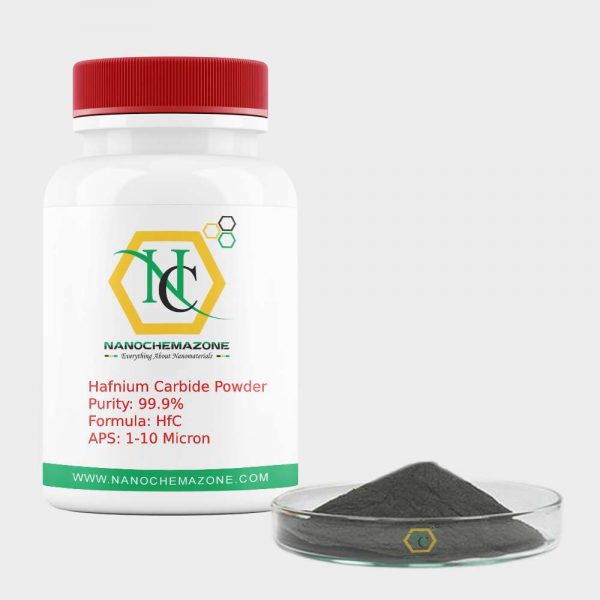
Hafnium Carbide Powder
Product Name: Hafnium Carbide Powder
| Product | Hafnium Carbide Powder |
| Colour | Gray Powder |
| Purity | ≥ 99.9% |
| Particle size | 1-10 µM (customizable) |
| Ingredient/MF | HfC |
| Product Code | NCZ-C-103/20 |
| CAS Number | 12069-85-1 |
Brief Description of Hafnium carbide powder HfC:
Hafnium carbide ( HfC) is a chemical compound of hafnium and carbon With a melting point of about 3900 °C it is one of the most refractory binary compounds known. However, it has low oxidation resistance, with the oxidation starting at temperatures as low as 430 °C Hafnium carbide is usually carbon deficient and therefore its composition is often expressed as HfCx (x = 0.5 to 1.0). It has a cubic (rock-salt) crystal structure at any value of xApplication of Hafnium carbide powder HfC:
- Used for preparation of ultra-high temperature ceramics
- The reactant in the synthesis of hafnium-containing organometallic polymers
- Used as an additive in alloys
- Used in coatings
- Widely used in microelectronics, semiconductor, aerospace high-temperature resistant material, coating materials, ceramic materials, ceramic target material, etc.
Hafnium carbide Powder related Information
Please email us for the customization. Email: contact@nanochemazone.com Please contact us for customization and price inquiry Note: We supply different size ranges of Nano and micron as per the client’s requirements and also accept customization in various parameters.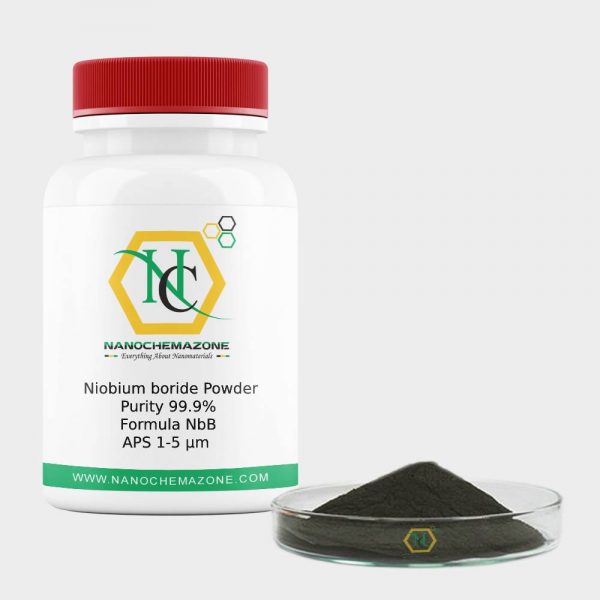
Niobium Boride Powder
Niobium Boride Powder
Product Name: Niobium Boride Powder
| MF | NbB |
| Chemical Name | Niobium Boride Powder |
| EINECS | 235-723-2 |
| Purity | 99.9% |
| Molecular weight | 103.72 |
| Product Number | NCZ-SC-112/20 |
| Cas Number | 12007-29-3 |
| Density | 7.39g/ml |
Niobium Boride Powder
Niobium boride Powders having NbB, NbB2, and Nb3B4 phases in various amounts and single-phase NbB powders were successfully synthesized by using powder metallurgy methods from related metal oxide raw materials in the presence of a strong reducing agent. Nb2O5, B2O3, and Mg powder blends were milled at room temperature by a high-energy ball mill for a different time. Subsequently, an undesired MgO phase was removed from the milled powders by HCl leaching to constitute NbB–NbB2–Nb3B4 as final products, and they were subjected to an annealing process at 1500 °C for 4 h to observe probable boride transformation. Characterization was carried out by XRD, DSC, PSA, SEM/EDX, TEM, and VSM.
The effects of milling time (up to 9 h) on the formation, microstructure, and thermal behavior of the final products were investigated. The reduction reaction took place after milling stoichiometric powder blends for 2 h. Nano-sized NbB–NbB2–Nb3B4 powders in high purity were obtained in the absence of any secondary phase and any impurity via mechanochemistry by milling for 5 h and leaching with 4 mol/L HCl. After annealing, pure and nano-sized NbB–NbB2–Nb3B4 powders transformed to a single NbB phase without leaving behind NbB2 and Nb3B4 phases.
RELATED INFORMATION Please email us for the customization. Email: contact@nanochemazone.com Please contact us for customization and price inquiry Note: We supply different size ranges of Nano and micron as per the client’s requirements and also accept customization in various parameters.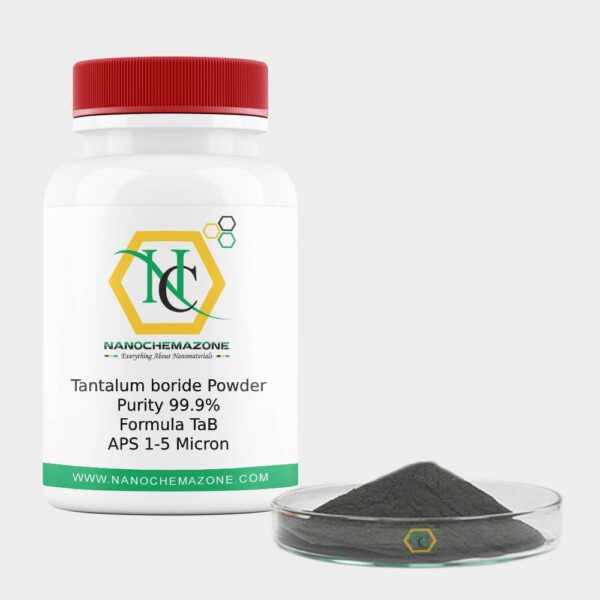
Tantalum boride Powder
Product Name: Tantalum boride Powder
| MF: | TaB |
| Chemical Name |
Tantalum boride Powder |
| Color | Gray |
| EINECS | 234-496-7 |
| Purity: | 99.9% |
| Molecular weight: | 191.76 |
| Product Number: | NCZ-SC-116/20 |
| Cas Number: | 12045-19-1 |
| Density: | 14.2 g/cm3 |
Tantalum boride Powder RELATED INFORMATION
Please email us for the customization. Email: contact@nanochemazone.com Please contact us for customization and price inquiry Note: We supply different size ranges of Nano and micron as per the client’s requirements and also accept customization in various parameters.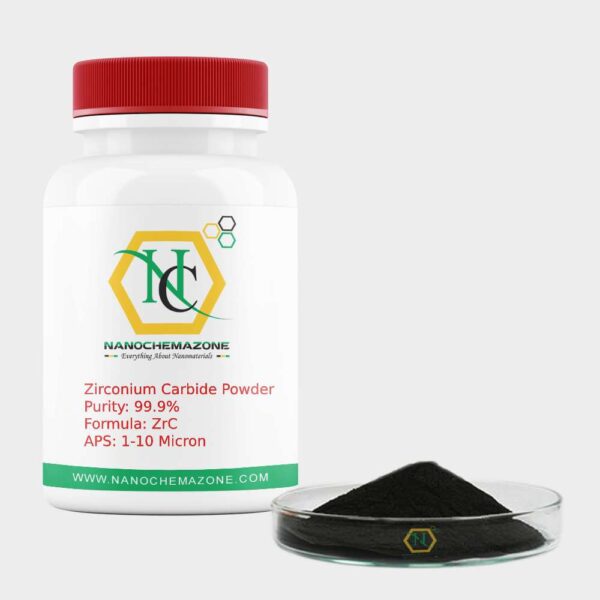
Zirconium Carbide Powder
Zirconium Carbide Powder
Product Name: Zirconium Carbide Powder
| Product | Zirconium Carbide Powder |
| Colour | Black |
| Purity | ≥ 99.9% |
| Particle size | 1-10 µM (customizable) |
| Ingredient/MF | ZrC |
| Product Code | NCZ-C-110/20 |
| CAS Number | 12070-14-3 |
Reviews
There are no reviews yet.