
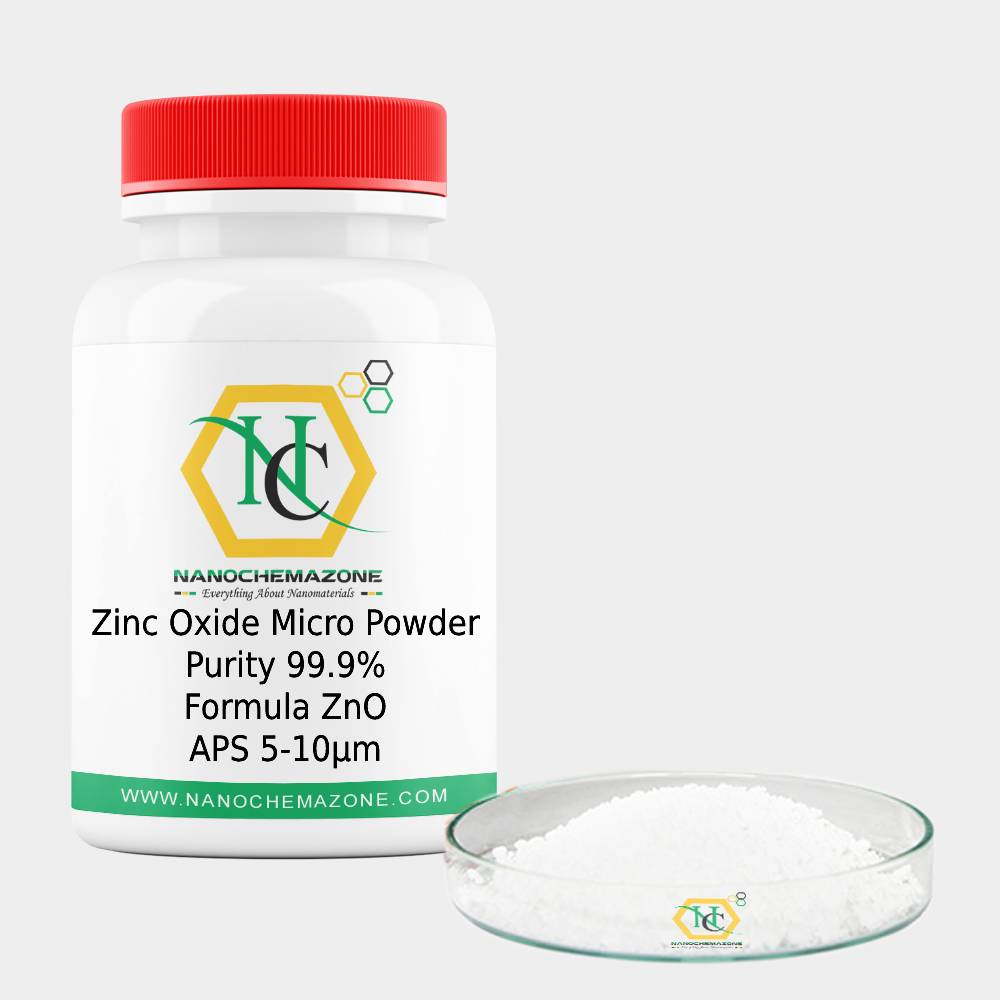


Zinc Oxide Micro Powder
₹0.00
Zinc Oxide Micro Powder
Product Name: Zinc Oxide Micro Powder
| Product Name | Zinc Oxide Micro Powder |
| Stock No | NCZ-NSC298-/20 |
| CAS No | 7782-42-5 |
| Purity | 99.9% |
| APS | 5,-10µm (Can be customized) |
| Molecular Formula | ZnO |
| Form | Powder |
| Color | White Powder |
| Density | 5600 kg/m3 |
Zinc Oxide Micro Powder
Zinc oxide Micro Powder is an inorganic compound with the formula is a white powder that is insoluble in water. It is used as an additive in numerous materials and products including cosmetics, food supplements, rubbers, plastics, ceramics, glass, cement, lubricants, paints, ointments, adhesives, sealants, pigments, foods, batteries, ferrites, fire retardants, and first-aid tapes. Although it occurs naturally as the mineral zincite, most zinc oxide is produced synthetically. ZnO is a wide-bandgap semiconductor of the semiconductor group.
The native doping of the semiconductor due to oxygen vacancies or zinc interstitials is n-type. Other favorable properties include good transparency, high electron mobility, wide bandgap, and strong room-temperature luminescence. Those properties are valuable in emerging applications for transparent electrodes in liquid crystal displays, energy-saving or heat-protecting windows, and electronics as thin-film transistors and light-emitting diodes
Physical Properties of Zinc Oxide Micro Powder
Zinc oxide crystallizes in two main forms, hexagonal wurtzite and cubic zincblende. The wurtzite structure is most stable at ambient conditions and thus most common. The zincblende form can be stabilized by growing on substrates with a cubic lattice structure. In both cases, the zinc and oxide centers are tetrahedral, the most characteristic geometry for Zn. It converts to the rocksalt motif at relatively high pressures about 10 GPa. T
he many remarkable medical properties of creams containing ZnO can be explained by its elastic softness, which is characteristic of tetrahedral coordinated binary compounds close to the transition to octahedral structures. Hexagonal and zincblende polymorphs have no inversion symmetry a reflection of a crystal relative to any given point does not transform it into itself. This and other lattice symmetry properties result in piezoelectricity of the hexagonal and zincblende ZnO, and pyroelectricity of hexagonal ZnO.
Mechanical properties of Zinc Oxide Micro Powder
ZnO is a relatively soft material with an approximate hardness of 4.5 on the Mohs scale. Its elastic constants are smaller than those of relevant semiconductors, such as GaN. The high heat capacity and heat conductivity, low thermal expansion, and high melting temperatures are beneficial for ceramics.
The E2 optical phonon exhibits an unusually long lifetime of Among the tetrahedrally bonded semiconductors, it has been stated that has the highest piezoelectric tensor, or at least one comparable to that of GaN and AlN. This property makes it a technologically important material for many piezoelectrical applications, which require a large electromechanical coupling. Therefore ZnO has been in forms of thin-film one of the most studied resonator material for thin-film bulk acoustic resonators.
Zinc Oxide Micro Powder Related Information
Storage Conditions:
Airtight sealed, avoid light, and keep dry at room temperature.
Please contact us for customization and price inquiry
Email: contact@nanochemazone.com
Note: We supply different size ranges of Nano and micron as per the client’s requirements and also accept customization in various parameters.
Note: For pricing & ordering information, please contact us at sales@nanochemazone.com
Please contact us for quotes on Larger Quantities & Customization. E-mail: contact@nanochemazone.com
Customization:
You must be logged in to post a review.
Related products
Aluminum Diboride Powder
Aluminum Diboride Powder
Product Name: Aluminum Diboride Powder
| MF: | AlB2-P |
| Chemical Name | Aluminum Diboride |
| Color | Gray Black |
| EINECS | 234-923-7 |
| Purity: | 99.9% |
| Particle size | 30 µm (Customizable) |
| Product Number: | NCZ-SC-113/20 |
| Cas Number: | 12041-50-8 |
Aluminum Diboride Powder RELATED INFORMATION
Aluminum boride is an ionic compound, with a hexagonal crystal structure. Aluminum boride at an absolute temperature slightly 40K (equivalent to -233 ℃) will be transformed into a superconductor. And its actual operating temperature is 20 ~ 30K. To reach this temperature, we can use liquid neon, liquid hydrogen, or closed-cycle refrigerator to finish cooling. Compared to the current industry using liquid helium to cool the niobium alloy (4K), these methods are simpler and more economical. Once it is doped with carbon or other impurities, magnesium diboride in a magnetic field, or there is a current passing, the ability to maintain the superconducting is as much as niobium alloys, or even better.
Please email us for the customization. Email: contact@nanochemazone.com Please contact us for customization and price inquiry Note: We supply different size ranges of nano and micron size powder as per the client’s requirements and also accept customization in various parameters.
Chromium Diboride Powder
Chromium Diboride Powder
Product Name: Chromium Diboride Powder
| MF: | CrB2 |
| Chemical Name |
Chromium Diboride Powder |
| Appearance | silver, ceramic material |
| EINECS | 234-499-3 |
| Purity: | 99.9% |
| Density: | 5.20 g/cm3 |
| Product Number: | NCZ-NCD-117/20 |
| Cas Number: | 12007-16-8 |
Ferrochrome Nitride Powder
Ferrochrome Nitride Powder
Product Name: Ferrochrome Nitride Powder
| Product | Ferrochrome Nitride Powder |
| Colour | Black Powder |
| Purity | ≥ 99.9% |
| Particle size | 1-10 µM (customizable) |
| Ingredient/MF | FeCrN |
| Product Code | NCZ-CN-151/20 |
| CAS Number | 7439-89-6, / 24094-93-7 |
Ferrochrome Nitride Powder Description:
Ferrochrome nitride is widely used in electric furnace and oxygen converter smelting nitrogen steel. Nitrogen is an element of austenite formation, It is used as a component to add chromium manganese and chromium manganese nickel stainless steel to replace the shortage of nickel.Ferrochrome Nitride Powder Application:
Ferrochrome, or ferrochromium (FeCr) is a type of ferroalloy, that is, an alloy of chromium and iron, generally containing 50 to 70% chromium by weight.
Ferrochrome is produced by electric arc carbothermic reduction of chromite. Most of the global output is produced in and India, which have large domestic chromite resources. Increasing amounts are coming from Russia and China.
Production of steel, especially that of stainless steel with a chromium content of 10 to 20%, is the largest consumer and the main application of ferrochrome.
Ferrochrome production is essentially a carbothermic reduction operation taking place at high temperatures. Chromium ore (an oxide of Cr and Fe) is reduced by coal and coke to form the iron-chromium alloy.
The heat for this reaction can come from several forms, but typically from the electric arc formed between the tips of electrodes at the bottom of the furnace and the furnace hearth.
This arc creates temperatures of about 2,800 °C (5,070 °F). In the process of smelting, huge amounts of electricity are consumed, making production very expensive in countries where power costs are high.
The tapping of the material from the furnace takes place intermittently. When enough smelted ferrochrome has accumulated in the furnace hearth.
The tap hole is drilled open and a stream of molten metal and slag rushes down a trough into a chill or ladle. Ferrochrome solidifies in large castings that are crushed for sale or further processed.
Ferrochrome is generally classified by the amount of carbon and chrome it contains.
The vast majority of FeCr produced is "charge chrome" from South Africa, with high carbon being the second largest segment followed by the smaller sectors of low carbon and intermediate carbon material.
Ferrochrome Nitride Powder Related Information
Please email us for the customization. Email: contact@nanochemazone.com Please contact us for customization and price inquiry Note: We supply different size ranges of Nano and micron as per the client’s requirements and also accept customization in various parameters.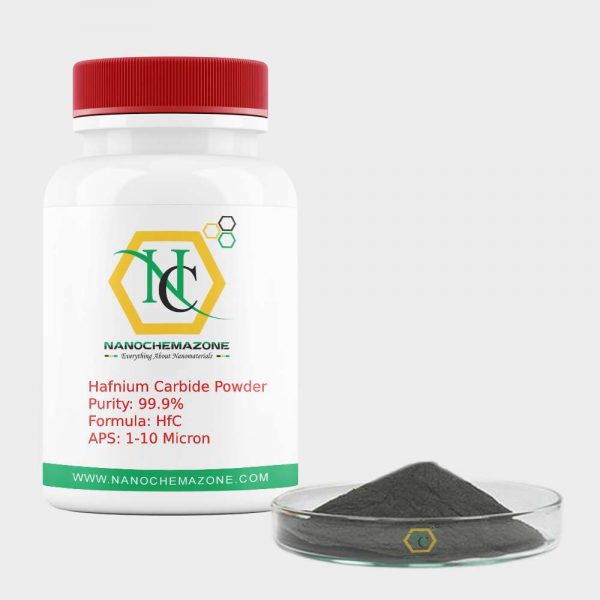
Hafnium Carbide Powder
Product Name: Hafnium Carbide Powder
| Product | Hafnium Carbide Powder |
| Colour | Gray Powder |
| Purity | ≥ 99.9% |
| Particle size | 1-10 µM (customizable) |
| Ingredient/MF | HfC |
| Product Code | NCZ-C-103/20 |
| CAS Number | 12069-85-1 |
Brief Description of Hafnium carbide powder HfC:
Hafnium carbide ( HfC) is a chemical compound of hafnium and carbon With a melting point of about 3900 °C it is one of the most refractory binary compounds known. However, it has low oxidation resistance, with the oxidation starting at temperatures as low as 430 °C Hafnium carbide is usually carbon deficient and therefore its composition is often expressed as HfCx (x = 0.5 to 1.0). It has a cubic (rock-salt) crystal structure at any value of xApplication of Hafnium carbide powder HfC:
- Used for preparation of ultra-high temperature ceramics
- The reactant in the synthesis of hafnium-containing organometallic polymers
- Used as an additive in alloys
- Used in coatings
- Widely used in microelectronics, semiconductor, aerospace high-temperature resistant material, coating materials, ceramic materials, ceramic target material, etc.
Hafnium carbide Powder related Information
Please email us for the customization. Email: contact@nanochemazone.com Please contact us for customization and price inquiry Note: We supply different size ranges of Nano and micron as per the client’s requirements and also accept customization in various parameters.
Molybdenum Boride Powder
Molybdenum Boride Powder
Product Name: Molybdenum Boride Powder
| MF: | Tr-MoB2 |
| Chemical Name | Molybdenum Boride Powder |
| Color | Yellow Gray |
| EINECS No.: | 234-502-8 |
| Purity: | 99.9% |
| Density: | 9.26 g/ cm3 |
| Product Number: | NCZ-NMB-112/20 |
| Cas Number: | 12006-99-4 |
Molybdenum Boride Powder
RELATED INFORMATION
It's mainly used as an additive of electronic tungsten, molybdenum alloy, etc., and can also be used in the manufacture of wear semiconductor thin film and coating materials. Please email us for the customization. Email: contact@nanochemazone.com Please contact us for customization and price inquiry Note: We supply different size ranges of Nano and micron as per the client’s requirements and also accept customization in various parameters.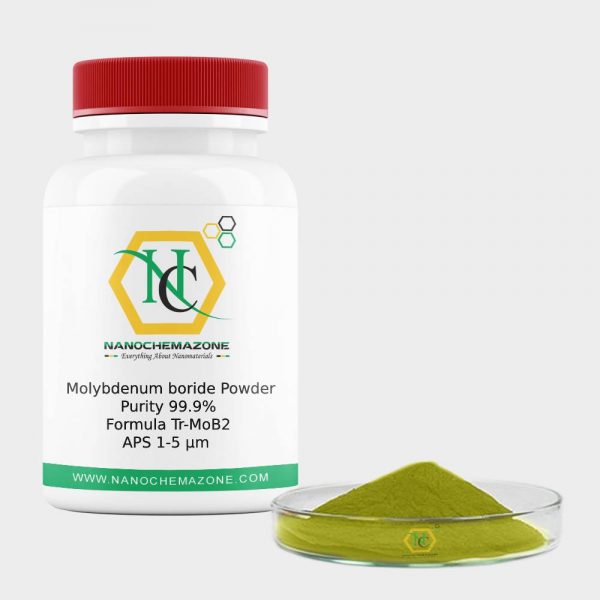
Molybdenum Boride Powder
Molybdenum Boride Powder
Product Name: Molybdenum Boride Powder
| MF: | Tr-MoB2 |
| Chemical Name | Boride Powder |
| Color | Yellow Gray |
| EINECS No.: | 234-502-8 |
| Purity: | 99.9% |
| Density: | 9.26 g/ cm3 |
| Product Number: | NCZ-NMB-112/20 |
| Cas Number: | 12006-99-4 |
RELATED INFORMATION
It's mainly used as an additive of electronic tungsten, molybdenum alloy, etc., and can also be used in the manufacture of wear semiconductor thin film and coating materials. Please email us for the customization. Email: contact@nanochemazone.com Please contact us for customization and price inquiry Note: We supply different size ranges of Nano and micron as per the client’s requirements and also accept customization in various parameters.
Niobium Boride Powder
Niobium Boride Powder
Product Name: Niobium Boride Powder
| MF | NbB |
| Chemical Name | Niobium Boride Powder |
| EINECS | 235-723-2 |
| Purity | 99.9% |
| Molecular weight | 103.72 |
| Product Number | NCZ-SC-112/20 |
| Cas Number | 12007-29-3 |
| Density | 7.39g/ml |
Niobium Boride Powder
Niobium boride Powders having NbB, NbB2, and Nb3B4 phases in various amounts and single-phase NbB powders were successfully synthesized by using powder metallurgy methods from related metal oxide raw materials in the presence of a strong reducing agent. Nb2O5, B2O3, and Mg powder blends were milled at room temperature by a high-energy ball mill for a different time. Subsequently, an undesired MgO phase was removed from the milled powders by HCl leaching to constitute NbB–NbB2–Nb3B4 as final products, and they were subjected to an annealing process at 1500 °C for 4 h to observe probable boride transformation. Characterization was carried out by XRD, DSC, PSA, SEM/EDX, TEM, and VSM.
The effects of milling time (up to 9 h) on the formation, microstructure, and thermal behavior of the final products were investigated. The reduction reaction took place after milling stoichiometric powder blends for 2 h. Nano-sized NbB–NbB2–Nb3B4 powders in high purity were obtained in the absence of any secondary phase and any impurity via mechanochemistry by milling for 5 h and leaching with 4 mol/L HCl. After annealing, pure and nano-sized NbB–NbB2–Nb3B4 powders transformed to a single NbB phase without leaving behind NbB2 and Nb3B4 phases.
RELATED INFORMATION Please email us for the customization. Email: contact@nanochemazone.com Please contact us for customization and price inquiry Note: We supply different size ranges of Nano and micron as per the client’s requirements and also accept customization in various parameters.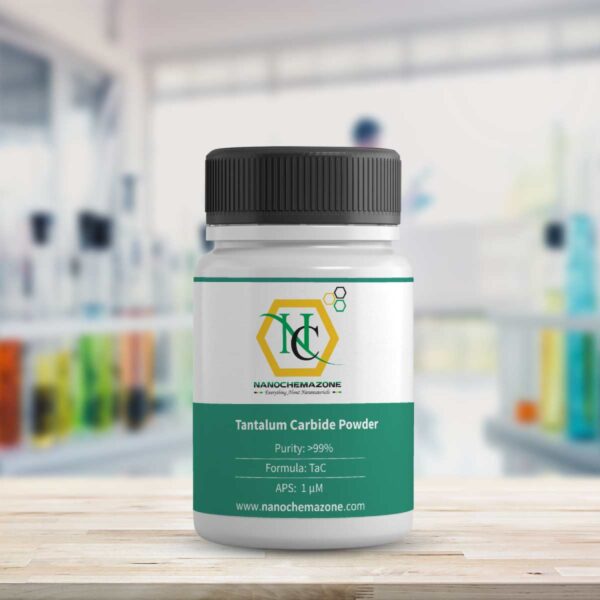
Tantalum carbide Powder
Product Name: Tantalum Carbide Powder
| Product | Tantalum Carbide Powder |
| Colour | Brown-Gray |
| Purity | ≥ 99.9% |
| Particle size | 1-10 µM (customizable) |
| Ingredient/MF | TaC |
| Product Code | NCZ-C-105/20 |
| CAS Number | 12070-06-3 |
Tantalum carbide Powder Description:
Tantalum carbides form a family of binary chemical compounds of tantalum and carbon with the empirical formula TaCx, where usually varies between 0.4 and 1. They are extremely hard, brittle, refractory ceramic materials with metallic electrical conductivity. They appear as brown-Gray powders, which are usually processed by sintering. Being important cermet materials, tantalum carbides are commercially used in tool bits for cutting applications and are sometimes added to tungsten carbide alloys.Properties of TaC Tantalum carbide powder:
Tantalum carbides have metallic electrical conductivity, both in terms of its magnitude and temperature dependence. TaC is a superconductor with a relatively high transition temperature of TC = 10.35 K. Application of TaC Tantalum carbide powder- Widely used in the production of microwave absorbing materials, metal powder injection
- Used as all kinds of superhard material and powder metallurgy products additives etc.
- Used as a cutting tool.
- Used for delicate Ceramics.
- Hard wear-resistant alloy tools, tools, molds, and wear-resistant corrosion-resistant structural components additive, improve the toughness of the alloy.
- Tantalum carbide sintered shown in gold, watches can be made decorations.
Reviews
There are no reviews yet.