

Zirconium Diboride Nano Powder
₹0.00
Zirconium Diboride Nano Powder
Product Name: Zirconium Diboride Nano Powder
| Product Name | Zirconium Diboride Nano Powder |
| Catalog No | NCZ-NSC309-/20 |
| CAS No. | 12045-64-6 |
| Purity | 99.9% |
| APS | 43nm, 750nm (Customizable) |
| Molecular Formula | ZrB2 |
| Molecular weight | 112.85 g/mol |
| Molecular weight | Powder |
| Appearance | Black Powder |
| Color | 6.09 g/cm3 |
| Density | 3,000 °C |
| Melting Point | 6000°C |
Zirconium Diboride Nano Powder Description
Zirconium diboride Nano Powder (ZrB2) is a highly covalent refractory ceramic material with a hexagonal crystal structure. ZrB2 is an ultra-high temperature ceramic with a melting point of 3246 °C. This along with its relatively low density of ~6.09 g/cm3 (measured density may be higher due to hafnium impurities) and good high-temperature strength makes it a candidate for high-temperature aerospace applications such as hypersonic flight or rocket propulsion systems.
It is an unusual ceramic, having relatively high thermal and electrical conductivities, properties it shares with isostructural titanium diboride and hafnium diboride. ZrB2 parts are usually hot pressed (pressure applied to the heated powder) and then machined to shape.
Sintering of ZrB2 is hindered by the material’s covalent nature and presence of surface oxides which increase grain coarsening before densification during sintering. Pressureless sintering of ZrB2 is possible with sintering additives such as boron carbide and carbon which react with the surface oxides to increase the driving force for sintering but mechanical properties are degraded compared to hot-pressed he extremely rapid heating rates can result in incomplete reactions between Zr and B, the formation of stable oxides of Zr, and the retention of porosity.
Stoichiometric reactions have also been carried out by reaction of attrition milled wearing materials by grinding Zr and B powder and then hot pressing at 600 °C for 6 h, and nanoscale particles have been obtained by reacting attrition milled Zr and B precursor crystallites 10 nm in size.
The reduction of ZrO2 and HfO2 to their respective diborides can also be achieved via metallothermic reduction. Inexpensive precursor materials are used and reacted according to the reaction.
Zirconium Diboride Nano Powder Related Information
Storage Conditions:
Airtight sealed, avoid light and keep dry at room temperature.
Please contact us for customization and price inquiry Email: contact@nanochemazone.com
Note: We supply different size ranges of Nano and micron as per the client’s requirements and also accept customization in various parameters.
Note: For pricing & ordering information, please contact us at sales@nanochemazone.com
Please contact us for quotes on Larger Quantities & Customization. E-mail: contact@nanochemazone.com
Customization:
You must be logged in to post a review.
Related products
Chromium Diboride Powder
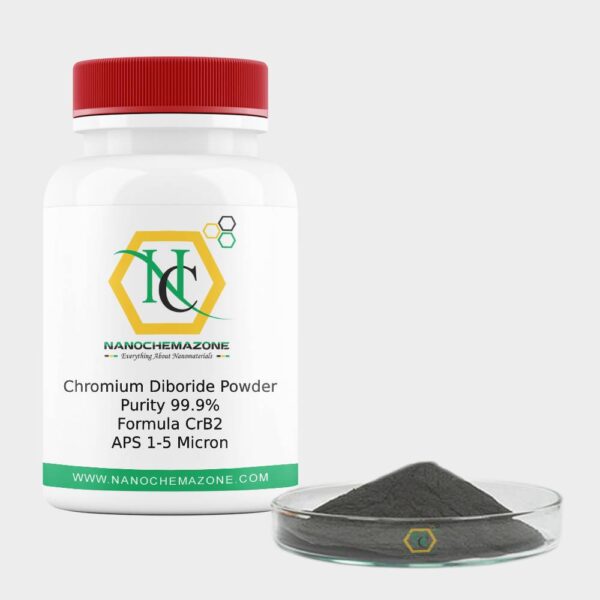
Chromium Diboride Powder
| MF: | CrB2 |
| Chemical Name |
Chromium Diboride Powder |
| Appearance | Silver, Ceramic Material |
| EINECS | 234-499-3 |
| Purity: | 99.9% |
| Density: | 5.20 g/cm3 |
| Product Number: | NCZ-NCD-117/20 |
| Cas Number: | 12007-16-8 |
RELATED INFORMATION
Please email us for the customization.
Email: contact@nanochemazone.com
Please contact us for customization and price inquiry
Note: We supply different size ranges of Nano and micron as per the client’s requirements and also accept customization in various parameters.
Iron Boride Powder
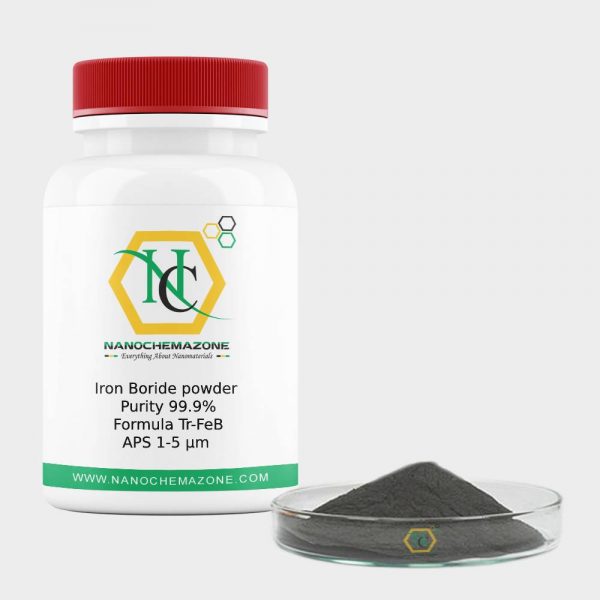
Product Name: Iron Boride Powder
| MF: | Tr-FeB |
| Chemical Name | Iron Boride Powder |
| Color | Grey Powder |
| EINECS Number: | 234-489-9 |
| Purity: | 99.9% |
| Density | ~7 g/cm3 |
| Product Number: | NCZ-NIB-112/20 |
| Cas Number: | 12006-84-8 |
Iron Boride Powder Description
Iron Boride Powder is often used to improve abrasion resistance, corrosion resistance, wear resistance, and oxidation resistance. It is used in oil and gas refinery, chemical extraction, automotive agricultural, stamping, textile extrusion, and injection molding industries. Iron-based coatings recently gained attention for their mechanical, frictional, and corrosion-resistant properties. As compared to the ceramic or cermet type of materials people have used before, iron-based materials are relatively inexpensive, less strategic, and can be produced economically by various thermal methods with ease of fabrication and machining.
Iron Boride Powder Related Information
Please email us for the customization.
Email: contact@nanochemazone.com
Please contact us for customization and price inquiry
Note: We supply different size ranges of Nano and micron as per the client’s requirements and also accept customization in various parameters.
Iron Boride Powder
Product Name: Iron Boride Powder
| MF: | Tr-FeB |
| Chemical Name | Iron Boride Powder |
| Color | Grey Powder |
| EINECS Number: | 234-489-9 |
| Purity: | 99.9% |
| Density | ~7 g/cm3 |
| Product Number: | NCZ-NIB-112/20 |
| Cas Number: | 12006-84-8 |
RELATED INFORMATION
Boriding is often used to improve abrasion resistance, corrosion resistance, wear resistance, and oxidation resistance. It is used in oil and gas refinery, chemical extraction, automotive agricultural, stamping, textile extrusion, and injection molding industries. Iron-based coatings recently gained attention for their mechanical, frictional, and corrosion-resistant properties. As compared to the ceramic or cermet type of materials people have used before, iron-based materials are relatively inexpensive, less strategic, and can be produced economically by various thermal methods with ease of fabrication and machining.
Please email us for the customization.
Email: contact@nanochemazone.com
Please contact us for customization and price inquiry
Note: We supply different size ranges of Nano and micron as per the client’s requirements and also accept customization in various parameters.
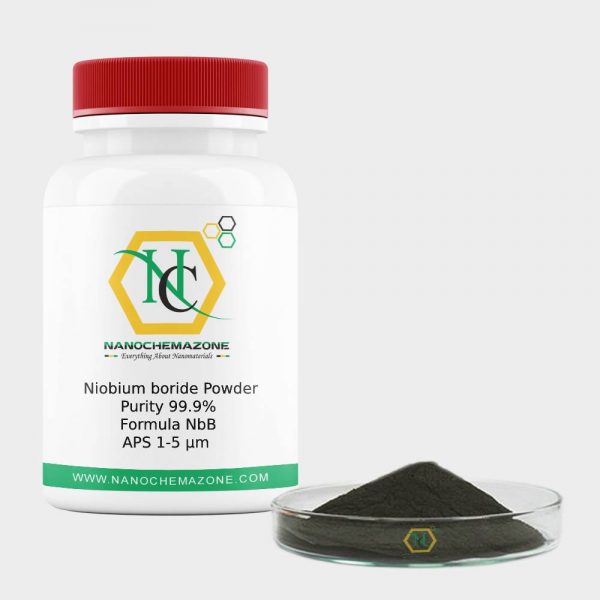
Niobium Boride Powder
Niobium Boride Powder
Product Name: Niobium Boride Powder
| MF | NbB |
| Chemical Name | Niobium Boride Powder |
| EINECS | 235-723-2 |
| Purity | 99.9% |
| Molecular weight | 103.72 |
| Product Number | NCZ-SC-112/20 |
| Cas Number | 12007-29-3 |
| Density | 7.39g/ml |
Niobium Boride Powder
Niobium boride Powders having NbB, NbB2, and Nb3B4 phases in various amounts and single-phase NbB powders were successfully synthesized by using powder metallurgy methods from related metal oxide raw materials in the presence of a strong reducing agent. Nb2O5, B2O3, and Mg powder blends were milled at room temperature by a high-energy ball mill for a different time. Subsequently, an undesired MgO phase was removed from the milled powders by HCl leaching to constitute NbB–NbB2–Nb3B4 as final products, and they were subjected to an annealing process at 1500 °C for 4 h to observe probable boride transformation. Characterization was carried out by XRD, DSC, PSA, SEM/EDX, TEM, and VSM.
The effects of milling time (up to 9 h) on the formation, microstructure, and thermal behavior of the final products were investigated. The reduction reaction took place after milling stoichiometric powder blends for 2 h. Nano-sized NbB–NbB2–Nb3B4 powders in high purity were obtained in the absence of any secondary phase and any impurity via mechanochemistry by milling for 5 h and leaching with 4 mol/L HCl. After annealing, pure and nano-sized NbB–NbB2–Nb3B4 powders transformed to a single NbB phase without leaving behind NbB2 and Nb3B4 phases.
RELATED INFORMATION
Please email us for the customization.
Email: contact@nanochemazone.com
Please contact us for customization and price inquiry
Note: We supply different size ranges of Nano and micron as per the client’s requirements and also accept customization in various parameters.
Niobium Boride Powder
Niobium Boride Powder
Product Name: Niobium Boride Powder
| MF: | NbB |
| Chemical Name | Niobium Boride Powder |
| EINECS: | 235-723-2 |
| Purity: | 99.9% |
| Molecular weight: | 103.72 |
| Product Number: | NCZ-SC-112/20 |
| Cas Number: | 12619-90-8 |
| Density | 7.39g/ml |
Niobium Boride Powder Related Information
Niobium boride powders having NbB, NbB2 and Nb3B4 phases in various amounts and single phase NbB powders were successfully synthesized by using powder metallurgy methods from related metal oxide raw materials in the presence of a strong reducing agent. Nb2O5, B2O3 and Mg powder blends were milled at room temperature
A high-energy ball mill for different time. Subsequently, an undesired MgO phase was removed from the milled powders by HCl leaching to constitute NbB–NbB2–Nb3B4 as final products, and they were subjected to an annealing process at 1500 °C for 4 h to observe probable boride transformation. Characterization was carried out by XRD, DSC, PSA, SEM/EDX, TEM, and VSM. The effects of milling time (up to 9 h) on the formation, microstructure, and thermal behavior of the final products were investigated.
The reduction reaction took place after milling stoichiometric powder blends for 2 h. Nano-sized NbB–NbB2–Nb3B4 powders in high purity were obtained in the absence of any secondary phase and any impurity via mechanochemistry by milling for 5 h and leaching with 4 mol/L HCl. After annealing, pure and nano-sized NbB–NbB2–Nb3B4 powders transformed into a single NbB phase without leaving behind NbB2 and Nb3B4 phases.
Please email us for the customization.
Email: contact@nanochemazone.com
Please contact us for customization and price inquiry
Note: We supply different size ranges of Nano and micron as per the client’s requirements and also accept customization in various parameters.
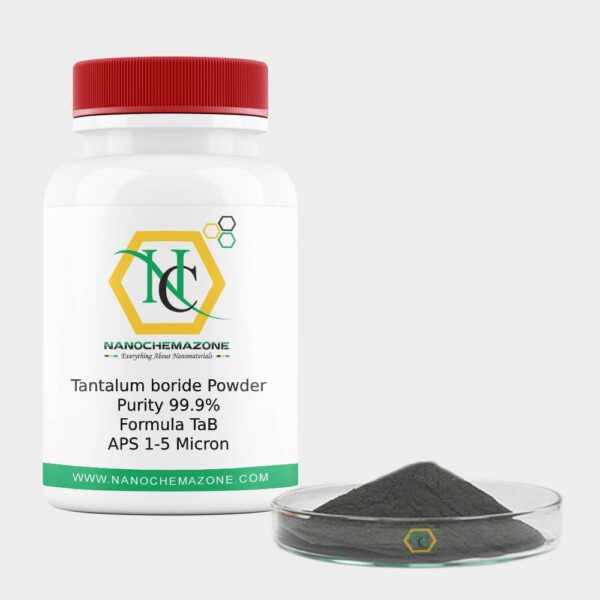
Tantalum boride Powder
Product Name: Tantalum boride Powder
| MF: | TaB |
| Chemical Name |
Tantalum boride Powder |
| Color | Gray |
| EINECS | 234-496-7 |
| Purity: | 99.9% |
| Molecular weight: | 191.76 |
| Product Number: | NCZ-SC-116/20 |
| Cas Number: | 12045-19-1 |
| Density: | 14.2 g/cm3 |
Tantalum boride Powder RELATED INFORMATION
Please email us for the customization.
Email: contact@nanochemazone.com
Please contact us for customization and price inquiry
Note: We supply different size ranges of Nano and micron as per the client’s requirements and also accept customization in various parameters.
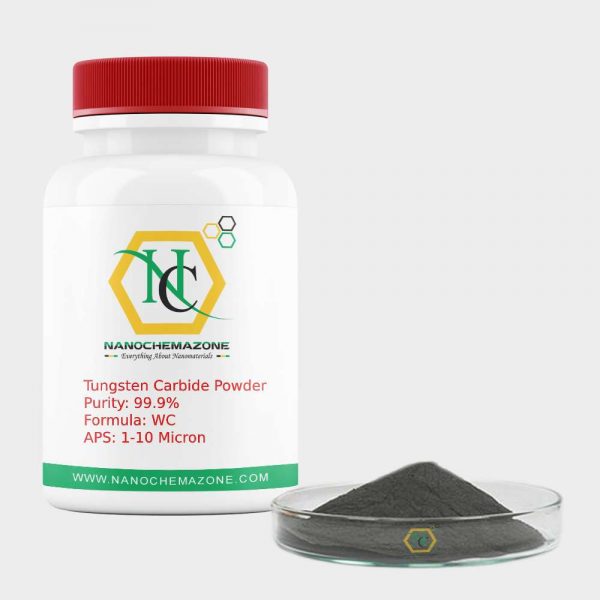
Tungsten Carbide Powder
Tungsten Carbide Powder
Product Name: Tungsten Carbide Powder
| Product | Tungsten Carbide Powder |
| Colour | Grey |
| Purity | ≥ 99.9% |
| Particle size | 1-10 µM (customizable) |
| Ingredient/MF | WC |
| Product Code | NCZ-C-109/20 |
| CAS Number | 12070-12-1 |
Brief Description of WC Tungsten Carbide Powder
Tungsten carbide powder (chemical formula: WC ) is a chemical compound (specifically, a carbide ) containing equal parts of tungsten and carbon atoms.
In its most basic form, tungsten carbide is a fine Gray powder, but it can be pressed and formed into shapes for use in industrial machinery, cutting tools, abrasives, armor-piercing rounds, other tools and instruments, and jewelry.
Physical Properties of WC Tungsten Carbide Powder
Tungsten carbide has a high melting point at 2,870 °C (5,200 °F), a boiling point of 6,000 °C (10,830 °F) when under a pressure equivalent to 1 standard atmosphere (100 kPa), the thermal conductivity of 110 W·m−1·K−1, and a coefficient of thermal expansion of 5.5 µm·m−1·K−1.
Tungsten carbide is extremely hard, ranking about 9 on Mohs scale, and with a Vickers number of around 2600.
It has Young’s modulus of approximately 530–700 GPa, a bulk modulus of 630–655 GPa, and a shear modulus of 274 GPa.
It has an ultimate tensile strength of 344 MPa, the ultimate compression strength of about 2.7 GPa and a Poisson’s ratio of 0.31.
Chemical Properties of WC Tungsten Carbide Powder
There are two well-characterized compounds of tungsten and carbon, WC and tungsten semi abide, W2C.
Both compounds may be present in coatings and the proportions can depend on the coating method.
At high temperatures, WC decomposes to tungsten and carbon and this can occur during high-temperature thermal spray, e.g., in high-velocity oxygen fuel (HVOF) and high energy plasma (HEP) methods.
Application of WC Tungsten Carbide Powder
1 Used for Producing high capability nano-crystalline or superfine horniness alloy, hard-face abrasion-resistant spraying and petrochemical cracking catalyst;
- Used for chipless forming tools; Cutting tools; Mining tolls; Nano-composites (for enhanced hardness, strength, and wear resistance);
- Used for erosion-resistant coatings; wear-resistance coatings; Corrosion-resistant coatings; Wear-resistant parts
- To produce hard carbide.
Please email us for the customization.
Email: contact@nanochemazone.com
Please contact us for customization and price inquiry
Note: We supply different size ranges of Nano and micron as per the client’s requirements and also accept customization in various parameters.
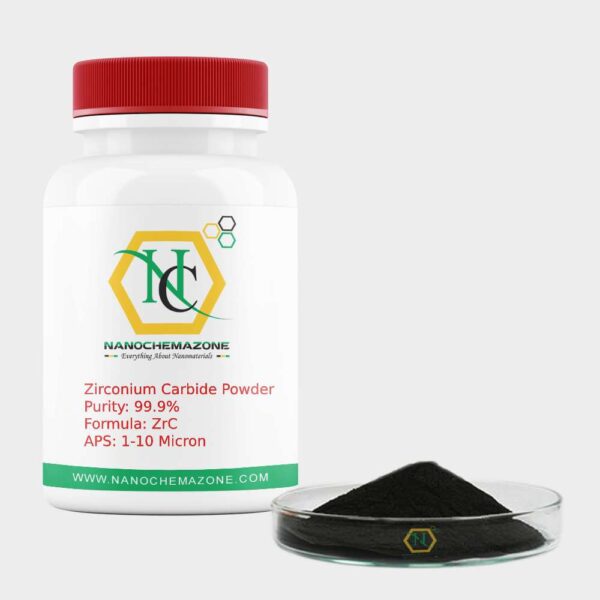
Zirconium Carbide Powder
Zirconium Carbide Powder
Product Name: Zirconium Carbide Powder
| Product | Zirconium Carbide Powder |
| Colour | Black |
| Purity | ≥ 99.9% |
| Particle size | 1-10 µM (customizable) |
| Ingredient/MF | ZrC |
| Product Code | NCZ-C-110/20 |
| CAS Number | 12070-14-3 |
Zirconium Carbide Powder Description:
Like most carbides of refractory metals, zirconium carbide is sub-stoichiometric, i.e., it contains carbon vacancies.
At carbon contents higher than approximately ZrC0.98 the material contains free carbon.
ZrC reacts with water and acids and is pyrophoric.
It becomes readily oxidized in the air when exposed to elevated temperatures.
It shows a high amount of corrosion resistance property and contains carbon vacancies.
It reacts with water as well as acids.
Application:
1.Used as an abrasive, in metal cladding, in cermet, incandescent filaments, and cutting tools.
2. The mixture of zirconium carbide and tantalum carbide is an important cermet material.
3. Hafnium-free zirconium carbide and niobium carbide can be used as refractory coatings in nuclear reactors.
4. Zirconium carbide is used extensively as a coating of uranium dioxide and thorium dioxide particles of nuclear fuel.
5. The coating is usually deposited by thermal chemical vapor deposition in a fluidized bed reactor.
6. High-temperature wear-resistant surface materials
Please email us for the customization.
Email: contact@nanochemazone.com
Please contact us for customization and price inquiry
Note: We supply different size ranges of Nano and micron as per the client’s requirements and also accept customization in various parameters.
Reviews
There are no reviews yet.