

Zirconium Diboride Nano Powder
₹0.00
Zirconium Diboride Nano Powder
Product Name: Zirconium Diboride Nano Powder
| Product Name | Zirconium Diboride Nano Powder |
| Catalog No | NCZ-NSC309-/20 |
| CAS No. | 12045-64-6 |
| Purity | 99.9% |
| APS | 43nm, 750nm (Customizable) |
| Molecular Formula | ZrB2 |
| Molecular weight | 112.85 g/mol |
| Molecular weight | Powder |
| Appearance | Black Powder |
| Color | 6.09 g/cm3 |
| Density | 3,000 °C |
| Melting Point | 6000°C |
Zirconium Diboride Nano Powder Description
Zirconium diboride Nano Powder (ZrB2) is a highly covalent refractory ceramic material with a hexagonal crystal structure. ZrB2 is an ultra-high temperature ceramic with a melting point of 3246 °C. This along with its relatively low density of ~6.09 g/cm3 (measured density may be higher due to hafnium impurities) and good high-temperature strength makes it a candidate for high-temperature aerospace applications such as hypersonic flight or rocket propulsion systems.
It is an unusual ceramic, having relatively high thermal and electrical conductivities, properties it shares with isostructural titanium diboride and hafnium diboride. ZrB2 parts are usually hot pressed (pressure applied to the heated powder) and then machined to shape.
Sintering of ZrB2 is hindered by the material’s covalent nature and presence of surface oxides which increase grain coarsening before densification during sintering. Pressureless sintering of ZrB2 is possible with sintering additives such as boron carbide and carbon which react with the surface oxides to increase the driving force for sintering but mechanical properties are degraded compared to hot-pressed he extremely rapid heating rates can result in incomplete reactions between Zr and B, the formation of stable oxides of Zr, and the retention of porosity.
Stoichiometric reactions have also been carried out by reaction of attrition milled wearing materials by grinding Zr and B powder and then hot pressing at 600 °C for 6 h, and nanoscale particles have been obtained by reacting attrition milled Zr and B precursor crystallites 10 nm in size.
The reduction of ZrO2 and HfO2 to their respective diborides can also be achieved via metallothermic reduction. Inexpensive precursor materials are used and reacted according to the reaction.
Zirconium Diboride Nano Powder Related Information
Storage Conditions:
Airtight sealed, avoid light and keep dry at room temperature.
Please contact us for customization and price inquiry Email: contact@nanochemazone.com
Note: We supply different size ranges of Nano and micron as per the client’s requirements and also accept customization in various parameters.
Note: For pricing & ordering information, please contact us at sales@nanochemazone.com
Please contact us for quotes on Larger Quantities & Customization. E-mail: contact@nanochemazone.com
Customization:
You must be logged in to post a review.
Related products
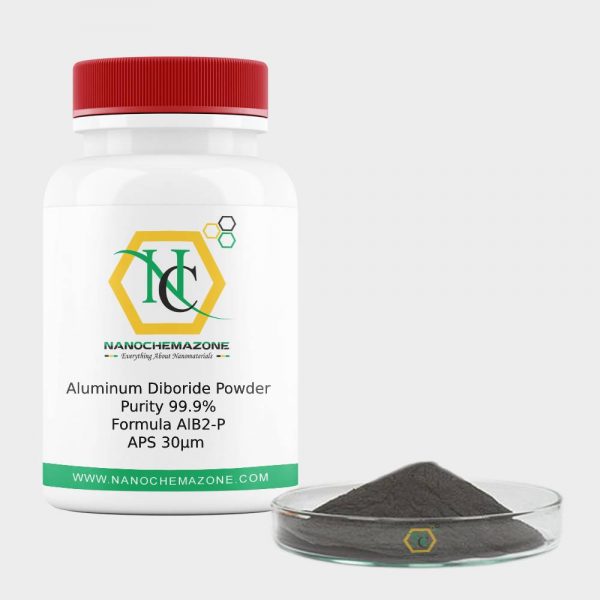
Aluminum Diboride Powder
Aluminum Diboride Powder
Product Name: Aluminum Diboride Powder
| MF: | AlB2-P |
| Chemical Name | Aluminum Diboride |
| Color | Gray Black |
| EINECS | 234-923-7 |
| Purity: | 99.9% |
| Particle size | 30 µm (Customizable) |
| Product Number: | NCZ-SC-113/20 |
| Cas Number: | 12041-50-8 |
Aluminum Diboride Powder RELATED INFORMATION
Aluminum boride is an ionic compound, with a hexagonal crystal structure. Aluminum boride at an absolute temperature slightly 40K (equivalent to -233 ℃) will be transformed into a superconductor. And its actual operating temperature is 20 ~ 30K. To reach this temperature, we can use liquid neon, liquid hydrogen, or closed-cycle refrigerator to finish cooling. Compared to the current industry using liquid helium to cool the niobium alloy (4K), these methods are simpler and more economical. Once it is doped with carbon or other impurities, magnesium diboride in a magnetic field, or there is a current passing, the ability to maintain the superconducting is as much as niobium alloys, or even better.
Please email us for the customization.
Email: contact@nanochemazone.com
Please contact us for customization and price inquiry
Note: We supply different size ranges of nano and micron size powder as per the client’s requirements and also accept customization in various parameters.
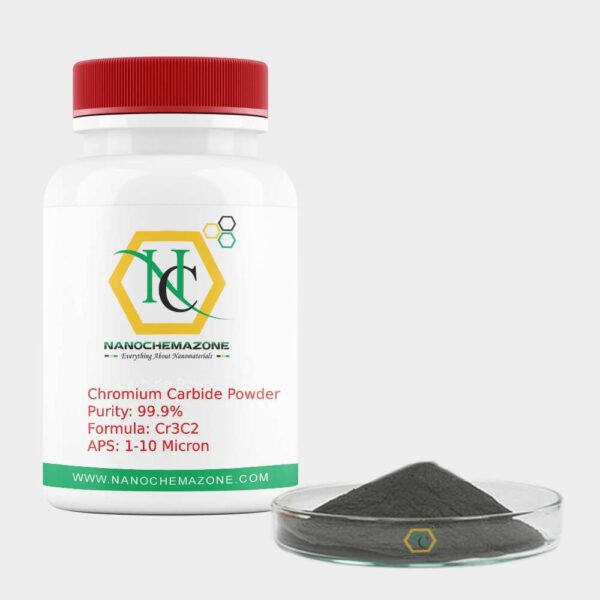
Chromium Carbide Cr3C2 Powder
Product Name: Chromium Carbide Cr3C2 Powder
| Product | Chromium Carbide |
| Colour | Gray Powder |
| Purity | ≥ 99.9% |
| Particle size | 1-10 µM (customizable) |
| Ingredient/MF | Cr3C2 |
| Product Code | NCZ-C-101/20 |
| CAS Number | 12012-35-0 |
Chromium Carbide Cr3C2 Powder APPLICATION FIELDS
Chromium Carbide Cr3C2 Powder is a ceramic compound that exists in several different chemical compositions: Cr3C2, Cr7C3, and Cr23C6. At standard conditions, it exists as a gray solid.
It is extremely hard and corrosion-resistant.
It is also a refractory compound, which means that it retains its strength at high temperatures as well.
These properties make use as an additive to metal alloys. When chromium carbide crystals are integrated into the surface of a metal it improves the wear resistance and corrosion resistance of the metal and maintains these properties at elevated temperatures.
Cr3C2 powder is mixed with solid nickel-chromium. This mixture is then heated to very high temperatures and sprayed onto the object being coated where it forms a protective layer. This layer is essentially its own metal matrix composite, consisting of hard ceramic Cr3C2 particles embedded in a nickel-chromium matrix.
Cr3C2 prevents large grains from forming in the composite, which results in a fine-grained structure of superior toughness.
Chromium Carbide Cr3C2 Application:
- Used as high temperature resistant and wear-resistant surface materials
- Used for welding and flux-cored wire
- Chromium carbide is useful in the surface treatment of metal components.
- Chromium carbide is used to coat the surface of another metal in a technique known as thermal spraying.
- Chromium carbide is used as an additive in cutting tools in order to improve toughness by preventing the growth of large grains.
Chromium Carbide Cr3C2 Properties:
There are three different crystal structures for chromium carbide corresponding to the three different chemical compositions. Cr23C6 has a cubic crystal structure and a Vickers hardness of 976 kg/mm2. Cr7C3 has a hexagonal crystal structure and a microhardness of 1336 kg/mm2.
Cr3C2 is the most durable of the three compositions and has an orthorhombic crystal structure with a microhardness of 2280 kg/mm2. For this reason, Cr3C2 is the primary form of chromium carbide used in surface treatment.
Please email us for the customization.
Email: contact@nanochemazone.com
Please contact us for customization and price inquiry
Note: We supply different size ranges of Nano and micron as per the client’s requirements and also accept customization in various parameters.
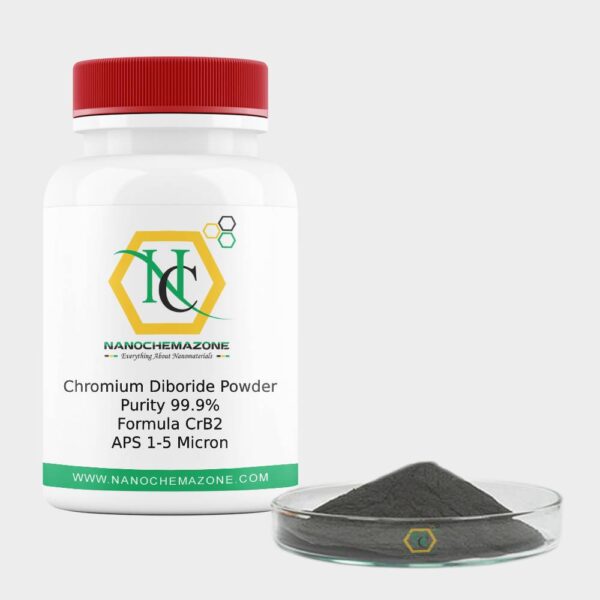
Chromium Diboride Powder
Chromium Diboride Powder
Product Name: Chromium Diboride Powder
| MF: | CrB2 |
| Chemical Name |
Chromium Diboride Powder |
| Appearance | silver, ceramic material |
| EINECS | 234-499-3 |
| Purity: | 99.9% |
| Density: | 5.20 g/cm3 |
| Product Number: | NCZ-NCD-117/20 |
| Cas Number: | 12007-16-8 |
RELATED INFORMATION
Please email us for the customization.
Email: contact@nanochemazone.com
Please contact us for customization and price inquiry
Note: We supply different size ranges of Nano and micron as per the client’s requirements and also accept customization in various parameters.
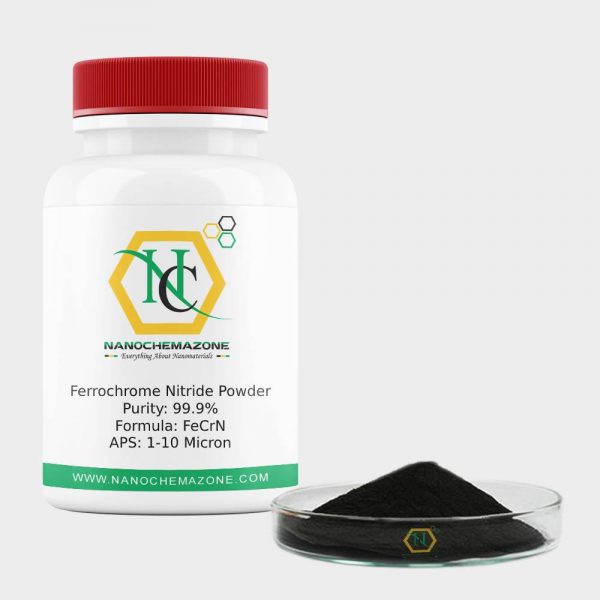
Ferrochrome Nitride Powder
Ferrochrome Nitride Powder
Product Name: Ferrochrome Nitride Powder
| Product | Ferrochrome Nitride Powder |
| Colour | Black Powder |
| Purity | ≥ 99.9% |
| Particle size | 1-10 µM (customizable) |
| Ingredient/MF | FeCrN |
| Product Code | NCZ-CN-151/20 |
| CAS Number | 7439-89-6, / 24094-93-7 |
Ferrochrome Nitride Powder Description:
Ferrochrome nitride is widely used in electric furnace and oxygen converter smelting nitrogen steel. Nitrogen is an element of austenite formation,
It is used as a component to add chromium manganese and chromium manganese nickel stainless steel to replace the shortage of nickel.
Ferrochrome Nitride Powder Application:
Ferrochrome, or ferrochromium (FeCr) is a type of ferroalloy, that is, an alloy of chromium and iron, generally containing 50 to 70% chromium by weight.
Ferrochrome is produced by electric arc carbothermic reduction of chromite. Most of the global output is produced in and India, which have large domestic chromite resources. Increasing amounts are coming from Russia and China.
Production of steel, especially that of stainless steel with a chromium content of 10 to 20%, is the largest consumer and the main application of ferrochrome.
Ferrochrome production is essentially a carbothermic reduction operation taking place at high temperatures. Chromium ore (an oxide of Cr and Fe) is reduced by coal and coke to form the iron-chromium alloy.
The heat for this reaction can come from several forms, but typically from the electric arc formed between the tips of electrodes at the bottom of the furnace and the furnace hearth.
This arc creates temperatures of about 2,800 °C (5,070 °F). In the process of smelting, huge amounts of electricity are consumed, making production very expensive in countries where power costs are high.
The tapping of the material from the furnace takes place intermittently. When enough smelted ferrochrome has accumulated in the furnace hearth.
The tap hole is drilled open and a stream of molten metal and slag rushes down a trough into a chill or ladle. Ferrochrome solidifies in large castings that are crushed for sale or further processed.
Ferrochrome is generally classified by the amount of carbon and chrome it contains.
The vast majority of FeCr produced is "charge chrome" from South Africa, with high carbon being the second largest segment followed by the smaller sectors of low carbon and intermediate carbon material.
Ferrochrome Nitride Powder Related Information
Please email us for the customization.
Email: contact@nanochemazone.com
Please contact us for customization and price inquiry
Note: We supply different size ranges of Nano and micron as per the client’s requirements and also accept customization in various parameters.
Ferrochrome Nitride Powder
Product Name: Ferrochrome Nitride Powder
| Product | Ferrochrome Nitride Powder |
| Colour | Black |
| Purity | ≥ 99.9% |
| Particle size | 1-10 µM (customizable) |
| Ingredient/MF | FeCrN |
| Product Code | NCZ-CN-151/20 |
| CAS Number | 7439-89-6, / 24094-93-7 |
Ferrochrome Nitride Powder Description:
Ferrochrome nitride is widely used in electric furnace and oxygen converter smelting nitrogen steel. Nitrogen is an element of austenite formation,
It is used as a component to add chromium manganese and chromium manganese nickel stainless steel to replace the shortage of nickel.
Ferrochrome Nitride Powder Application:
- Widely used in stainless steel, heat resistant steel, corrosion-resistant steel, alloy steel, and other special steel smelting production
- Used in steelmaking industrial, casting foundry
Please email us for the customization.
Email: contact@nanochemazone.com
Please contact us for customization and price inquiry
Note: We supply different size ranges of Nano and micron as per the client’s requirements and also accept customization in various parameters.
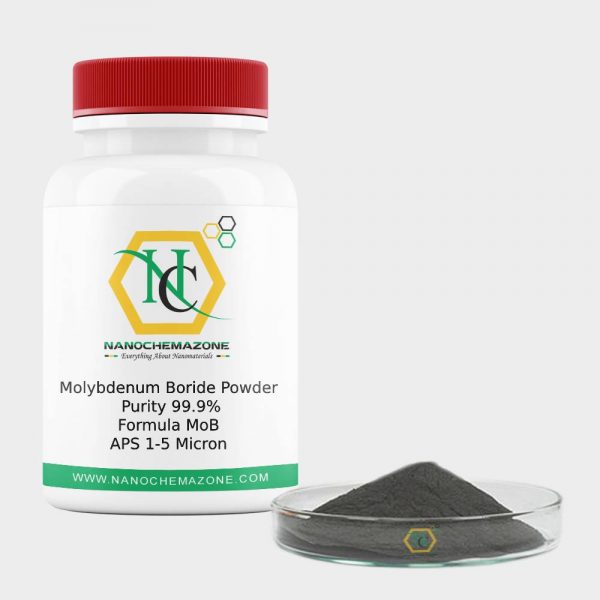
Molybdenum Boride Powder
Molybdenum Boride Powder
Product Name: Molybdenum Boride Powder
| MF: | Tr-MoB2 |
| Chemical Name | Molybdenum Boride Powder |
| Color | Yellow Gray |
| EINECS No.: | 234-502-8 |
| Purity: | 99.9% |
| Density: | 9.26 g/ cm3 |
| Product Number: | NCZ-NMB-112/20 |
| Cas Number: | 12006-99-4 |
Molybdenum Boride Powder
RELATED INFORMATION
It's mainly used as an additive of electronic tungsten, molybdenum alloy, etc., and can also be used in the manufacture of wear semiconductor thin film and coating materials.
Please email us for the customization.
Email: contact@nanochemazone.com
Please contact us for customization and price inquiry
Note: We supply different size ranges of Nano and micron as per the client’s requirements and also accept customization in various parameters.
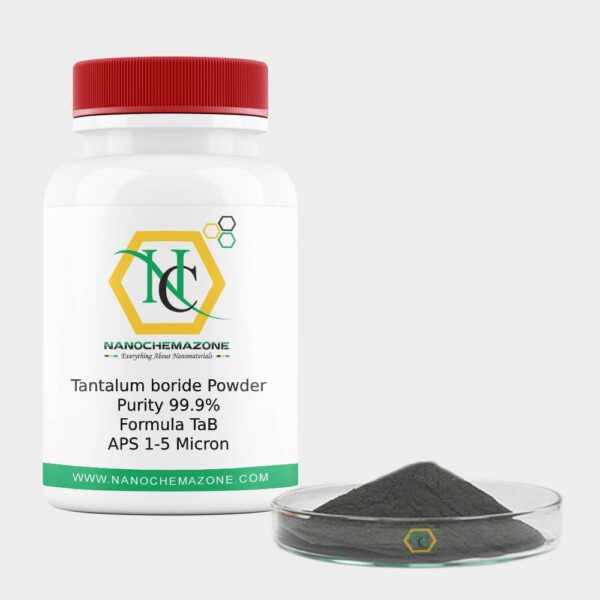
Tantalum boride Powder
Product Name: Tantalum boride Powder
| MF: | TaB |
| Chemical Name |
Tantalum boride Powder |
| Color | Gray |
| EINECS | 234-496-7 |
| Purity: | 99.9% |
| Molecular weight: | 191.76 |
| Product Number: | NCZ-SC-116/20 |
| Cas Number: | 12045-19-1 |
| Density: | 14.2 g/cm3 |
Tantalum boride Powder RELATED INFORMATION
Please email us for the customization.
Email: contact@nanochemazone.com
Please contact us for customization and price inquiry
Note: We supply different size ranges of Nano and micron as per the client’s requirements and also accept customization in various parameters.
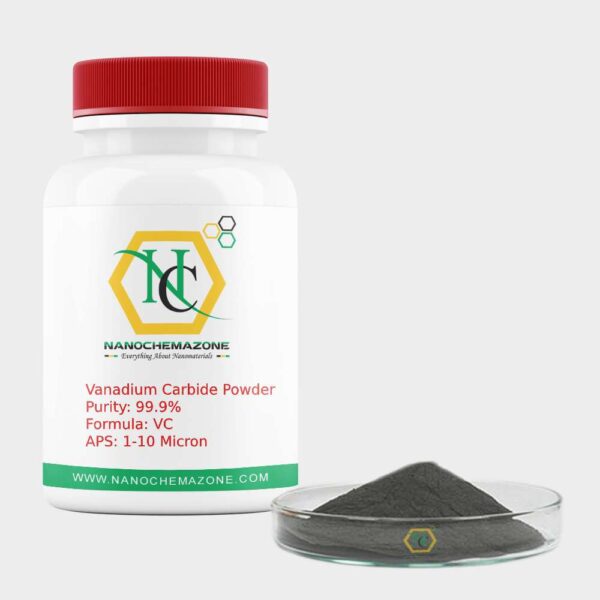
Vanadium Carbide Powder
Vanadium Carbide Powder
Product Name: Vanadium Carbide Powder
| Product | Vanadium Carbide Powder |
| Colour | Grey Powder |
| Purity | ≥ 99.9% |
| Particle size | 1-10 µM (customizable) |
| Ingredient/MF | VC |
| Product Code | NCZ-C-108/20 |
| CAS Number | 12070-10-9 |
Vanadium Carbide Description:
Vanadium carbide is the inorganic compound with the formula VC.
It is an extremely hard refractory ceramic material. With a hardness of 9-9.5 Mohs, it is possibly the hardest metal-carbide known.
It is of interest because it is prevalent in vanadium metal and alloys.
Vanadium carbide is Gray metallic powder with a cubic system structure of NaCl type, the crystalline constant is 4.182A.
The carbide is chemically stable and has excellent high-temperature property.
Application:
- Used in mechanical lapping
- Used as engineering ceramic materials
- Used for metallurgy refractory
- Used for temperature hot accidentally
- Used in faraday shield
- Applies in flinty domains and so on thin film, target material, welding material, hard alloy, cermet, aerospace
- May improve the hard alloy as the hard alloy and cermet’s chemical additive each performance.
- It can be used in cutting tool and steel industry,
- also can be used as an additive to fine the WC cemented carbide crystal to improve the property of alloy. 3. Used for erosion-resistant coatings; wear-resistance coatings; Corrosion-resistant coatings; Wear-resistant parts……
Vanadium Carbide Related Information
Please email us for the customization.
Email: contact@nanochemazone.com
Please contact us for customization and price inquiry
Note: We supply different size ranges of Nano and micron as per the client’s requirements and also accept customization in various parameters.
Reviews
There are no reviews yet.