

Zirconium Diboride Nano Powder
₹0.00
Zirconium Diboride Nano Powder
Product Name: Zirconium Diboride Nano Powder
| Product Name | Zirconium Diboride Nano Powder |
| Catalog No | NCZ-NSC309-/20 |
| CAS No. | 12045-64-6 |
| Purity | 99.9% |
| APS | 43nm, 750nm (Customizable) |
| Molecular Formula | ZrB2 |
| Molecular weight | 112.85 g/mol |
| Molecular weight | Powder |
| Appearance | Black Powder |
| Color | 6.09 g/cm3 |
| Density | 3,000 °C |
| Melting Point | 6000°C |
Zirconium Diboride Nano Powder Description
Zirconium diboride Nano Powder (ZrB2) is a highly covalent refractory ceramic material with a hexagonal crystal structure. ZrB2 is an ultra-high temperature ceramic with a melting point of 3246 °C. This along with its relatively low density of ~6.09 g/cm3 (measured density may be higher due to hafnium impurities) and good high-temperature strength makes it a candidate for high-temperature aerospace applications such as hypersonic flight or rocket propulsion systems.
It is an unusual ceramic, having relatively high thermal and electrical conductivities, properties it shares with isostructural titanium diboride and hafnium diboride. ZrB2 parts are usually hot pressed (pressure applied to the heated powder) and then machined to shape.
Sintering of ZrB2 is hindered by the material’s covalent nature and presence of surface oxides which increase grain coarsening before densification during sintering. Pressureless sintering of ZrB2 is possible with sintering additives such as boron carbide and carbon which react with the surface oxides to increase the driving force for sintering but mechanical properties are degraded compared to hot-pressed he extremely rapid heating rates can result in incomplete reactions between Zr and B, the formation of stable oxides of Zr, and the retention of porosity.
Stoichiometric reactions have also been carried out by reaction of attrition milled wearing materials by grinding Zr and B powder and then hot pressing at 600 °C for 6 h, and nanoscale particles have been obtained by reacting attrition milled Zr and B precursor crystallites 10 nm in size.
The reduction of ZrO2 and HfO2 to their respective diborides can also be achieved via metallothermic reduction. Inexpensive precursor materials are used and reacted according to the reaction.
Zirconium Diboride Nano Powder Related Information
Storage Conditions:
Airtight sealed, avoid light and keep dry at room temperature.
Please contact us for customization and price inquiry Email: contact@nanochemazone.com
Note: We supply different size ranges of Nano and micron as per the client’s requirements and also accept customization in various parameters.
Note: For pricing & ordering information, please contact us at sales@nanochemazone.com
Please contact us for quotes on Larger Quantities & Customization. E-mail: contact@nanochemazone.com
Customization:
You must be logged in to post a review.
Related products
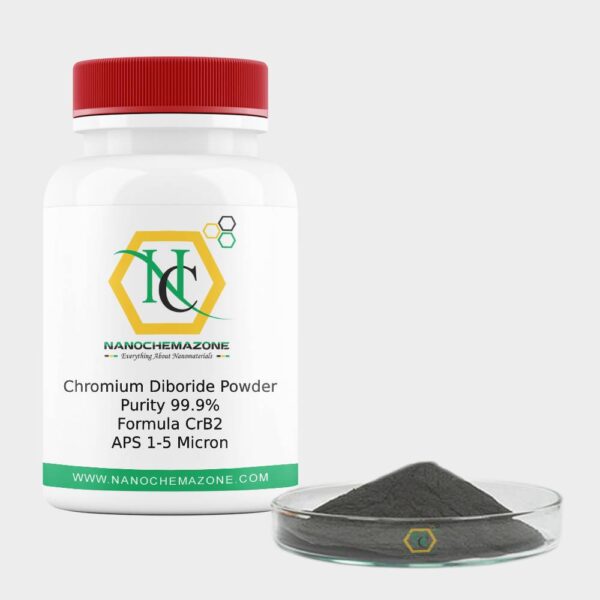
Chromium Diboride Powder
Chromium Diboride Powder
Product Name: Chromium Diboride Powder
| MF: | CrB2 |
| Chemical Name |
Chromium Diboride Powder |
| Appearance | silver, ceramic material |
| EINECS | 234-499-3 |
| Purity: | 99.9% |
| Density: | 5.20 g/cm3 |
| Product Number: | NCZ-NCD-117/20 |
| Cas Number: | 12007-16-8 |
RELATED INFORMATION
Please email us for the customization.
Email: contact@nanochemazone.com
Please contact us for customization and price inquiry
Note: We supply different size ranges of Nano and micron as per the client’s requirements and also accept customization in various parameters.
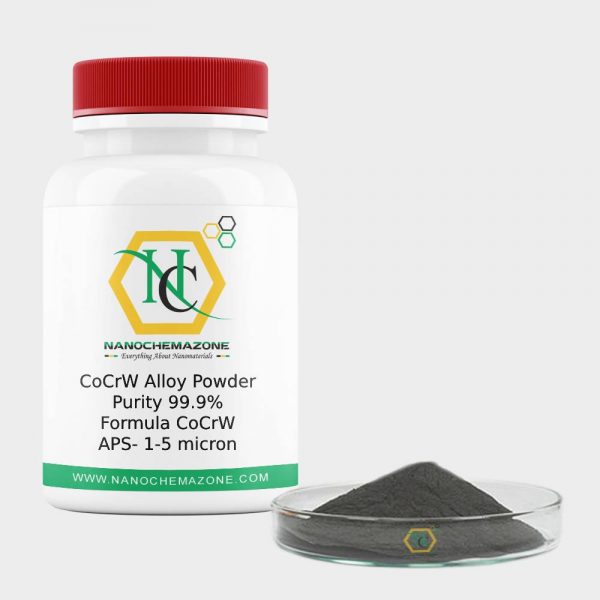
CoCrW Alloy Powder
Product Name: CoCrW Alloy Powder
| Product |
CoCrW Alloy Powder |
| CAS No. | 7440-50-8/7440-47-3 |
| Appearance | Grey |
| Purity | 99.9% |
| APS | 1 – 5 Microns (Can be customized) |
| Ingredient | CoCrW |
| Product Code | NCZ-NSC-164/20 |
Description:
| 3D printing metal Powder
Powder metallurgy(PM), injection molding(MIM), spray painting(SP) etc. |
RELATED INFORMATION
Storage Conditions:
Airtight sealed, avoid light, and keep dry at room temperature.
Please email us for the customization.
Email: contact@nanochemazone.com
Note: We supply different size ranges of Nano and micron as per the client’s requirements and also accept customization in various parameters.
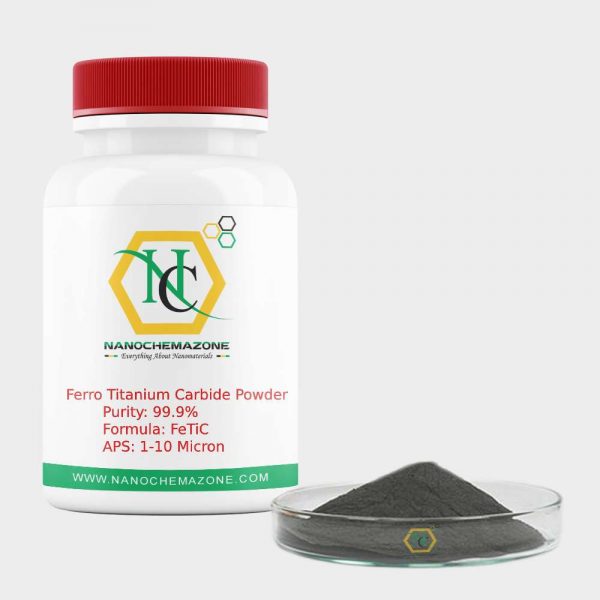
Ferro Titanium Carbide Powder
Product Name: Ferro Titanium Carbide Powder
| Product | Ferro Titanium Carbide Powder |
| Colour | Gray Powder |
| Purity | ≥ 99.9% |
| Particle size | 1-10 µM (customizable) |
| Ingredient/MF | FeTiC |
| Product Code | NCZ-C-102/20 |
| CAS Number | 12604-56-7 |
Ferro Titanium Carbide Powder Applications Fields:
Ferro Titanium Carbide Powder is a ferroalloy, an alloy of iron and titanium with between 10–20% iron and 45–75% titanium and sometimes a small amount of carbon. Ferrotitanium can be manufactured by mixing titanium sponge and scrap with iron and melting them together in an induction furnace.
During steelmaking, titanium is usually introduced as ferrotitanium because of its relatively low melting temperature and high density.
Ferrotitanium is usually produced by induction melting of titanium scrap with iron or steel; however, it also is produced directly from titanium mineral concentrates.
Application of Ferro Titanium carbide powder:
In the present study, Fe-based hardfacing coating reinforced by TiC particles was obtained by manual shielded metal arc welding (SMAW) in which H08A bare electrode was coated with fluxes, to which different measures of ferrotitanium, rutile, graphite, calcium carbonate, and calcium fluoride had been added.
The microstructure and wear properties of the hardfacing coating were studied through scanning electron microscopy (SEM), transmission electron microscopy (TEM), an X-ray diffractometer (XRD), and a wear test.
The results indicate that TiC particles are produced by a direct metallurgical reaction between ferrotitanium and graphite during welding.
TiC particles are uniformly dispersed in the matrix of lath martensite and retained austenite with particle sizes in the range of 3–5 μm. Fe-based hardfacing coating reinforced by TiC particles is found to possess better wear resistance and a lower coefficient of friction than that of the AISI 1045 steel substrate.
Please email us for the customization.
Email: contact@nanochemazone.com
Please contact us for customization and price inquiry
Note: We supply different size ranges of Nano and micron as per the client’s requirements and also accept customization in various parameters.
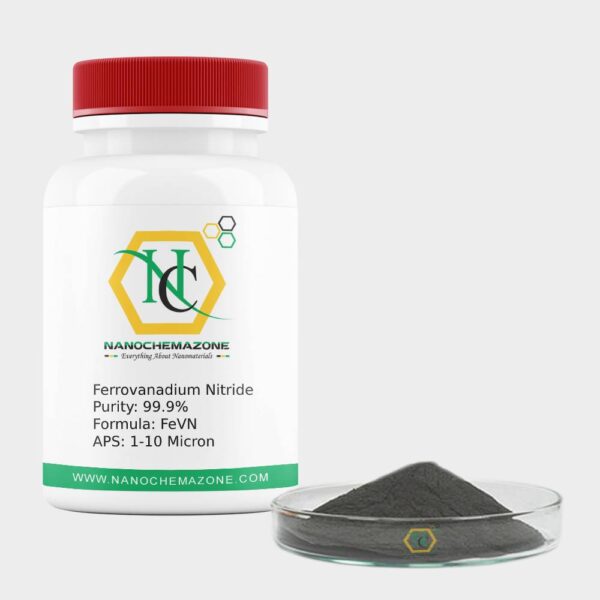
Ferrovanadium Nitride Powder
Product Name: Ferrovanadium Nitride Powder
| Product | Ferrovanadium Nitride Powder |
| Colour | Greyish silver |
| Purity | ≥ 99.9% |
| Particle size | 1-10 µM (customizable) |
| Ingredient/MF | FeVN |
| Product Code | NCZ-CN-149/20 |
| CAS Number | 7439-89-6 / 24646-85-3 |
Ferrovanadium Nitride Powder Description:
Ferrovanadium Nitride (Vanadium-Nitrogen alloy) is a composition ferrovanadium nitride.
Ferrovanadium nitride is proposed for joint nitrogen and vanadium steel doping.
Ferrovanadium Nitride (Vanadium-Nitrogen Alloy) is a new type of alloy additive,
It can substitute Ferro Vanadium used in the production of Micro alloying-steel.
Ferrovanadium Nitride Powder Application:
- FeVN alloy powder can be used for structural steel, tool steel, pipeline steel, steel, and cast iron.
- It is used for nitrogen-containing steel melting: high- strength low-alloy steel (HSLA), rail steel, quick cutting steel, etc.
- Ferrovanadium Nitride adding to the steel can increase the strength, tough, tactility, anti-thermal fatigue, etc.
- It also can make the steel be able to fulfill solderability to attain the same strength, adding Ferrovanadium Nitride could save 30-40% of Vanadium, thereby saving the cost.
Ferrovanadium Nitride Powder Advantages:
- Low melting point, high-density products, under the condition of the same production, vanadium and nitrogen yield is higher than similar products.
- Low nitrogen vanadium than more reasonable, high strengthening ability.
- Stable high product purity, ingredients, production has smaller fluctuation, the mechanical performance of steel performance has higher reliability.
Please email us for the customization.
Email: contact@nanochemazone.com
Please contact us for customization and price inquiry
Note: We supply different size ranges of Nano and micron as per the client’s requirements and also accept customization in various parameters.
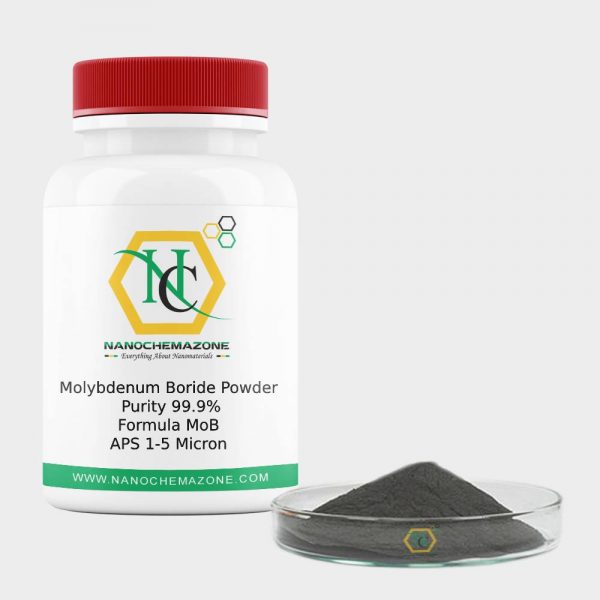
Molybdenum Boride Powder
Molybdenum Boride Powder
Product Name: Molybdenum Boride Powder
| MF: | Tr-MoB2 |
| Chemical Name | Molybdenum Boride Powder |
| Color | Yellow Gray |
| EINECS No.: | 234-502-8 |
| Purity: | 99.9% |
| Density: | 9.26 g/ cm3 |
| Product Number: | NCZ-NMB-112/20 |
| Cas Number: | 12006-99-4 |
Molybdenum Boride Powder
RELATED INFORMATION
It's mainly used as an additive of electronic tungsten, molybdenum alloy, etc., and can also be used in the manufacture of wear semiconductor thin film and coating materials.
Please email us for the customization.
Email: contact@nanochemazone.com
Please contact us for customization and price inquiry
Note: We supply different size ranges of Nano and micron as per the client’s requirements and also accept customization in various parameters.
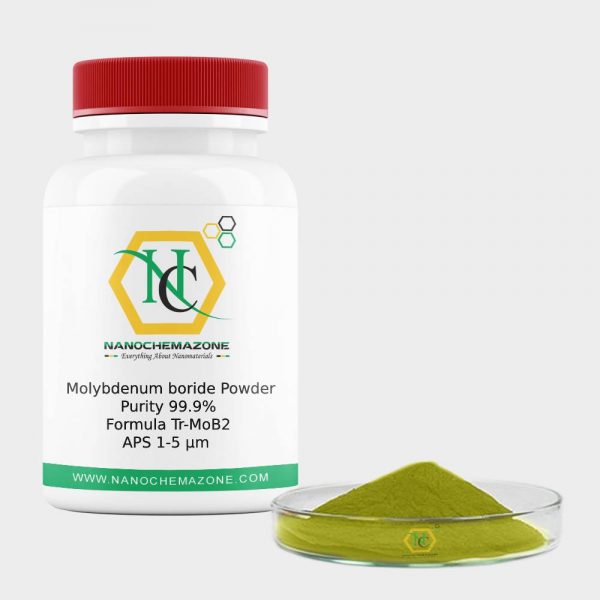
Molybdenum Boride Powder
Molybdenum Boride Powder
Product Name: Molybdenum Boride Powder
| MF: | Tr-MoB2 |
| Chemical Name | Boride Powder |
| Color | Yellow Gray |
| EINECS No.: | 234-502-8 |
| Purity: | 99.9% |
| Density: | 9.26 g/ cm3 |
| Product Number: | NCZ-NMB-112/20 |
| Cas Number: | 12006-99-4 |
RELATED INFORMATION
It's mainly used as an additive of electronic tungsten, molybdenum alloy, etc., and can also be used in the manufacture of wear semiconductor thin film and coating materials.
Please email us for the customization.
Email: contact@nanochemazone.com
Please contact us for customization and price inquiry
Note: We supply different size ranges of Nano and micron as per the client’s requirements and also accept customization in various parameters.
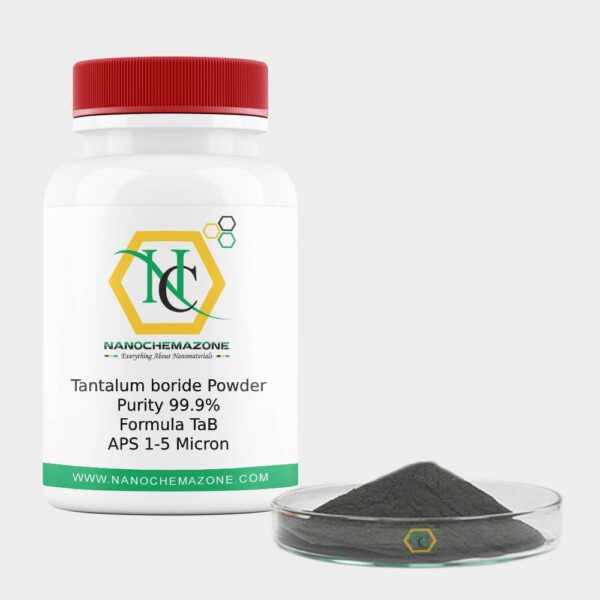
Tantalum boride Powder
Product Name: Tantalum boride Powder
| MF: | TaB |
| Chemical Name |
Tantalum boride Powder |
| Color | Gray |
| EINECS | 234-496-7 |
| Purity: | 99.9% |
| Molecular weight: | 191.76 |
| Product Number: | NCZ-SC-116/20 |
| Cas Number: | 12045-19-1 |
| Density: | 14.2 g/cm3 |
Tantalum boride Powder RELATED INFORMATION
Please email us for the customization.
Email: contact@nanochemazone.com
Please contact us for customization and price inquiry
Note: We supply different size ranges of Nano and micron as per the client’s requirements and also accept customization in various parameters.
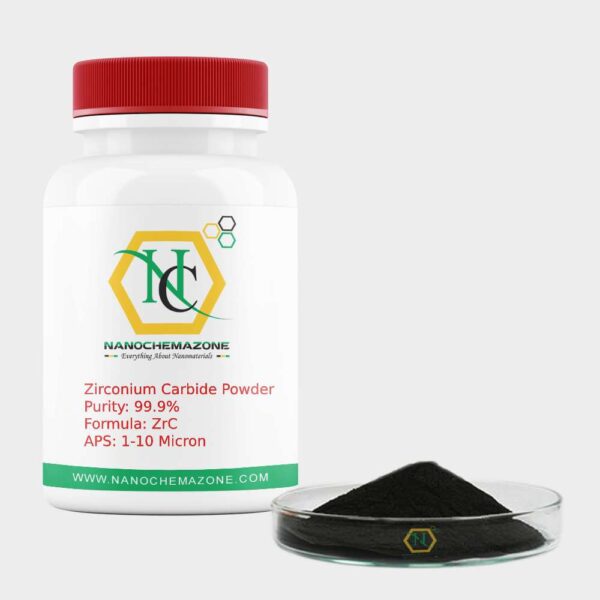
Zirconium Carbide Powder
Zirconium Carbide Powder
Product Name: Zirconium Carbide Powder
| Product | Zirconium Carbide Powder |
| Colour | Black |
| Purity | ≥ 99.9% |
| Particle size | 1-10 µM (customizable) |
| Ingredient/MF | ZrC |
| Product Code | NCZ-C-110/20 |
| CAS Number | 12070-14-3 |
Zirconium Carbide Powder Description:
Like most carbides of refractory metals, zirconium carbide is sub-stoichiometric, i.e., it contains carbon vacancies.
At carbon contents higher than approximately ZrC0.98 the material contains free carbon.
ZrC reacts with water and acids and is pyrophoric.
It becomes readily oxidized in the air when exposed to elevated temperatures.
It shows a high amount of corrosion resistance property and contains carbon vacancies.
It reacts with water as well as acids.
Application:
1.Used as an abrasive, in metal cladding, in cermet, incandescent filaments, and cutting tools.
2. The mixture of zirconium carbide and tantalum carbide is an important cermet material.
3. Hafnium-free zirconium carbide and niobium carbide can be used as refractory coatings in nuclear reactors.
4. Zirconium carbide is used extensively as a coating of uranium dioxide and thorium dioxide particles of nuclear fuel.
5. The coating is usually deposited by thermal chemical vapor deposition in a fluidized bed reactor.
6. High-temperature wear-resistant surface materials
Please email us for the customization.
Email: contact@nanochemazone.com
Please contact us for customization and price inquiry
Note: We supply different size ranges of Nano and micron as per the client’s requirements and also accept customization in various parameters.
Reviews
There are no reviews yet.