

Zirconium Diboride Nano Powder
₹0.00
Zirconium Diboride Nano Powder
Product Name: Zirconium Diboride Nano Powder
| Product Name | Zirconium Diboride Nano Powder |
| Catalog No | NCZ-NSC309-/20 |
| CAS No. | 12045-64-6 |
| Purity | 99.9% |
| APS | 43nm, 750nm (Customizable) |
| Molecular Formula | ZrB2 |
| Molecular weight | 112.85 g/mol |
| Molecular weight | Powder |
| Appearance | Black Powder |
| Color | 6.09 g/cm3 |
| Density | 3,000 °C |
| Melting Point | 6000°C |
Zirconium Diboride Nano Powder Description
Zirconium diboride Nano Powder (ZrB2) is a highly covalent refractory ceramic material with a hexagonal crystal structure. ZrB2 is an ultra-high temperature ceramic with a melting point of 3246 °C. This along with its relatively low density of ~6.09 g/cm3 (measured density may be higher due to hafnium impurities) and good high-temperature strength makes it a candidate for high-temperature aerospace applications such as hypersonic flight or rocket propulsion systems.
It is an unusual ceramic, having relatively high thermal and electrical conductivities, properties it shares with isostructural titanium diboride and hafnium diboride. ZrB2 parts are usually hot pressed (pressure applied to the heated powder) and then machined to shape.
Sintering of ZrB2 is hindered by the material’s covalent nature and presence of surface oxides which increase grain coarsening before densification during sintering. Pressureless sintering of ZrB2 is possible with sintering additives such as boron carbide and carbon which react with the surface oxides to increase the driving force for sintering but mechanical properties are degraded compared to hot-pressed he extremely rapid heating rates can result in incomplete reactions between Zr and B, the formation of stable oxides of Zr, and the retention of porosity.
Stoichiometric reactions have also been carried out by reaction of attrition milled wearing materials by grinding Zr and B powder and then hot pressing at 600 °C for 6 h, and nanoscale particles have been obtained by reacting attrition milled Zr and B precursor crystallites 10 nm in size.
The reduction of ZrO2 and HfO2 to their respective diborides can also be achieved via metallothermic reduction. Inexpensive precursor materials are used and reacted according to the reaction.
Zirconium Diboride Nano Powder Related Information
Storage Conditions:
Airtight sealed, avoid light and keep dry at room temperature.
Please contact us for customization and price inquiry Email: contact@nanochemazone.com
Note: We supply different size ranges of Nano and micron as per the client’s requirements and also accept customization in various parameters.
Note: For pricing & ordering information, please contact us at sales@nanochemazone.com
Please contact us for quotes on Larger Quantities & Customization. E-mail: contact@nanochemazone.com
Customization:
You must be logged in to post a review.
Related products
Chromium Diboride Powder
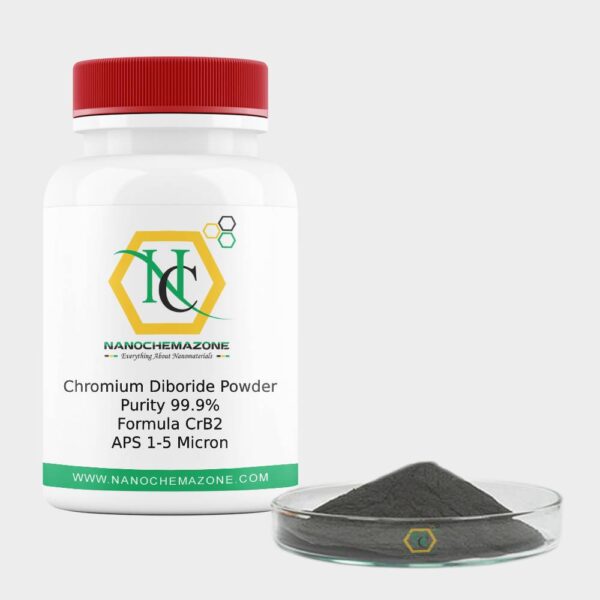
Chromium Diboride Powder
Product Name: Chromium Diboride Powder
| MF: | CrB2 |
| Chemical Name |
Chromium Diboride Powder |
| Appearance | silver, ceramic material |
| EINECS | 234-499-3 |
| Purity: | 99.9% |
| Density: | 5.20 g/cm3 |
| Product Number: | NCZ-NCD-117/20 |
| Cas Number: | 12007-16-8 |
RELATED INFORMATION
Please email us for the customization.
Email: contact@nanochemazone.com
Please contact us for customization and price inquiry
Note: We supply different size ranges of Nano and micron as per the client’s requirements and also accept customization in various parameters.
Ferrochrome Nitride Powder
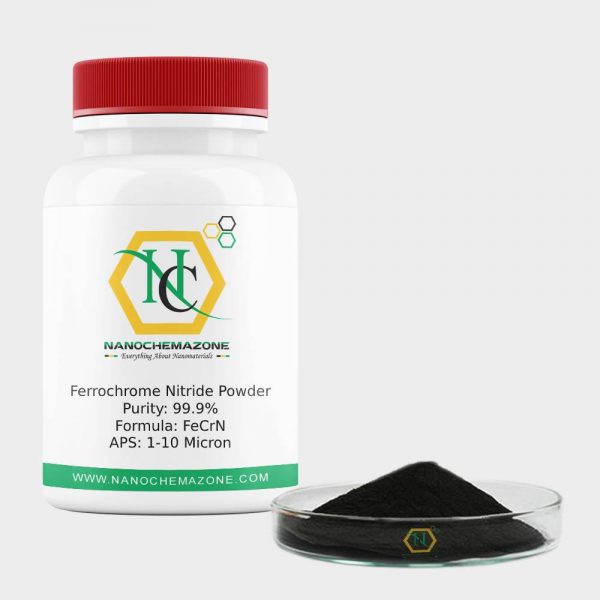
Product Name: Ferrochrome Nitride Powder
| Product | Ferrochrome Nitride Powder |
| Colour | Black |
| Purity | ≥ 99.9% |
| Particle size | 1-10 µM (customizable) |
| Ingredient/MF | FeCrN |
| Product Code | NCZ-CN-151/20 |
| CAS Number | 7439-89-6, / 24094-93-7 |
Ferrochrome Nitride Powder Description:
Ferrochrome nitride is widely used in electric furnace and oxygen converter smelting nitrogen steel. Nitrogen is an element of austenite formation,
It is used as a component to add chromium manganese and chromium manganese nickel stainless steel to replace the shortage of nickel.
Ferrochrome Nitride Powder Application:
- Widely used in stainless steel, heat resistant steel, corrosion-resistant steel, alloy steel, and other special steel smelting production
- Used in steelmaking industrial, casting foundry
Please email us for the customization.
Email: contact@nanochemazone.com
Please contact us for customization and price inquiry
Note: We supply different size ranges of Nano and micron as per the client’s requirements and also accept customization in various parameters.
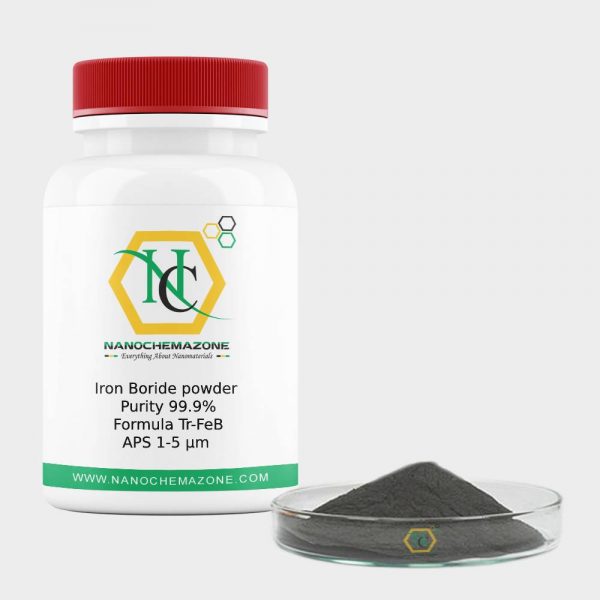
Iron Boride Powder
Product Name: Iron Boride Powder
| MF: | Tr-FeB |
| Chemical Name | Iron Boride Powder |
| Color | Grey Powder |
| EINECS Number: | 234-489-9 |
| Purity: | 99.9% |
| Density | ~7 g/cm3 |
| Product Number: | NCZ-NIB-112/20 |
| Cas Number: | 12006-84-8 |
Iron Boride Powder Description
Iron Boride Powder is often used to improve abrasion resistance, corrosion resistance, wear resistance, and oxidation resistance. It is used in oil and gas refinery, chemical extraction, automotive agricultural, stamping, textile extrusion, and injection molding industries. Iron-based coatings recently gained attention for their mechanical, frictional, and corrosion-resistant properties. As compared to the ceramic or cermet type of materials people have used before, iron-based materials are relatively inexpensive, less strategic, and can be produced economically by various thermal methods with ease of fabrication and machining.
Iron Boride Powder Related Information
Please email us for the customization.
Email: contact@nanochemazone.com
Please contact us for customization and price inquiry
Note: We supply different size ranges of Nano and micron as per the client’s requirements and also accept customization in various parameters.
Iron Boride Powder
Product Name: Iron Boride Powder
| MF: | Tr-FeB |
| Chemical Name | Iron Boride Powder |
| Color | Grey Powder |
| EINECS Number: | 234-489-9 |
| Purity: | 99.9% |
| Density | ~7 g/cm3 |
| Product Number: | NCZ-NIB-112/20 |
| Cas Number: | 12006-84-8 |
RELATED INFORMATION
Boriding is often used to improve abrasion resistance, corrosion resistance, wear resistance, and oxidation resistance. It is used in oil and gas refinery, chemical extraction, automotive agricultural, stamping, textile extrusion, and injection molding industries. Iron-based coatings recently gained attention for their mechanical, frictional, and corrosion-resistant properties. As compared to the ceramic or cermet type of materials people have used before, iron-based materials are relatively inexpensive, less strategic, and can be produced economically by various thermal methods with ease of fabrication and machining.
Please email us for the customization.
Email: contact@nanochemazone.com
Please contact us for customization and price inquiry
Note: We supply different size ranges of Nano and micron as per the client’s requirements and also accept customization in various parameters.
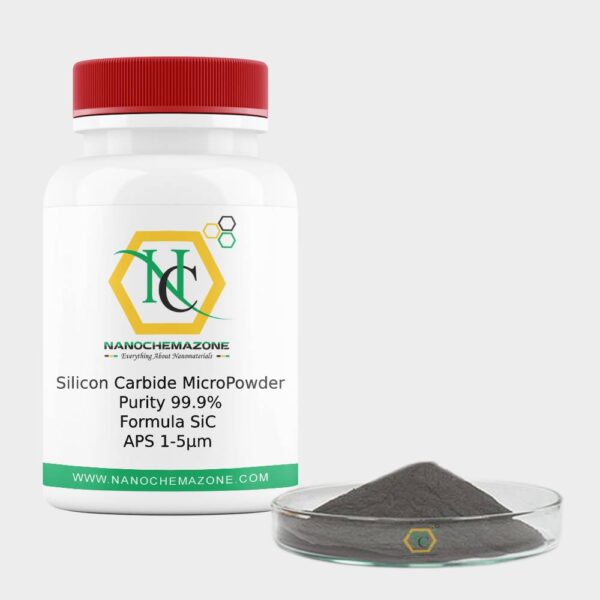
Silicon Carbide Powder
Product Name: Silicon Carbide Powder
| Product | Silicon Carbide Powder |
| Colour | Black Powder |
| Purity | ≥ 99.9% |
| Particle size | 1-10 µM (customizable) |
| Ingredient/MF | SiC |
| Product Code | NCZ-C-104/20 |
| CAS Number | 409-21-2 |
Silicon Carbide Powder Description:
Silicon carbide is produced in the same way as Black silicon Carbide except for some differences in the raw material. Its crystallization has higher purity and hardness. Green silicon carbide is suitable for processing hard alloy, metallic and non-metallic materials with hard and brittle features such as copper, brass, Aluminum, magnesium, jewel, optical glass, ceramics, etc.
Silicon Carbide Applications:
- One of the best properties of silicon carbide is that it is resistant to alkali and acids.
- It retains strength when applied at high temperatures.
- It shows good electrical conductivity and shock resistance capacity and for this reason, it is preferred for applying in an electric furnace to heat elements.
- It is compatible to apply under extreme conditions of applications.
- Apart from that, this chemical component also shows considerable thermal expansion and conductivity.
- It is an ideal component for applications requiring good flexural strength.
- We provide this product after evaluating the properties, ingredients, and applicability to cover a wide range of industrial usages.
Advantages:
- Large melting furnace, longer melting time, lead to more crystallization, bigger crystals, higher purity, and fewer impurities.
- Beckman coulter particle size distribution instrument.
- The laboratory is registered at the government Import and Export Inspection Bureau.
Silicon Carbide Powder Related Information
Please email us for the customization.
Email: contact@nanochemazone.com
Please contact us for customization and price inquiry
Note: We supply different size ranges of Nano and micron as per the client’s requirements and also accept customization in various parameters.
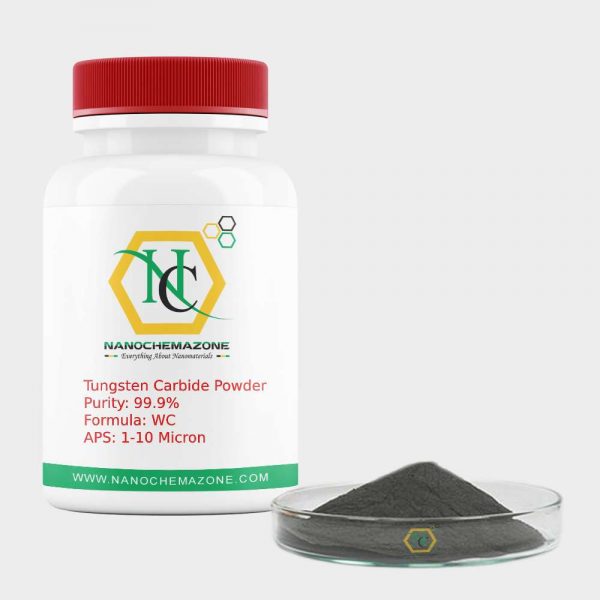
Tungsten Carbide Powder
Tungsten Carbide Powder
Product Name: Tungsten Carbide Powder
| Product | Tungsten Carbide Powder |
| Colour | Grey |
| Purity | ≥ 99.9% |
| Particle size | 1-10 µM (customizable) |
| Ingredient/MF | WC |
| Product Code | NCZ-C-109/20 |
| CAS Number | 12070-12-1 |
Brief Description of WC Tungsten Carbide Powder
Tungsten carbide powder (chemical formula: WC ) is a chemical compound (specifically, a carbide ) containing equal parts of tungsten and carbon atoms.
In its most basic form, tungsten carbide is a fine Gray powder, but it can be pressed and formed into shapes for use in industrial machinery, cutting tools, abrasives, armor-piercing rounds, other tools and instruments, and jewelry.
Physical Properties of WC Tungsten Carbide Powder
Tungsten carbide has a high melting point at 2,870 °C (5,200 °F), a boiling point of 6,000 °C (10,830 °F) when under a pressure equivalent to 1 standard atmosphere (100 kPa), the thermal conductivity of 110 W·m−1·K−1, and a coefficient of thermal expansion of 5.5 µm·m−1·K−1.
Tungsten carbide is extremely hard, ranking about 9 on Mohs scale, and with a Vickers number of around 2600.
It has Young’s modulus of approximately 530–700 GPa, a bulk modulus of 630–655 GPa, and a shear modulus of 274 GPa.
It has an ultimate tensile strength of 344 MPa, the ultimate compression strength of about 2.7 GPa and a Poisson’s ratio of 0.31.
Chemical Properties of WC Tungsten Carbide Powder
There are two well-characterized compounds of tungsten and carbon, WC and tungsten semi abide, W2C.
Both compounds may be present in coatings and the proportions can depend on the coating method.
At high temperatures, WC decomposes to tungsten and carbon and this can occur during high-temperature thermal spray, e.g., in high-velocity oxygen fuel (HVOF) and high energy plasma (HEP) methods.
Application of WC Tungsten Carbide Powder
1 Used for Producing high capability nano-crystalline or superfine horniness alloy, hard-face abrasion-resistant spraying and petrochemical cracking catalyst;
- Used for chipless forming tools; Cutting tools; Mining tolls; Nano-composites (for enhanced hardness, strength, and wear resistance);
- Used for erosion-resistant coatings; wear-resistance coatings; Corrosion-resistant coatings; Wear-resistant parts
- To produce hard carbide.
Please email us for the customization.
Email: contact@nanochemazone.com
Please contact us for customization and price inquiry
Note: We supply different size ranges of Nano and micron as per the client’s requirements and also accept customization in various parameters.
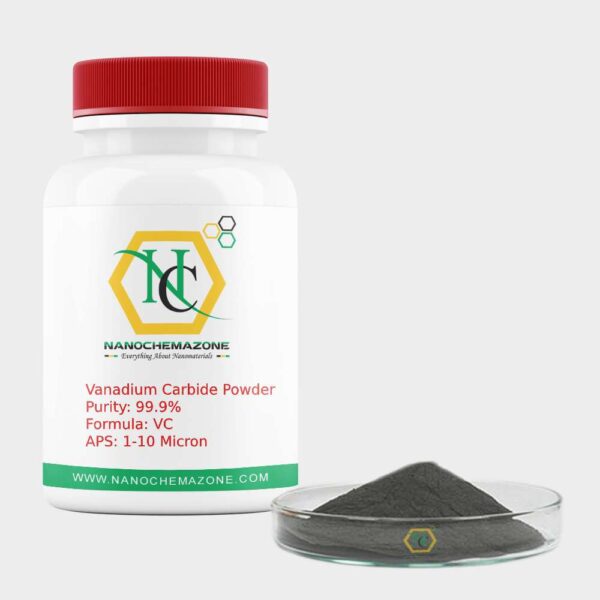
Vanadium Carbide Powder
Vanadium Carbide Powder
Product Name: Vanadium Carbide Powder
| Product | Vanadium Carbide Powder |
| Colour | Grey Powder |
| Purity | ≥ 99.9% |
| Particle size | 1-10 µM (customizable) |
| Ingredient/MF | VC |
| Product Code | NCZ-C-108/20 |
| CAS Number | 12070-10-9 |
Vanadium Carbide Description:
Vanadium carbide is the inorganic compound with the formula VC.
It is an extremely hard refractory ceramic material. With a hardness of 9-9.5 Mohs, it is possibly the hardest metal-carbide known.
It is of interest because it is prevalent in vanadium metal and alloys.
Vanadium carbide is Gray metallic powder with a cubic system structure of NaCl type, the crystalline constant is 4.182A.
The carbide is chemically stable and has excellent high-temperature property.
Application:
- Used in mechanical lapping
- Used as engineering ceramic materials
- Used for metallurgy refractory
- Used for temperature hot accidentally
- Used in faraday shield
- Applies in flinty domains and so on thin film, target material, welding material, hard alloy, cermet, aerospace
- May improve the hard alloy as the hard alloy and cermet’s chemical additive each performance.
- It can be used in cutting tool and steel industry,
- also can be used as an additive to fine the WC cemented carbide crystal to improve the property of alloy. 3. Used for erosion-resistant coatings; wear-resistance coatings; Corrosion-resistant coatings; Wear-resistant parts……
Vanadium Carbide Related Information
Please email us for the customization.
Email: contact@nanochemazone.com
Please contact us for customization and price inquiry
Note: We supply different size ranges of Nano and micron as per the client’s requirements and also accept customization in various parameters.
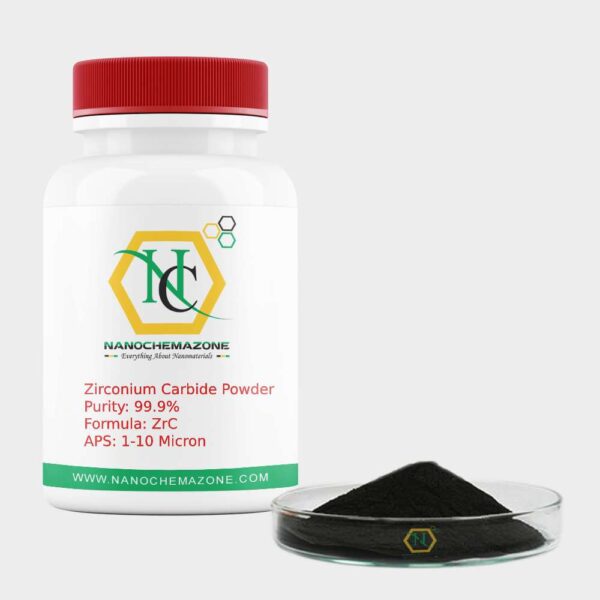
Zirconium Carbide Powder
Zirconium Carbide Powder
Product Name: Zirconium Carbide Powder
| Product | Zirconium Carbide Powder |
| Colour | Black |
| Purity | ≥ 99.9% |
| Particle size | 1-10 µM (customizable) |
| Ingredient/MF | ZrC |
| Product Code | NCZ-C-110/20 |
| CAS Number | 12070-14-3 |
Zirconium Carbide Powder Description:
Like most carbides of refractory metals, zirconium carbide is sub-stoichiometric, i.e., it contains carbon vacancies.
At carbon contents higher than approximately ZrC0.98 the material contains free carbon.
ZrC reacts with water and acids and is pyrophoric.
It becomes readily oxidized in the air when exposed to elevated temperatures.
It shows a high amount of corrosion resistance property and contains carbon vacancies.
It reacts with water as well as acids.
Application:
1.Used as an abrasive, in metal cladding, in cermet, incandescent filaments, and cutting tools.
2. The mixture of zirconium carbide and tantalum carbide is an important cermet material.
3. Hafnium-free zirconium carbide and niobium carbide can be used as refractory coatings in nuclear reactors.
4. Zirconium carbide is used extensively as a coating of uranium dioxide and thorium dioxide particles of nuclear fuel.
5. The coating is usually deposited by thermal chemical vapor deposition in a fluidized bed reactor.
6. High-temperature wear-resistant surface materials
Please email us for the customization.
Email: contact@nanochemazone.com
Please contact us for customization and price inquiry
Note: We supply different size ranges of Nano and micron as per the client’s requirements and also accept customization in various parameters.
Reviews
There are no reviews yet.