
Inorganic Metal Powders

Silicon Disulfide Powder
Silver Vanadium Oxide Powder
| Product |
Silver Vanadium Oxide |
| CAS No. | 12026-36-7 |
| Appearance | Yellow |
| Purity | 99% |
| APS | 1-5µM (Can be customized) |
| Ingredient | Ag2V4O11 |
| Product Code | NCZ-NSC527/20 |
| Molecular Weight | 595.50 g/mol |
| Density | 3.357 g/cm3 |
| Melting Point | 690 °C |
Silver Vanadium Oxide Description
Vanadium Oxide is a highly insoluble thermally stable Vanadium source suitable for glass, optic and ceramic applications. Vanadium oxide is a poisonous by yellow solid that is the most stable and abundant compound of vanadium. Oxide compounds are not conductive to electricity. However, certain perovskite structured oxides are electronically conductive finding application High Purity 99.9%.Vanadium Oxide (V2O3) Powder in the cathode of solid oxide fuel cells and oxygen generation systems.
They are compounds containing at least one oxygen anion and one metallic cation. They are typically insoluble in aqueous solutions (water) and extremely stable making them useful in ceramic structures as simple as producing clay bowls to advanced electronics and in light weight structural components in aerospace and electrochemical applications such as fuel cells in which they exhibit ionic conductivity. Metal oxide compounds are basic anhydrides and can therefore react with acids and with strong reducing agents in redox reactions.
Vanadium Oxide is also available in pellets, pieces, powder, sputtering targets, tablets, and nanopowder (from Nanochemazone nanoscale production facilities). Typical and custom packaging is available, as is additional research, technical and safety (MSDS) data. Please contact us above for information on specifications, lead time and pricing.
Silver Vanadium Oxide Related Information
Storage Conditions:
Airtight sealed, avoid light and keep dry at room temperature.
Please contact us for customization and price inquiry
Email: contact@nanochemazone.com
Note: We supply different size ranges of Nano and micron as per the client’s requirements and also accept customization in various parameters.
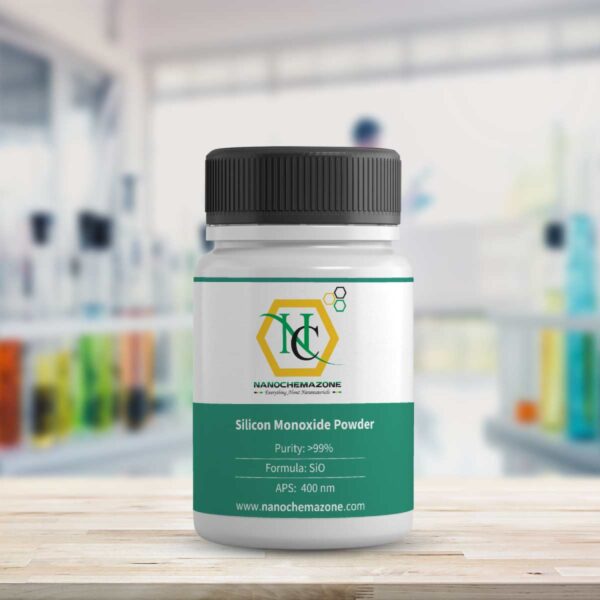
Silicon Monoxide Powder
Silicon Monoxide (SiO)
Product Name: Silicon Monoxide Powder
| Product Name | Silicon Monoxide |
| Cat No. | NCZ-MN-056/20 |
| CAS No. | 10097-28-6 |
| MF | SiO |
| Purity | >99% |
| APS | 400 nm (Customizable) |
| Appearance | Black Brown Powder |
| Molecular Weight | 44.08 |
| Melting Point | 1702°C |
| Boiling Point | 1880°C |
| Density | 2.13g/cm³ |
| Refractive index | 1.980 |
| Application | Plating of optical equipment such as lens |
| Crushing to submicron level below D50 | 500 nm is also available |
Silicon Monoxide Chemical component (standard value): ppm max
| Fe | <20 ppm |
| Al | <20 ppm |
| Cu | <10 ppm |
| Ti | <10 ppm |
| Ca | <10 ppm |
| Mn | <30 ppm |
Silicon Monoxide Application Fields:
Lithium-ion secondary battery anode material precursors to prepare silicon-based anode material Fine ceramic, synthetic raw materials; such as silicon nitride and silicon carbide Because silicon monoxide fine powder is very active, it can be used as fine ceramic, synthetic raw materials, such as silicon nitride and silicon carbide fine ceramic powder raw materials. Used for the preparation of optical glass and semiconductor materials.
Evaporate it in a vacuum and coat it on the metal mirror surface of the optical instrument as a protective film. Preparation of semiconductor materials.
The hunt is on advanced battery materials with enhanced storage capacity, higher energy density, and better cycle characteristics than traditional lithium-ion batteries. Conventional lithium-ion batteries rely on graphite-based anodes, whose well-established properties aren’t ideal for meeting the growing consumer demand for high-performance electronics, such as smartphones, laptops, and electric vehicles. Current research focuses on developing new alternatives that perform better and are safer than lithium-ion, and Nanochemazone is leading the way.
Silicon monoxide is a promising alternative to graphite because of its high specific gravity, low volume expansion, and small initial surface area. Silicon-based anodes can increase capacity ten times over standard graphite, allowing smaller batteries to produce the same amount of power or increasing the ability of a battery of the same size. This is possible because of the internal channels within the silicon monoxide Nanospheres. These channels allow lithium ions to flow rapidly for quick charging, and they shorten the paths for a boost in power.
Nanochemazone offers a 99.99% pure silicon monoxide powder prepared using chemical vapor deposition, suitable for secondary battery anode material precursors to prepare silicon-based anode materials and fine ceramic, synthetic raw materials. Our silicon monoxide battery material is prized by researchers and innovators around the world for its quality, purity, and consistency.
Silicon Monoxide SiO Related Information
Silicon Monoxide Powder Storage Conditions:
Airtight sealed, avoid light and keep dry at room temperature.
Please contact us for customization and price inquiry
Email: contact@nanochemazone.com
Note: We supply different size ranges of Nano and micron as per the client’s requirements and also accept customization in various parameters.
Silver Cadmium Oxide
Silver Cadmium Oxide
| Product |
Silver Cadmium Oxide |
| Colour | Metallic solid |
| Purity | 99% |
| Particle Size | 1-5µM(Customizable) |
| Ingredient/MF | AgCdO |
| Product Code | NCZ-CP-380/20 |
| CAS Number | N/A |
| Density | 9.95-10.15 g/cm3 |
| Melting point | N/A |
| Boiling Point | N/A |
| Molecular Weight | 411.46 |
| Exact Mass | 236.803 g/mol |
| Thermal Conductivity | 350-370 W/m•K |
| Tensile Strength | 250-310 MPa |
Silver Cadmium Oxide Description
Cadmium is a Block D, Group 12, Period 5 element with an atomic weight of 112.411. The number of electrons in each of Cadmium's shells is 2, 8, 18, 18, 2 and its electron configuration is [Kr] 4d10 5s2. The cadmium atom has a radius of 151 pm and a Van der Waals radius of 230 pm.Cadmium was discovered and first isolated by Karl Samuel Leberecht Hermann and Friedrich Stromeyer in 1817. In its elemental form, cadmium has a silvery bluish gray metallic appearance.
Cadmium makes up about 0.1 ppm of the earth's crust. No significant deposits of cadmium containing ores are known, however, it is sometimes found in its metallic form. It is a common impurity in zinc ores and is isolated during the production of zinc.
Cadmium is a key component in battery production and particular pigments and coatings due to its distinct yellow color. Cadmium oxide is used in phosphors for television picture tubes. The name Cadmium originates from the Latin word 'cadmia' and the Greek word 'kadmeia'.
Silver:
Silver is a Block D, Group 11, Period 5 element with an atomic weight of 107.8682. The number of electrons in each of Silver's shells is 2, 8, 18, 18, 1 and its electron configuration is [Kr]4d10 5s1.
The silver atom has a radius of 144 pm and a Van der Waals radius of 203 pm. Silver was first discovered by Early Man prior to 5000 BC. In its elemental form, silver has a brilliant white metallic luster.
It is a little harder than gold and is very ductile and malleable, being exceeded only by gold and perhaps palladium. Pure silver has the highest electrical and thermal conductivity of all metals and possesses the lowest contact resistance.
It is stable in pure air and water, but tarnishes when exposed to ozone, hydrogen sulfide, or air containing sulfur. It is found in copper, copper-nickel, lead, and lead-zinc ores, among others. Silver was named after the Anglo-Saxon word "seolfor" or "siolfur," meaning 'silver'.
Related Information
Please email us for the customization.
Email: contact@nanochemazone.com
Please contact us for customization and price inquiry
Note: We supply different size ranges of Nano and micron as per the client’s requirements and also accept customization in various parameters.

Silver Citrate Hydrate
Silver Citrate Hydrate
| Product |
Silver Citrate Hydrate |
| Colour | White to gray powder |
| Purity | 99% |
| Pack size | 100-325 Mesh (customizable) |
| Ingredient/MF | Ag3C6H5O7•xH2O |
| Melting point | 170 °C |
| Product Code | NCZ-CP-237/20 |
| CAS Number | 206986-90-5 |
Silver Citrate Hydrate Description
Silver Citrate Hydrate is generally immediately available in most volumes. High purity, submicron and nanopowder forms may be considered. Nanochemazone produces to many standard grades when applicable, including Mil Spec (military grade); ACS, Reagent and Technical Grade; Food, Agricultural and Pharmaceutical Grade; Optical Grade, USP and EP/BP (European Pharmacopoeia/British Pharmacopoeia) and follows applicable ASTM testing standards. Typical and custom packaging is available. Additional technical, research and safety (MSDS) information is available as is a Reference Calculator for converting relevant units of measurement.
Related Information
Please email us for the customization.
Email: contact@nanochemazone.com
Please contact us for customization and price inquiry
Note: We supply different size ranges of Nano and micron as per the client’s requirements and also accept customization in various parameters.

Silver Citrate Nanoparticles
Silver Citrate Nanoparticles
Product Name: Silver Citrate Nanoparticles (C6H5Ag3O7, Purity: >99.9%, APS: <100 nm)
| Product | Silver Citrate Nanoparticles |
| Cat No | NCZ-MN-103/20 |
| CAS No | 206986-90-5 |
| APS | < 100nm |
| Purity | >99.9% |
| Molecular Formula | C6H5Ag3O7 |
| Molecular Weight | 512.70g/mol |
| Form | Powder |
| Melting Point | 170 °C |
| Solubility | Insoluble in water |
Please email us for the customization.
Email: contact@nanochemazone.com
Please contact us for customization and price inquiry
Note: We supply different size ranges of Nano and micron as per the client’s requirements and also accept customization in various parameters.

Silver hexafluoroarsenate Powder
Silver hexafluoroarsenate Powder
| Product |
Silver hexafluoroarsenate Powder |
| Colour | White |
| Purity | 99% |
| Pack size | 100-325 Mesh (customizable) |
| Ingredient/MF | AgAsF6 |
| Product Code | NCZ-CP-220/20 |
| CAS Number | 13510-44-6 |
Silver hexafluoroarsenate Description
Silver Hexafluoroarsenate is generally immediately available in most volumes. High purity, submicron and nanopowder forms may be considered. Nanochemazone produces to many standard grades when applicable, including Mil Spec (military grade); ACS, Reagent and Technical Grade; Food, Agricultural and Pharmaceutical Grade; Optical Grade, USP and EP/BP (European Pharmacopoeia/British Pharmacopoeia) and follows applicable ASTM testing standards. Typical and custom packaging is available. Additional technical, research and safety (MSDS) information is available as is a Reference Calculator for converting relevant units of measurement.
Related Information
Please email us for the customization.
Email: contact@nanochemazone.com
Please contact us for customization and price inquiry
Note: We supply different size ranges of Nano and micron as per the client’s requirements and also accept customization in various parameters.

Silver Iodide Powder
Silver Iodide Powder
| Product |
Silver Iodide Powder |
| Colour | yellow, crystalline solid |
| Purity | 99% |
| Particle size | 100 Mesh (Customizable) |
| Ingredient/MF | AgI |
| Product Code | NCZ-CP-275/20 |
| Density | 5.675 g/cm3, solid |
| CAS No | 7783-96-2 |
| Melting point | 558 °C (1,036 °F; 831 K) |
| Boiling point | 1,506 °C (2,743 °F; 1,779 K) |
Silver Iodide Description
Silver iodide is an inorganic compound with the formula AgI. The compound is a bright yellow solid, but samples almost always contain impurities of metallic silver that give a gray coloration. Used in medicine for its caustic, astringent and antiseptic effects.
Used in photography, and in the estimation of silver. Through heterogeneous nucleation, it is used in cloud seeding, relying on its beta-AgI crystal structure being similar to that of Ice. Mercury Silver Iodide is generally immediately available in most volumes. High purity, submicron and nanopowder forms may be considered.
Iodide compounds are water soluble; however, iodide-rich solutions act as better dissolution agents for creating iodide solutions. Iodides are often used in internal medicine. Treating an iodide with manganese dioxide and sulfuric acid sublimes the iodine.
Nanochemazone produces to many standard grades when applicable, including Mil Spec (military grade); ACS, Reagent and Technical Grade; Food, Agricultural and Pharmaceutical Grade; Optical Grade, USP and EP/BP (European Pharmacopoeia/British Pharmacopoeia) and follows applicable ASTM testing standards. Typical and custom packaging is available. Additional technical, research and safety (MSDS) information is available as is a Reference Calculator for converting relevant units of measurement.
Related Information
Please email us for the customization.
Email: contact@nanochemazone.com
Please contact us for customization and price inquiry
Note: We supply different size ranges of Nano and micron as per the client’s requirements and also accept customization in various parameters.

Silver Molybdenum Oxide
Silver Molybdenum Oxide
Product |
Silver Molybdenum Oxide Powder |
| Colour | yellow crystals |
| Purity | 99% |
| Pack size | 100-325 Mesh (customizable) |
| Ingredient/MF | Ag2MoO4 |
| Density | 6.18 g/cm3 |
| Melting point | 483 °C (901 °F; 756 K) |
| Product Code | NCZ-CP-236/20 |
| CAS Number | 13765-74-7 |
Silver Molybdenum Oxide
Silver Molybdenum Oxide is generally immediately available in most volumes. High purity, submicron and nano powder forms may be considered. Nanochemazone produces to many standard grades when applicable, including Mil Spec (military grade); ACS, Reagent and Technical Grade; Food, Agricultural and Pharmaceutical Grade; Optical Grade, USP and EP/BP (European Pharmacopoeia/British Pharmacopoeia) and follows applicable ASTM testing standards. Typical and custom packaging is available. Additional technical, research and safety (MSDS) information is available as is a Reference Calculator for converting relevant units of measurement.
Related Information
Please email us for the customization.
Email: contact@nanochemazone.com
Please contact us for customization and price inquiry
Note: We supply different size ranges of Nano and micron as per the client’s requirements and also accept customization in various parameters.
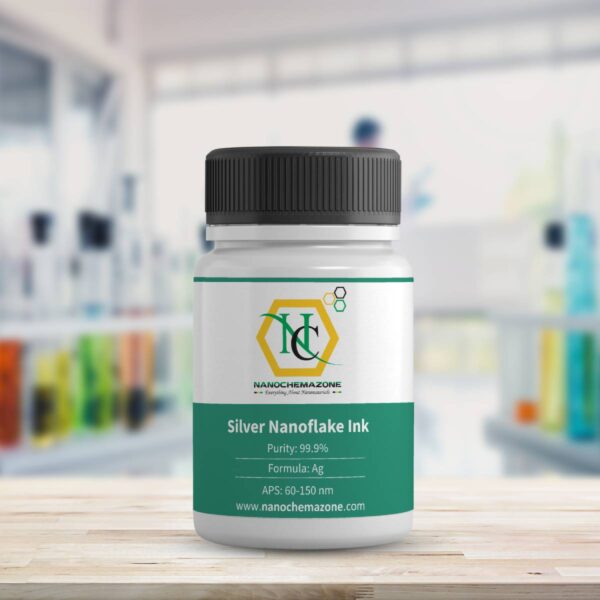
Silver Nanoflake Ink
Silver Nanoflake Ink
Product Name: Silver Nanoflake Ink (Ag, Purity: 99.9%, APS 60-150 nm)
| Product | Silver Nanoflake Ink |
| Cat No | NCZ-MN-108/20 |
| CAS No | 7440-22-4 |
| Purity | 99.9% |
| APS | 60-150 nm (Can be Customized) |
| Molecular Formula | Ag |
| Molecular Weight | 107.87 g/mol |
| Form | Liquid |
| Color | Silver |
| Density | 1.22 g/mL at 25 °C |
| Bulk Density | 0.312 g/cm3 |
| SSA | 5.37m2/g |
| Thermal Expansion | (25 °C) 18.9 µm•m-1•K-1 |
| Passion Ration | 0.37 |
| Vickers Hardnes | 251 MPa |
| Young’s Modulus | 83 GPa |
Please email us for the customization.
Email: contact@nanochemazone.com
Please contact us for customization and price inquiry
Note: We supply different size ranges of Nano and micron as per the client’s requirements and also accept customization in various parameters.

Silver Nanoparticle Ink
Silver Nanoparticle Ink
Product Name: Silver Nanoparticle Ink (Ag, 99.9%, APS: 30-100 nm)
| Product | Silver Nanoparticle Ink |
| Cat No | NCZ-MN-109/20 |
| CAS No | 7440-22-4 |
| Purity | 99.9% |
| APS | 30-100 nm (Can be Customized) |
| Molecular Formula | Ag |
| Molecular Weight | 107.87 g/mol |
| Form | Liquid |
| Color | Silver |
| Density | 1.22 g/mL at 25 °C |
| Bulk Density | 0.312 g/cm3 |
| Thermal Expansion | (25 °C) 18.9 µm•m-1•K-1 |
| Passion Ration | 0.37 |
| Vickers Hardness | 251 MPa |
| Young’s Modulus | 83 GPa |
Please email us for the customization.
Email: contact@nanochemazone.com
Please contact us for customization and price inquiry
Note: We supply different size ranges of Nano and micron as per the client’s requirements and also accept customization in various parameters.
Silver Perchlorate Monohydrate
Silver Perchlorate Monohydrate
| Product |
Silver Perchlorate Monohydrate |
| Colour | Colorless hygroscopic crystals |
| Purity | 99% |
| Pack size | 100 Mesh (customizable) |
| Density | 2.800g/cm3 |
| Melting Point | 485°C |
| Ingredient/MF | AgClO4•xH2O |
| Product Code | NCZ-CP-228/20 |
| CAS Number | 331717-44-3 |
Silver Perchlorate Monohydrate
Silver Perchlorate Hydrate is generally immediately available in most volumes. High purity, submicron and nanopowder forms may be considered. Chloride compounds can conduct electricity when fused or dissolved in water. Silver Perchlorate Monohydrate is generally immediately available in most volumes.
High purity, submicron and nano powder forms may be considered. Chloride compounds can conduct electricity when fused or dissolved in water. Chloride materials can be decomposed by electrolysis to chlorine gas and the metal. They are formed through various chlorination processes whereby at least one chlorine anion (Cl-) is covalently bonded to the relevant metal or cation. Ultra high purity and proprietary formulations can be prepared. The chloride ion controls fluid equilibrium and pH levels in metabolic systems. They can form either inorganic or organic compounds.
Nanochemazone produces to many standard grades when applicable, including Mil Spec (military grade); ACS, Reagent and Technical Grade; Food, Agricultural and Pharmaceutical Grade; Optical Grade, USP and EP/BP (European Pharmacopoeia/British Pharmacopoeia) and follows applicable ASTM testing standards. Typical and custom packaging is available. Additional technical, research and safety (MSDS) information is available as is a Reference Calculator for converting relevant units of measurement.
Related Information
Please email us for the customization.
Email: contact@nanochemazone.com
Please contact us for customization and price inquiry
Note: We supply different size ranges of Nano and micron as per the client’s requirements and also accept customization in various parameters.
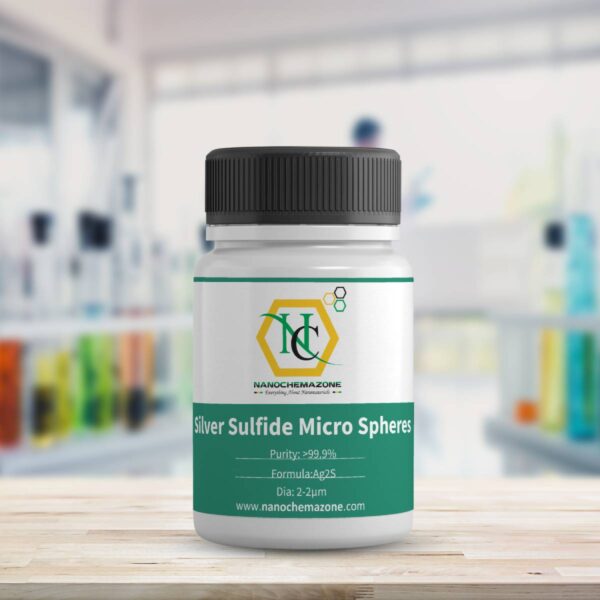
Silver Sulfide Micro Spheres
Silver Sulfide Micro Spheres
Product Name: Silver Sulfide Micro Spheres (Ag2S, Purity: 99.9%, Dia: 2-2µm)
| Product |
Silver Sulfide Micro Spheres |
| Cat No | NCZ-NSC881/20 |
| CAS No | 21548-73-2 |
| Purity | 99.9% |
| Molecular Formula | Ag2S |
| Molecular Weight | 247.80 g/mol |
| Form | Powder |
| Color | Black powder |
| Density | 9.7g/cm³ |
| Melting Point | 845°C |
Related Information
Storage Conditions:
Airtight sealed, avoid light and keep dry at room temperature.
Please contact us for customization and price inquiry
Email: contact@nanochemazone.com
Note: We supply different size ranges of Nano and micron as per the client’s requirements and also accept customization in various parameters.
Silver Tetrafluoroborate Powder
Silver Tetrafluoroborate Powder
Product |
Silver Tetrafluoroborate Powder |
| Colour | white |
| Purity | 99% |
| Pack size | 100 Mesh (customizable) |
| Ingredient/MF | AgBF4 |
| Melting point | 71.5 °C (160.7 °F; 344.6 K) |
| Product Code | NCZ-CP-239/20 |
| CAS Number | 14104-20-2 |
Silver Tetrafluoroborate Description
Silver tetrafluoroborate is an inorganic compound with the chemical formula AgBF4. It is a white solid that dissolves in polar organic solvents as well as water. In its solid state, the Ag+ centers are bound to fluoride. Silver tetrafluoroborate finds applications as a useful reagent in inorganic, organic and organomettalic chemistry. It acts as a moderately strong oxidant in dichloromethane, replaces halide anions and ligands with weakly coordinating tetrafluoroborate anions, and behaves as a catalyst for cyclization reactions. It is a potent promoter for chemical glycosylation
Related Information
Please email us for the customization.
Email: contact@nanochemazone.com
Please contact us for customization and price inquiry
Note: We supply different size ranges of Nano and micron as per the client’s requirements and also accept customization in various parameters.
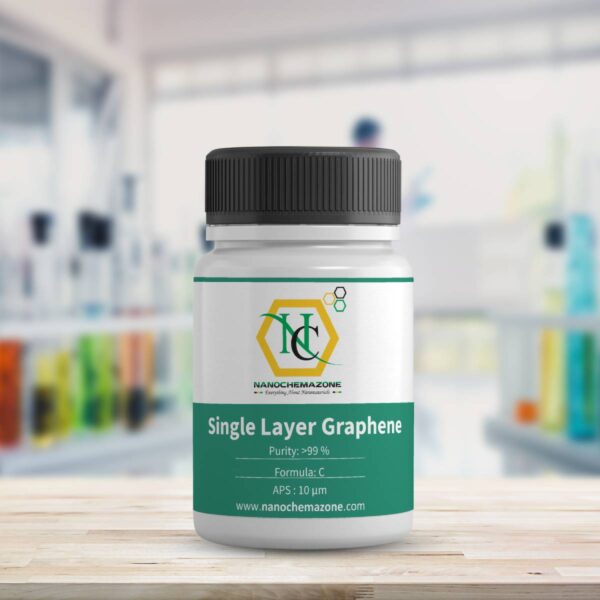
Single Layer Graphene
Single Layer Graphene
Product Name: Single Layer Graphene (C, Purity: >99%, Thickness: 1.6nm, Lateral Size: 10µm)
Product |
Single Layer Graphene |
| Cat No | NZC-NSC831/20 |
| CAS No | 1034343-98-0 |
| Purity | >99% |
| Lateral size | 10µm (Can be customized) |
| Thickness | 1.6nm ( < 3 Monolayers) |
| Molecular Formula | C |
| Molecular Weight | 12.01g/mol |
| Form | Flake |
| Color | Black |
| Melting Point | 3,452-3,697 °C |
| Boiling Point | 4830 °C |
| Solubility | Slightly soluble in water |
Related Information
Storage Conditions:
Airtight sealed, avoid light and keep dry at room temperature.
Please contact us for customization and price inquiry
Email: contact@nanochemazone.com
Note: We supply different size ranges of Nano and micron as per the client’s requirements and also accept customization in various parameters.
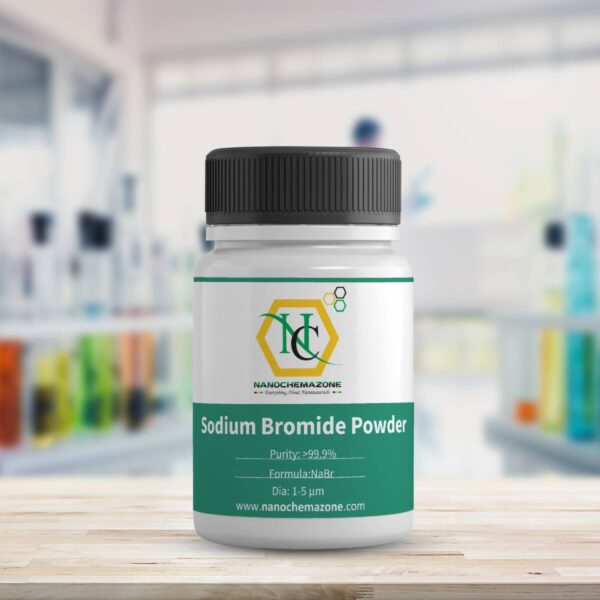
Sodium Bromide Powder
Sodium Bromide Powder
Product Name: Sodium Bromide Powder (NaBr, Purity: >99.9%)
| Product |
Sodium Bromide Powder |
| Cat No | NZC-NSC882/20 |
| CAS No | 7647-15-6 |
| Purity | >99.9% |
| Molecular Formula | NaBr |
| Molecular Weight | 102.89 g/mol |
| Color | White |
| Melting Point | 747 °C |
| Boiling Point | 1396 °C |
| Solubility | Soluble in alcohol, amine, water |
| APS | 1-5 µm (Can be customized) |
Related Information
Storage Conditions:
Airtight sealed, avoid light and keep dry at room temperature.
Please contact us for customization and price inquiry
Email: contact@nanochemazone.com
Note: We supply different size ranges of Nano and micron as per the client’s requirements and also accept customization in various parameters.
Sodium Lead Alloy Powder
Sodium Lead Alloy Powder
| Product |
Sodium Lead Alloy |
| CAS No. | 12740-44-2 |
| Appearance | Gray |
| Purity | 99% |
| APS | 1-5µM (Can be customized) |
| Ingredient | NaPb |
| Product Code | NCZ-NSC811/20 |
| Molecular Weight | 230.19 g/mol |
| Density | N/A |
| Melting Point | N/A |
Sodium Lead Alloy Description
Lead (atomic symbol: Pb, atomic number: 82) is a Block P, Group 14, Period 6 element with an atomic radius of 207.2. The number of electrons in each of Lead's shells is [2, 8, 18, 32, 18, 4] and its electron configuration is [Xe] 4f14 5d10 6s2 6p2. The lead atom has a radius of 175 pm and a Van der Waals radius of 202 pm. In its elemental form, lead has a metallic gray appearance.
Lead occurs naturally as a mixture of four stable isotopes: 204Pb (1.48%), 206Pb (23.6%), 207Pb (22.6%), and 208Pb (52.3%). Elemental Lead is obtained mainly from galena (PbS) by a roasting process. Anglesite, cerussite, and minim are other common lead containing minerals. Lead does occur as a free element in nature, but it is rare.
It is a dense, soft metal that is very resistant to corrosion and poorly conductive compared to other metals. Its density and low melting point make it useful in applications such as electrolysis and industrial materials.
Related Information
Storage Conditions:
Airtight sealed, avoid light and keep dry at room temperature.
Please contact us for customization and price inquiry
Email: contact@nanochemazone.com
Note: We supply different size ranges of Nano and micron as per the client’s requirements and also accept customization in various parameters.

Sodium Methylparaben
Sodium Methylparaben
Product Name: Sodium Methylparaben (C8H7NaO3, Purity: 99.9%, APS: 40-60 µm)
| Product | Sodium Methyl Paraben |
| Cat No | NCZ-CP-510/20 |
| CAS No | 5026-62-0 |
| APS | 40-60 µm (Can be Customized) |
| Purity | 99.9% |
| Molecular Formula | C8H7NaO3 |
| Molecular Weight | 174.13g/mol |
| Form | Powder |
| Color | White |
Please email us for the customization.
Email: contact@nanochemazone.com
Please contact us for customization and price inquiry
Note: We supply different size ranges of Nano and micron as per the client’s requirements and also accept customization in various parameters.
Sodium Nanoparticles
Sodium Nanoparticles
Product Name: Sodium Nanoparticles (Na, Purity: >99%, APS: 80-100nm)
| Product | Sodium Nanoparticles |
| Cat No | NCZ-MN-075/20 |
| CAS No | 7440-23-5 |
| Purity | >99% |
| APS | 80-100 nm (Can be Customized) |
| Molecular Formula | Na |
| Molecular Weight | 22.98g/mol |
| Form | Powder |
| Density | 0.968 g/cm³ |
| Melting Point | 97.79 °C |
| Boiling Point | 882.94 °C |
| Solubility | Insoluble in water |
Description:
Sodium nanoparticles are utilized in the food industry. These particles have been employed in the cultivation, production, and packaging. There are several methods for the development of Nano food. These involve enhancement of food safety, improvement of nutrition and flavor, and cutting production and consumer costs. In addition, nanofood provides various advantages by which involve health-promoting additives, longer shelf lives and new flavor varieties.
Please email us for the customization.
Email: contact@nanochemazone.com
Please contact us for customization and price inquiry
Note: We supply different size ranges of Nano and micron as per the client’s requirements and also accept customization in various parameters.
Sodium Polystyrene Sulfonate Nanopowder
Sodium Polystyrene Sulfonate Nanopowder
Product Name: Sodium Polystyrene Sulfonate Nanopowder ((C8H7NaO3S)n, Purity: >99.9%, APS: < 100nm)
| Product | Sodium Polystyrene Sulfonate Nanopowder |
| Cat No | NCZ-MN-104/20 |
| CAS No | 25704-18-1 |
| APS | < 100nm |
| Purity | >99.9% |
| Molecular Formula | (C8H7NaO3S)n |
| Molecular Weight | avg~70,000g/mol |
| Form | Powder |
| Density | 0.801g/cm³ |
| Melting Point | 460 °C |
| Solubility | Soluble in water, Lower glycols |
Please email us for the customization.
Email: contact@nanochemazone.com
Please contact us for customization and price inquiry
Note: We supply different size ranges of Nano and micron as per the client’s requirements and also accept customization in various parameters.
Sodium Propyl Paraben
Sodium Propyl Paraben
Product Name: Sodium Propyl Paraben (C10H11NaO3, Purity: 99.9%)
| Product | Sodium Propyl Paraben |
| Cat No | NCZ-CP-511/20 |
| CAS No | 35285-69-9 |
| Purity | 99.9% |
| Molecular Formula | C10H11NaO3 |
| Molecular Weight | 202.185 g/mol |
| Density | 1 g/cm³ |
| Form | Lyophilized |
| Color | White |
| APS | 1-5 µM (Can be Customized) |
Please email us for the customization.
Email: contact@nanochemazone.com
Please contact us for customization and price inquiry
Note: We supply different size ranges of Nano and micron as per the client’s requirements and also accept customization in various parameters.
Sodium Yttrium Fluoride
Sodium Yttrium Fluoride
| Product |
Sodium Yttrium Fluoride |
| CAS No. | 65453-57-8 |
| Appearance | Dark |
| Purity | 99% |
| APS | 1-5 µM(Can be customized) |
| Ingredient | NaYF4 |
| Product Code | NCZ-NSC565/20 |
| Molecular Weight | 187.8892 g/mol |
| Density | N/A |
| Melting Point | 2230 °C, 2503 K |
Sodium Yttrium Fluoride Description
Ytterbium And Thulium Doped Sodium Yttrium Fluoride (NaYF4: Yb, Tm) is a luminescent phosphor material for use in solar and alternative energy applications. NaYF4:Yb,Er is one of the most highly efficient up-conversion phorphors, fluorescing in the blue range of visible light with a UV excitation source in the 940-980 nm range.
Nanochemazone can produce most materials in high purity and ultra high purity 99.9%. Forms and follows applicable ASTM testing standards; a range of grades are available including Mil Spec (military grade), ACS, Reagent and Technical Grade, Food, Agricultural and Pharmaceutical Grade, Optical Grade, USP and EP/BP (European Pharmacopoeia/British Pharmacopoeia).
We can also produce materials to custom specifications by request, in addition to custom compositions for commercial and research applications and new proprietary technologies. Typical and custom packaging is available, as is additional research, technical and safety (MSDS) data. Please contact us above for information on specifications, lead time and pricing.
Sodium Yttrium Fluoride Related Information
Storage Conditions:
Airtight sealed, avoid light and keep dry at room temperature.
Please contact us for customization and price inquiry
Email: contact@nanochemazone.com
Note: We supply different size ranges of Nano and micron as per the client’s requirements and also accept customization in various parameters.
Sodium Yttrium Fluoride
Sodium Yttrium Fluoride
Product |
Sodium Yttrium Fluoride |
| CAS No. | 65453-57-8 |
| Appearance | White |
| Purity | 99% |
| APS | 1-5 µM (Can be customized) |
| Ingredient | NaYF4 |
| Product Code | NCZ-NSC581/20 |
| Molecular Weight | 187.8892 g/mol |
| Density | 2.1 g/cm³ |
| Melting Point | 1,387 °C (2,529 °F; 1,660 K) |
Sodium Yttrium Fluoride Description :
Ytterbium And Erbium Doped Sodium Yttrium Fluoride is a luminescent phosphor material for use in solar and alternative energy applications. Sodium Yttrium is one of the most highly efficient up-conversion phorphors, fluorescing in the green range of visible light with an IR excitation source in the 940-980 nm range. Nanochemazone can produce most materials in high purity and ultra high purity 99.9% forms and follows applicable ASTM testing standards; a range of grades are available including Mil Spec (military grade), ACS, Reagent and Technical Grade, Food, Agricultural and Pharmaceutical Grade, Optical Grade, USP and EP/BP (European Pharmacopoeia/British Pharmacopoeia). We can also produce materials to custom specifications by request, in addition to custom compositions for commercial and research applications and new proprietary technologies. Typical and custom packaging is available, as is additional research, technical and safety (MSDS) data. Please contact us above for information on specifications, lead time and pricing.
Related Information
Storage Conditions:
Airtight sealed, avoid light and keep dry at room temperature.
Please contact us for customization and price inquiry
Email: contact@nanochemazone.com
Note: We supply different size ranges of Nano and micron as per the client’s requirements and also accept customization in various parameters.
Sodium Zirconium Phosphate
Sodium Zirconium Phosphate
| Product |
Sodium Zirconium Phosphate |
| CAS No. | N/A |
| Appearance | White |
| Purity | 99.9% |
| APS | 1-5 µM (Can be customized) |
| Ingredient | NaZr2P3O12 |
| Product Code | NCZ-NSC658/20 |
| Molecular Weight | 490.35 g/mol |
| Density | N/A |
| Melting Point | N/A |
Sodium Zirconium Phosphate Description
Sodium zirconium phosphate structural family, of which is the parent composition, has been reviewed as a host ceramic waste form for nuclear waste immobilization. It compounds are characterized for their ionic conductivity, low thermal expansion and structural flexibility to accommodate a large number of multivalent ions. This latter property of the Sodium Zirconium Phosphate structure allows the incorporation of almost all 42 nuclides present in a typical commercial nuclear waste. The leach studies of simulated waste forms based on Sodium Zirconium Phosphate have shown reasonable resistance for the release of its constituents. The calculation of dissolution rates of Sodium Zirconium Phosphate structure has demonstrated that it would take 20,000 times longer to dissolve than quartz.
Related Information
Storage Conditions:
Airtight sealed, avoid light and keep dry at room temperature.
Please contact us for customization and price inquiry
Email: contact@nanochemazone.com
Note: We supply different size ranges of Nano and micron as per the client’s requirements and also accept customization in various parameters.
Sodium Zirconium Silicophosphate
Sodium Zirconium Silicophosphate
Product |
Sodium Zirconium Silicophosphate |
| CAS No. | 58572-20-6 |
| Appearance | White |
| Purity | 99% |
| APS | 1-5 µM(Can be customized) |
| Ingredient | Na3Zr2Si2PO12 |
| Product Code | NCZ-NSC593/20 |
| Molecular Weight | 530.55 g/mol |
| Density | N/A |
| Melting Point | 2550 °C |
| Thermal Conductivity | 3.5 W/m-K |
| Thermal Expansion | 5.0 µm/m-K |
| Tensile Strength | 290 MPa (Ultimate) |
Description
Zirconium Silicate Nanopowder particles are typically < 100 nm (BET) and < 50 nm (XRD). Nano Zirconium Particles are also available in passivated and in Ultra high purity and high purity and carbon coated and dispersed forms. They are also available as a dispersion through the Nanochemazone Nanofluid production group.
Nanofluids are generally defined as suspended nanoparticles in solution either using surfactant or surface charge technology. Nanofluid dispersion and coating selection technical guidance is also available.
Other nanostructures include nanorods, nanowhiskers, nanohorns, nanopyramids and other nanocomposites.Development research is underway in Nano Electronics and Photonics materials, such as MEMS and NEMS, Bio Nano Materials, such as Biomarkers, Bio Diagnostics & Bio Sensors, and Related Nano Materials, for use in Polymers, Textiles, Fuel Cell Layers, Composites and Solar Energy materials.
Nanopowders are analyzed for chemical composition by ICP, particle size distribution (PSD) by laser diffraction, and for Specific Surface Area (SSA) by BET multi-point correlation techniques.
Novel nanotechnology applications also include quantum dots. High surface areas can also be achieved using solutions and using thin film by sputtering targets and evaporation technology using pellets, rod and foil Zirconium(IV) Silicate Nanopowder is generally immediately available in most volumes. Additional technical, research and safety (MSDS) information is available.
Related Information
Storage Conditions:
Airtight sealed, avoid light and keep dry at room temperature.
Please contact us for customization and price inquiry
Email: contact@nanochemazone.com
Note: We supply different size ranges of Nano and micron as per the client’s requirements and also accept customization in various parameters.
Sodium Zirconium Silicophosphate
Sodium Zirconium Silicophosphate
| Product |
Sodium Zirconium Silicophosphate |
| CAS No. | 58572-20-6 |
| Appearance | White |
| Purity | 99.9% |
| APS | 1-5 µM (Can be customized) |
| Ingredient | Na3Zr2Si2PO12 |
| Product Code | NCZ-NSC659/20 |
| Molecular Weight | 530.55 g/mol |
| Density | N/A |
| Melting Point | N/A |
Sodium Zirconium Silicophosphate Description
Sodium Zirconium Silicophosphate is generally immediately available in most volumes. Ultra high purity, high purity, submicron and Nano powder forms may be considered. Nanochemazone produces to many standard grades when applicable, including Mil Spec (military grade); ACS, Reagent and Technical Grade; Food, Agricultural and Pharmaceutical Grade; Optical Grade, USP and EP/BP (European Pharmacopoeia/British Pharmacopoeia) and follows applicable ASTM testing standards. Typical and custom packaging is available. Additional technical, research and safety (MSDS) information is available as is a Reference Calculator for converting relevant units of measurement.
Related Information
Storage Conditions:
Airtight sealed, avoid light and keep dry at room temperature.
Please contact us for customization and price inquiry
Email: contact@nanochemazone.com
Note: We supply different size ranges of Nano and micron as per the client’s requirements and also accept customization in various parameters.
Soot Carbon Black Nanopowder
Soot Carbon Black Nanopowder
Product Name: Soot Carbon Black Nanopowder (C, Purity: >99%, APS: < 100nm)
| Product | Soot Carbon Black Nanopowder |
| Cat No | NCZ-MN-076/20 |
| CAS No | 7440-44-0 |
| Purity | >99% |
| APS | < 100nm (Can be Customized) |
| Molecular Formula | C |
| Molecular Weight | 12.011 g/mol |
| Form | Powder |
| Color | Black |
| Density | 2.2g/cm³ |
| Melting Point | 3550 °C |
| Boiling Point | 4027 °C |
| Solubility | Insoluble in water |
Soot Carbon Black Nanopowder Description:
Carbon Black (CB) is a specific type of elemental carbon in the form of colloidal particles that is generated or produced through incomplete combustion processes or the thermal decomposition of gaseous or liquid hydrocarbons under controlled conditions. It occurs as a black fine dusty powder that must be differentiated from the undefined byproducts soot and diesel exhaust particulates generated during coal or hydrocarbon combustion. Carbon black consists of more than 96 percent of amorphous carbon and of small quantities of oxygen, hydrogen, nitrogen, and sulfur. Most of these elements are concentrated on the surface. Subsequently oxidized carbon black may contain up to 15 percent of oxygen.
Carbon black can be tailored to the respective intended purposes, hence is characterized by a high diversity that is essentially determined by the method of production and the variation of the process parameters. Carbon black consists of chain-type or botryoidal aggregates that have coalesced during production from smallest, mostly spherical particles.While still in the reactor, these aggregates form large agglomerates. The types of carbon black that have a high specific surface and widely ramified aggregates are particularly conductive. These conductive carbon blacks are used, for example, in antistatic finishings of plastics. For many applications, the carbon blacks are subjected to aftertreatments. In paints and varnishes with high color intensities, one uses e.g. carbon blacks that have been enhanced through subsequent oxidation.
Please email us for the customization.
Email: contact@nanochemazone.com
Please contact us for customization and price inquiry
Note: We supply different size ranges of Nano and micron as per the client’s requirements and also accept customization in various parameters.
Spherical High Speed Steel
Spherical High Speed Steel
Spherical High Speed Steel
Product |
Spherical High Speed Steel |
| Colour | N/A |
| Purity | 99% |
| Particle size | 1-5μm (Customizable) |
| Ingredient/MF | CoCrMoVW |
| Product Code | NCZ-CP-296/20 |
| CAS No | N/A |
Spherical High Speed Steel Description
Stainless steel is a group of iron-based alloys that contain a minimum of approximately 11% chromium a composition that prevents the iron from rusting and also provides heat-resistant properties.
Different types of stainless steel include the elements carbon (from 0.03% to greater than 1.00%), nitrogen, aluminium, silicon, sulfur, titanium, nickel, copper, selenium, niobium, and molybdenum.[4]:3 Specific types of stainless steel are often designated by a three-digit number, e.g., 304 stainless.
Stainless steel's resistance to rusting results from the presence of chromium in the alloy, which forms a passive film that protects the underlying material from corrosion attack, and can self-heal in the presence of oxygen.[4]:3 Corrosion resistance can be increased further, by:
increasing the chromium content to levels above 11%
addition of 8% or higher amounts of nickel.
addition of molybdenum (which also improves resistance to "pitting corrosion").
The addition of nitrogen also improves resistance to pitting corrosion and increases mechanical strength.
Thus, there are numerous grades of stainless steel with varying chromium and molybdenum contents to suit the environment the alloy must endure.
Resistance to corrosion and staining, low maintenance, and familiar luster make stainless steel an ideal material for many applications where both the strength of steel and corrosion resistance are required. Moreover, stainless steel can be rolled into sheets, plates, bars, wire, and tubing.
These can be used in cookware, cutlery, surgical instruments, major appliances, construction material in large buildings, industrial equipment (e.g., in paper mills, chemical plants, water treatment), and storage tanks and tankers for chemicals and food products.
The material's corrosion resistance, the ease with which it can be steam-cleaned and sterilized, and the absence of the need for surface coatings have prompted the use of stainless steel in kitchens and food processing plants
Related Information
Please email us for the customization.
Email: contact@nanochemazone.com
Please contact us for customization and price inquiry
Note: We supply different size ranges of Nano and micron as per the client’s requirements and also accept customization in various parameters.

Spinel Nanopowder
Spinel Nanopowder
Product Name: Spinel Nanopowder (MgAl2O4, Purity: 99.9% APS: < 50 nm)
| Product |
Spinel Nanopowder |
| Cat No | NCZ-MN-146/20 |
| CAS No | 1302-67-6 |
| Purity | 99.9% |
| Molecular Formula | MgAl2O4 |
| Density | 3.578 g/cc |
| Melting Point | 2135 °C |
| APS | < 50nm |
| Morphology | Spinal |
| MgO:Al2O3 | 1:1 |
| Thermal Expansion | 9.17 × 10⁻⁶ /°C (25-1500 °C) |
| Thermal Conductivity | 0.147-0.054 W/cm °C |
| Specific Heat | 0.29 |
| Tensile | 19.2 × 10³ psi |
| Compressive | 270 ×103 psi |
| Young’s Modulus | 34.5 ×10⁶ psi |
Spinel Related Information
Storage Conditions:
Airtight sealed, avoid light and keep dry at room temperature.
Please contact us for customization and price inquiry
Email: contact@nanochemazone.com
Note: We supply different size ranges of Nano and micron as per the client’s requirements and also accept customization in various parameters.
Stainless Steel Spherical Powder
Stainless Steel Spherical
| Product |
Stainless Steel (Fe-Cr19Ni10)-Spherical |
| Colour | N/A |
| Purity | 99% |
| Particle size | 1-5μm (Customizable) |
| Ingredient/MF | Fe-Cr19Ni10 |
| Product Code | NCZ-CP-293/20 |
| CAS No | N/A |
Stainless Steel Spherical Description
Nanochemazone mainly produces various specifications of the nickel base alloy powder, cobalt base alloy powder, iron base alloy powder, laser, plasma ceramic alloy powder, stainless steel alloy powder spraying powder, copper alloy, copper, aluminum powder, aluminum powder spraying alloy powder, pure tungsten powder, cobalt powder, pure nickel powder, pure copper powder, pure tin powder, stainless steel powder.
The addition of nitrogen also improves resistance to pitting corrosion and increases mechanical strength.Thus, there are numerous grades of stainless steel with varying chromium and molybdenum contents to suit the environment the alloy must endure.
Resistance to corrosion and staining, low maintenance, and familiar luster make stainless steel an ideal material for many applications where both the strength of steel and corrosion resistance are required. Moreover, stainless steel can be rolled into sheets, plates, bars, wire, and tubing.
These can be used in cookware, cutlery, surgical instruments, major appliances, construction material in large buildings, industrial equipment (e.g., in paper mills, chemical plants, water treatment), and storage tanks and tankers for chemicals and food products.
The material's corrosion resistance, the ease with which it can be steam-cleaned and sterilized, and the absence of the need for surface coatings have prompted the use of stainless steel in kitchens and food processing plants
Related Information
Please email us for the customization.
Email: contact@nanochemazone.com
Please contact us for customization and price inquiry
Note: We supply different size ranges of Nano and micron as per the client’s requirements and also accept customization in various parameters.

Stannous Oxide Nanoparticles
Stannous Oxide Nanoparticles
Product Name: Stannous Oxide Nanoparticles (SnO, Purity: 99.9%, APS: 20 nm)
| Product | Stannous Oxide Nanoparticles |
| Cat No | NCZ-CP-533/20 |
| CAS No | 13463-67-7 |
| Purity | 99.9 % |
| APS | 20nm (Can be Customized) |
| Rutile | 85% |
| Anatase | 15% |
| Molecular Formula | TiO2 |
| Molecular Weight | 79.87 g/mol |
| Form | Powder |
| Color | White |
| Density | 4.26 g/cm³ |
| Solubility | Insoluble in water, dilute acids,
Organic acids. |
Please email us for the customization.
Email: contact@nanochemazone.com
Please contact us for customization and price inquiry
Note: We supply different size ranges of Nano and micron as per the client’s requirements and also accept customization in various parameters.
Strontium Aluminum Fluoride
Strontium Aluminum Fluoride
| Product |
Strontium Aluminum Fluoride |
| CAS No. | 31794-92-0 |
| Appearance | White |
| Purity | 99% |
| APS | 1-5µM (Can be customized) |
| Ingredient | SrAlF5 |
| Product Code | NCZ-NSC566/20 |
| Molecular Weight | 125.6 g/mol |
| Density | 4.24 g/cm3 |
| Melting Point | 1,477 °C (2,691 °F; 1,750 K) |
Strontium Aluminum Fluoride Description
Aluminum Strontium is one of numerous metal alloys sold by Nanochemazone under the trade name Nanochemazone Alloys™. Aluminum Strontium is available as bar, Ingot, ribbon, wire, shot, sheet, and foil. Ultra high purity and high purity forms also include metal powder, submicron powder and nanoscale, targets for thin film deposition, and pellets for evaporation. Aluminum Strontium is generally immediately available in most volumes. Nanochemazone produces to many standard grades when applicable, including Mil Spec (military grade); ACS, Reagent and Technical Grade; Food, Agricultural and Pharmaceutical Grade; Optical Grade, USP and EP/BP (European Pharmacopoeia/British Pharmacopoeia) and follows applicable ASTM testing standards. Typical and custom packaging is available. Primary applications include bearing assembly, ballast, casting, step soldering, and radiation shielding.
Related Information
Storage Conditions:
Airtight sealed, avoid light and keep dry at room temperature.
Please contact us for customization and price inquiry
Email: contact@nanochemazone.com
Note: We supply different size ranges of Nano and micron as per the client’s requirements and also accept customization in various parameters.
Strontium Carbonate Nanoparticles
Strontium Carbonate Nanoparticles
Product Name: Strontium Carbonate Nanoparticles
| Product | Strontium Carbonate Nanoparticles |
| Cat No | NCZ-MN-105/20 |
| CAS No | 1633-05-2 |
| APS | 80-100nm (Can be customized) |
| Purity | >99.9 % |
| Molecular Formula | SrCO3 |
| Molecular Weight | 147.63 g/mol |
| Color | Light Gray |
| Density | 3.7 g/cm³ |
| Bulk Density | 0.95 g/cm³ |
| Melting Point | 1290 °C |
| Solubility | Soluble in ammonium chloride Slightly soluble in ammonia |
Please email us for the customization.
Email: contact@nanochemazone.com
Please contact us for customization and price inquiry
Note: We supply different size ranges of Nano and micron as per the client’s requirements and also accept customization in various parameters.
Strontium Carbonate Powder
Strontium Carbonate Powder
Product Name: Strontium Carbonate Powder (SrCO3, Purity: >99.9%, APS: 40-50µm)
| Product |
Strontium Carbonate Powder |
| Cat No | NCZ-NSC883/20 |
| CAS No | 1633-05-2 |
| Purity | >99.9% |
| APS | 40-50µm (Can be customized) |
| Molecular Formula | SrCO3 |
| Molecular Weight | 147.63 g/mol |
| Form | Powder |
| Color | White |
| Density | 3.7 g/cm³ |
| Melting Point | 1494 °C |
| Solubility | Soluble in ammonium salt |
Related Information
Storage Conditions:
Airtight sealed, avoid light and keep dry at room temperature.
Please contact us for customization and price inquiry
Email: contact@nanochemazone.com
Note: We supply different size ranges of Nano and micron as per the client’s requirements and also accept customization in various parameters.
Strontium Carbonate Submicron
Strontium Carbonate Submicron
Product Name: Strontium Carbonate Submicron (SrCO3 Purity: >99%, APS: < 1μm)
| Product |
Strontium Carbonate Submicron |
| Cat No | NCZ-NSC901/20 |
| CAS No | 1633-05-2 |
| Purity | >99% |
| APS | < 1μm (Can be customized) |
| Molecular Formula | SrCO3 |
| Molecular Weight | 147.63 g/mol |
| Form | Powder |
| Color | White/off-White |
| Density | 3.70 g/cm³ |
| Bulk Density | 0.95 g/cm³ |
| Melting Point | 1100 °C |
| Solubility | Soluble in ammonium chloride, Slightly soluble in ammonia |
Related Information
Storage Conditions:
Airtight sealed, avoid light and keep dry at room temperature.
Please contact us for customization and price inquiry
Email: contact@nanochemazone.com
Note: We supply different size ranges of Nano and micron as per the client’s requirements and also accept customization in various parameters.
Strontium Dodecairon Nonadecaoxide Nanopowder
Strontium Dodecairon Nonadecaoxide Nanopowder
Product Name: Strontium Dodecairon Nonadecaoxide Nanopowder (SrFe12O19, Purity: >99.9%, APS: 100-200nm, Metal Basis)
| Product | Strontium Dodecairon Nonadecaoxide Nanopowder |
| Cat No | NCZ-MN-106/20 |
| CAS No | 12023-91-5 |
| APS | 100-200nm (Can be Customized) |
| Purity | >99.9% |
| Molecular Formula | SrFe12O19 |
| Molecular Weight | 1061.77 g/mol |
| Form | Powder |
| Color | Black |
| Density | 5.18 g/cm³ |
| Melting Point | >450 °C |
| Solubility | Soluble in organic solvents |
Please email us for the customization.
Email: contact@nanochemazone.com
Please contact us for customization and price inquiry
Note: We supply different size ranges of Nano and micron as per the client’s requirements and also accept customization in various parameters.
Strontium Hexaluminate Powder
Strontium Hexaluminate Powder
| Product |
Strontium Hexaluminate |
| CAS No. | 7440-24-6 |
| Appearance | Red |
| Purity | 99% |
| APS | 1-5µM (Can be customized) |
| Ingredient | SrAl12O19 |
| Product Code | NCZ-NSC534/20 |
| Molecular Weight | 715.39 g/mol |
| Density | ~4.0 g/cm³ |
| Melting Point | 777 °C |
Strontium Hexaluminate Description
Strontium Aluminum Oxide (Strontium Aluminate or Strontium Hexaaluminate) Nanopowder or Nanoparticles, nanodots or nanocrystals are spherical or faceted high surface area oxide magnetic nanostructured particles. Nanoscale Strontium Aluminum Oxide Particles are typically 20-80 nanometers (nm) with specific surface area (SSA) in the 10 - 50 m2/g range and also available with an average particle size of 100 nm range with a specific surface area of approximately 7- 10 m2/g.
Nano Strontium Aluminum Oxide Particles are also available in ultra high purity and high purity, transparent, and coated and dispersed forms. They are also available as a dispersion through the Nanochemazone Nanofluid production group. Nanofluids are generally defined as suspended nanoparticles in solution either using surfactant or surface charge technology.
Related Information
Storage Conditions:
Airtight sealed, avoid light and keep dry at room temperature.
Please contact us for customization and price inquiry
Email: contact@nanochemazone.com
Note: We supply different size ranges of Nano and micron as per the client’s requirements and also accept customization in various parameters.
Strontium Hydrogen Phosphate
Strontium Hydrogen Phosphate
| Product |
Strontium Hydrogen Phosphate |
| CAS No. | 13450-99-2 |
| Appearance | White |
| Purity | 99.9% |
| APS | 1-5 µM (Can be customized) |
| Ingredient | SrHPO4 |
| Product Code | NCZ-NSC660/20 |
| Molecular Weight | 183.6 g/mol |
| Density | 3.54 g/cm³ |
| Melting Point | 400ºC (752°F) |
Strontium Hydrogen Phosphate Description
Strontium Hydrogenphosphate (Strontium phosphate dibasic) is generally immediately available in most volumes. High purity, submicron and nanopowder forms may be considered. Nanochemazone produces to many standard grades when applicable, including Mil Spec (military grade); ACS, Reagent and Technical Grade; Food, Agricultural and Pharmaceutical Grade; Optical Grade, USP and EP/BP (European Pharmacopoeia/British Pharmacopoeia) and follows applicable ASTM testing standards. Typical and custom packaging is available. Additional technical, research and safety (MSDS) information is available. Please request a quote above for more information on lead time and pricing.
Related Information
Storage Conditions:
Airtight sealed, avoid light and keep dry at room temperature.
Please contact us for customization and price inquiry
Email: contact@nanochemazone.com
Note: We supply different size ranges of Nano and micron as per the client’s requirements and also accept customization in various parameters.
Strontium Iron Molybdenum Oxide
Strontium Iron Molybdenum Oxide
Product |
Strontium Iron Molybdenum Oxide |
| Colour | Crystalline solid |
| Purity | 99% |
| Particle Size | 1-5µM(Customizable) |
| Ingredient/MF | SrFeMoO |
| Product Code | NCZ-CP-381/20 |
| CAS Number | 389082-20-6 |
| Density | N/A |
| Melting point | N/A |
| Boiling Point | N/A |
| Molecular Weight | 255.42 |
| Exact Mass | 257.740872 g/mol |
Strontium Iron Molybdenum Oxide Description
Iron is a Block D, Group 8, Period 4 element with an atomic weight of 55.845. The number of electrons in each of Iron's shells is 2, 8, 14, 2 and its electron configuration is [Ar] 3d6 4s2.
The iron atom has a radius of 126 pm and a Van der Waals radius of 194 pm. Iron was discovered by humans before 5000 BC. In its elemental form, iron has a lustrous grayish metallic appearance.
Iron is the fourth most common element in the Earth's crust and the most common element by mass forming the earth as a whole. Iron is rarely found as a free element, since it tends to oxidize easily; it is usually found in minerals such as magnetite, hematite, goethite, limonite, or siderite.
Though pure iron is typically soft, the addition of carbon creates the alloy known as steel, which is significantly stronger.
Molybdenum:
Molybdenum is a Block D, Group 6, Period 5 element with an atomic weight of 95.96. The number of electrons in each of molybdenum's shells is [2, 8, 18, 13, 1] and its electron configuration is [Kr] 4d5 5s1. The molybdenum atom has a radius of 139 pm and a Van der Waals radius of 209 pm. In its elemental form, molybdenum has a gray metallic appearance. Molybdenum was discovered by Carl Wilhelm in 1778 and first isolated by Peter Jacob Hjelm in 1781. Molybdenum is the 54th most abundant element in the earth's crust. It has the third highest melting point of any element, exceeded only by tungsten and tantalum. Molybdenum does not occur naturally as a free metal, it is found in various oxidation states in minerals.
The primary commercial source of molybdenum is molybdenite, although it is also recovered as a byproduct of copper and tungsten mining. The origin of the name Molybdenum comes from the Greek word molubdos meaning lead.
Strontium:
Strontium is a Block S, Group 2, Period 5 element with an atomic weight of 87.62 . The number of electrons in each of Strontium's shells is [2, 8, 18, 8, 2] and its electron configuration is [Kr] 5s2.
The strontium atom has a radius of 215 pm and a Van der Waals radius of 249 pm. Strontium was discovered by William Cruickshank in 1787 and first isolated by Humphry Davy in 1808. In its elemental form, strontium is a soft, silvery white metallic solid that quickly turns yellow when exposed to air.
Cathode ray tubes in televisions are made of strontium, which are becoming increasingly displaced by other display technologies pyrotechnics and fireworks employ strontium salts to achieve a bright red color.
Radioactive isotopes of strontium have been used in radioisotope thermoelectric generators (RTGs) and for certain cancer treatments. In nature, most strontium is found in celestite (as strontium sulfate) and strontianite (as strontium carbonate). Strontium was named after the Scottish town where it was discovered.
Related Information
Please email us for the customization.
Email: contact@nanochemazone.com
Please contact us for customization and price inquiry
Note: We supply different size ranges of Nano and micron as per the client’s requirements and also accept customization in various parameter.
Strontium Phosphate Powder
Strontium Phosphate Powder
| Product |
Strontium Phosphate |
| CAS No. | 7446-28-8 |
| Appearance | White |
| Purity | 99.9% |
| APS | 1-5 µM (Can be customized) |
| Ingredient | Sr3(PO4)2 |
| Product Code | NCZ-NSC661/20 |
| Molecular Weight | 452.8 g/mol |
| Density | N/A |
| Melting Point | 380ºC (716°F) |
Strontium Phosphate Description
Strontium Phosphate is generally immediately available in most volumes. High purity, submicron and Nano powder forms may be considered. Nanochemazone produces to many standard grades when applicable, including Mil Spec (military grade); ACS, Reagent and Technical Grade; Food, Agricultural and Pharmaceutical Grade; Optical Grade, USP and EP/BP (European Pharmacopoeia/British Pharmacopoeia) and follows applicable ASTM testing standards. Typical and custom packaging is available. Additional technical, research and safety (MSDS) information is available as is a Reference Calculator for converting relevant units of measurement.
Related Information
Storage Conditions:
Airtight sealed, avoid light and keep dry at room temperature.
Please contact us for customization and price inquiry
Email: contact@nanochemazone.com
Note: We supply different size ranges of Nano and micron as per the client’s requirements and also accept customization in various parameters.
Strontium Powder
Strontium Powder
Product Name: Strontium Powder (Sr, Purity: 99.9%, APS: 10-20µm)
| Product |
Strontium Powder |
| Cat No | NCZ-NSC884/20 |
| CAS No | 7440-24-6 |
| Purity | 99.9% |
| APS | 10-20µm (Can be customized ) |
| Molecular Formula | Sr |
| Molecular Weight | 87.62g/mol |
| Form | Powder |
| Color | Silvery white |
| Density | 2.54 g/cm³ |
| Melting Point | 769°C |
| Boiling Point | 1384°C |
| pH | Acidic (< 1) |
Related Information
Storage Conditions:
Airtight sealed, avoid light and keep dry at room temperature.
Please contact us for customization and price inquiry
Email: contact@nanochemazone.com
Note: We supply different size ranges of Nano and micron as per the client’s requirements and also accept customization in various parameters.
Strontium Pyrophosphate Powder
Strontium Pyrophosphate Powder
| Product |
Strontium Pyrophosphate |
| CAS No. | 13812-81-2 |
| Appearance | White |
| Purity | 99.9% |
| APS | 1-5 µM (Can be customized) |
| Ingredient | Sr2P2O7 |
| Product Code | NCZ-NSC662/20 |
| Molecular Weight | 349.18 g/mol |
| Density | 3.54 g/mL |
| Melting Point | 380ºC (716°F) |
Strontium Pyrophosphate Description
Strontium Pyrophosphate is generally immediately available in most volumes. High purity, submicron and nanopowder forms may be considered. Nanochemazone produces to many standard grades when applicable, including Mil Spec (military grade); ACS, Reagent and Technical Grade; Food, Agricultural and Pharmaceutical Grade; Optical Grade, USP and EP/BP (European Pharmacopoeia/British Pharmacopoeia) and follows applicable ASTM testing standards. Typical and custom packaging is available. Additional technical, research and safety (MSDS) information is available as is a Reference Calculator for converting relevant units of measurement.
Related Information
Storage Conditions:
Airtight sealed, avoid light and keep dry at room temperature.
Please contact us for customization and price inquiry
Email: contact@nanochemazone.com
Note: We supply different size ranges of Nano and micron as per the client’s requirements and also accept customization in various parameters.
Strontium Tin Oxide
Strontium Tin Oxide
| Product |
Strontium Tin Oxide |
| Colour | Solid |
| Purity | 99% |
| Particle Size | 1-5 µM(Customizable) |
| Ingredient/MF | Sr3SnO |
| Product Code | NCZ-CP-383/20 |
| CAS Number | N/A |
| Density | 4.92 Mg·m−3 |
| Melting point | N/A |
| Boiling Point | N/A |
| Molecular Weight | 234.77 |
| Exact Mass | N/A |
Strontium Tin Oxide Description
Strontium is a Block S, Group 2, Period 5 element with an atomic weight of 87.62 . The number of electrons in each of Strontium's shells is [2, 8, 18, 8, 2] and its electron configuration is [Kr] 5s2. The strontium atom has a radius of 215 pm and a Van der Waals radius of 249 pm. Strontium was discovered by William Cruickshank in 1787 and first isolated by Humphry Davy in 1808.
In its elemental form, strontium is a soft, silvery white metallic solid that quickly turns yellow when exposed to air. Cathode ray tubes in televisions are made of strontium, which are becoming increasingly displaced by other display technologies pyrotechnics and fireworks employ strontium salts to achieve a bright red color.
Radioactive isotopes of strontium have been used in radioisotope thermoelectric generators (RTGs) and for certain cancer treatments. In nature, most strontium is found in celestite (as strontium sulfate) and strontianite (as strontium carbonate).
Strontium was named after the Scottish town where it was discovered.Tin is a Block P, Group 14, Period 5 element with an atomic weight of 118.710. The number of electrons in each of tin's shells is 2, 8, 18, 18, 4 and its electron configuration is [Kr] 4d10 5s2 5p2.
The tin atom has a radius of 140.5 pm and a Van der Waals radius of 217 pm.In its elemental form, tin has a silvery-gray metallic appearance.
It is malleable, ductile and highly crystalline. Tin has nine stable isotopes and 18 unstable isotopes. Under 3.72 degrees Kelvin, Tin becomes a superconductor. Applications for tin include soldering, plating, and such alloys as pewter.
The first uses of tin can be dated to the Bronze Age around 3000 BC in which tin and copper were combined to make the alloy bronze.
The origin of the word tin comes from the Latin word Stannum which translates to the Anglo-Saxon word tin.
For more information on tin, including properties, safety data, research, and Nanochemazone catalog of tin products, visit the Tin element page.
Related Information
Please email us for the customization.
Email: contact@nanochemazone.com
Please contact us for customization and price inquiry
Note: We supply different size ranges of Nano and micron as per the client’s requirements and also accept customization in various parameters.
Strontium Titanate Nanoparticles
Strontium Titanate Nanoparticles
Product Name: Strontium Titanate Nanoparticles (SrTiO3, Purity: >99.9%, APS: 100 nm)
| Product | Strontium Titanate Nanoparticles |
| Cat No | NCZ-MN-107/20 |
| CAS No | 12060-59-2 |
| APS | 100 nm (Can be Customized) |
| Purity | >99.9 % |
| Molecular Formula | SrTiO3 |
| Molecular Weight | 183.49 g/mol |
| Form | Powder |
| Color | Gray/White off |
| Density | 4.81 g/cm³ |
| Melting Point | 2060 °C |
| Boiling Point | >3000 °C |
| Solubility | Insoluble in water |
Please email us for the customization.
Email: contact@nanochemazone.com
Please contact us for customization and price inquiry
Note: We supply different size ranges of Nano and micron as per the client’s requirements and also accept customization in various parameters.
Sulphur Nanoparticles
Sulphur Nanoparticles
Product Name: Sulphur Nanoparticles (Purity: >99%, APS: < 100 nm)
| Product | Sulphur Nanoparticles |
| Cat No. | NCZ-MN-077/20 |
| CAS | 7704-34-9 |
| Purity | >99% |
| APS | < 100 nm (Can be Customized) |
| Molecular Weight | 32.07 g/mol |
| Color | Light Yellow |
| Density | 1.9-2.1 g/cm³ |
| Melting Point | 115.21 °C |
| Boiling Point | 444.6 °C |
| Molecular Formula | S |
Sulphur Nanoparticles Description:
Sulfur Nanopowder, nanodots or nanoparticles are typically 10 - 45 nanometers (nm) with specific surface area (SSA) in the 30 - 50 m2/g range and also available with an average particle size of 75 - 100 nm range with a specific surface area of approximately 2 - 10 m2/g. Nano Sulfur Particles are also available in passivated and Ultra high purity and high purity and coated and dispersed forms. They are also available as a dispersion through the AE Nanofluid production group. Nanofluids are generally defined as suspended nanoparticles in solution either using surfactant or surface charge technology. Nanofluid dispersion and coating selection technical guidance is also available. Other nanostructures include nanorods, nanowhiskers, nanohorns, nanopyramids and other nanocomposites. Gold Nanoparticles and Carbon Nanoparticles have found novel application in cancer treatment using radio waves to heat and destroy a tumor, lymphoma, or metastasized cancer. Recent discoveries confirm the feasibility of this technology in humans. Surface functionalized nanoparticles allow for the particles to be preferentially adsorbed at the surface interface using chemically bound polymers.
Please email us for the customization.
Email: contact@nanochemazone.com
Please contact us for customization and price inquiry
Note: We supply different size ranges of Nano and micron as per the client’s requirements and also accept customization in various parameters.
Super Activated Charcoal Nanopowder
Super Activated Charcoal Nanopowder
Super Activated Charcoal Nanopowder (C, Purity: >99%, APS: < 40 nm, Natural Raw Materials)
| Product Name | Super Activated Charcoal Nanopowder |
| Cat No. | NCZ-MN-078/20 |
| CAS No. | 7440-44-0 |
| MF | C |
| Purity | >99% |
| APS | < 40nm (Can be Customized) |
| Molecular Weight | 12.01 g/mol |
| Form | Powder |
| Color | Black |
| True Density | 0.46g/ml |
| pH | 7-10 |
| Bulk Density | 0.3g/ml |
Activated Carbon Nanoparticles Product Feature:
The Super Activated Carbon Nanopowder is made from a selection of Indonesian coconut shell charcoal through special carbonization, activation, grinding and classification, therefore, the nanopowder possesses the following features: Powerful specific surface Area (SSA>1300m2/g); Electrical conductivity (0.4Ω.cm); high activation; Easy to disperse; Powerful iodine adsorption (absorption capability >1250mg/g); Methylene blue number >260mg/g; Negative-ions concentration 7150/cm3; Far Infrared emission rate 91%.
Activated Carbon Nanoparticles Application:
Mainly used in military industry, aviation and aerospace, textile, rubber, functional materials, chemical industry, food, pharmaceutical, electronics technology, environmental protection, etc.
Activated Carbon Nanoparticles Storage Conditions:
Damp reunion will affect its dispersion performance and using effects, therefore, this product should be sealed in vacuum and stored in cool and dry room and it should not be exposed to air. In addition, the product should be avoided under stress.
Activated Carbon Nanoparticles Frequently Asked Questions:
"Activated Carbon", also called activated charcoal or activated coal is a form of carbon that has been processed to make it extremely porous and thus to have a very large surface area available for adsorption or chemical reactions
Please email us for the customization.
Email: contact@nanochemazone.com
Please contact us for customization and price inquiry
Note: We supply different size ranges of Nano and micron as per the client’s requirements and also accept customization in various parameters.
Suplite RB Nanopowder
Suplite RB Nanopowder
Product Name: Suplite RB Nanopowder (Purity: >99.9%, APS: < 60 nm)
| Product |
Suplite RB Nanopowder |
| Cat No | NCZ-MN-147/20 |
| Purity | >99.9% |
| APS | < 60 nm |
| Density | 3.578 g/cc |
| Melting Point | 2135 °C |
| Loss on drying | 5.0% |
| pH | 6.5 ~6.8 |
| Standard Plate Count | ≤200 cfu/g |
| Yeast and Mould Count | ≤100 cfu/g |
| Silver coating | 2-3Wt% |
| Acid insoluble substance | ≤0.1% |
Suplite RB Related Information
Storage Conditions:
Airtight sealed, avoid light and keep dry at room temperature.
Please contact us for customization and price inquiry
Email: contact@nanochemazone.com
Note: We supply different size ranges of Nano and micron as per the client’s requirements and also accept customization in various parameters.
Tantalum Carbide Powder
Tantalum Carbide Powder
Tantalum Carbide Powder (TaC, Purity: 99.9%, APS: 1000 nm, Cubic)
| Product | Tantalum Carbide Powder |
| Cat No | NCZ-MN-260/20 |
| CAS No | 12070-06-3 |
| APS | 1000 nm (customizable) |
| Purity | 99.9% |
| Molecular Formula | TaC |
| Molecular Weight | 192.96 g/mol |
| Form | Powder |
| Color | Gray |
| Density | 14.30 g/cm³ |
| Melting Point | 3,880 °C |
| Boiling Point | 4,780 °C |
| Solubility | Insoluble in water |
They are extremely hard, brittle, refractory ceramic materials with metallic electrical conductivity. They appear as brown-gray powders, which are usually processed by sintering.
Being important cermet materials, tantalum carbides are commercially used in tool bits for cutting applications and are sometimes added to tungsten carbide alloys.
The melting points of tantalum carbides peak at about 3880 °C depending on the purity and measurement conditions; this value is among the highest for binary compounds. Only tantalum hafnium carbide may have a slightly higher melting point of about 3942 °C, whereas the melting point of hafnium carbide is comparable to that of TaC.
Tantalum Carbide Application:
Tantalum Carbide Powder Applications
1. Tantalum carbide is often added to tungsten carbide/cobalt (WC/Co) powder attritions to enhance the physical properties of the sintered structure. It also acts as a grain growth inhibitors preventing the formation of large grains, thus producing materials of optimal hardness.
2. It is also used as a coating for steel molds in the injection molding of aluminum alloys. While providing a hard, wear-resistant surface, it also provides a low friction mold surface.
3. Tantalum carbide is also used in the production of sharp instruments with extreme mechanical resistance and hardness.
4. It is also used in tool bits for cutting tools.
Tantalum carbide is widely used as a sintering additive in ultra-high temperature ceramics (UHTCs) or as a ceramic reinforcement in high-entropy alloys (HEAs) due to its excellent physical properties in melting point, hardness, elastic modulus, thermal conductivity, thermal shock resistance, and chemical stability, which makes it a desirable material for aircraft and rockets in aerospace industries.
Nanochemazone specializes in producing high purity Tantalum Carbide Powder with the smallest possible average grain sizes for use in the preparation of pressed and bonded sputtering targets and in Chemical Vapor Deposition (CVD) and Physical Vapor Deposition (PVD) processes including Thermal and Electron Beam (E-Beam) Evaporation, Low-Temperature Organic Evaporation, Atomic Layer Deposition (ALD), Metallic-Organic and Chemical Vapor Deposition (MOCVD). Powders are also useful in any application where high surface areas are desired such as water treatment and in fuel cell and solar applications. Nanoparticles also produce very high surface areas. Our standard powder particle sizes average in the range of - 325 mesh, - 100 mesh, 10-50 microns, and submicron (< 1 micron). We can also provide many materials in the nanoscale range.
Tantalum Carbide Related Information
Storage Conditions:
Airtight sealed, avoid light and keep dry at room temperature.
Please contact us for customization and price inquiry
Email: contact@nanochemazone.com
Note: We supply different size ranges of Nano and micron as per the client’s requirements and also accept customization in various parameters.

Tantalum Titanium Oxide
Tantalum Titanium Oxide
| Product |
Tantalum Titanium Oxide |
| Colour | Gray |
| Purity | 99% |
| Particle Size | 1-5 µM(Customizable) |
| Ingredient/MF | Ta2TiO7 |
| Product Code | NCZ-CP-386/20 |
| CAS Number | N/A |
| Density | 6.5 g/cm3 |
| Melting point | 1800 °C |
| Boiling Point | N/A |
| Molecular Weight | 521.76 |
| Exact Mass | N/A |
Tantalum Titanium Oxide Description
Tantalum is a Block D, Group 5, Period 6 element with an atomic weight of 180.94788. The number of electrons in each of tantalum's shells is [2, 8, 18, 32, 11, 2] and its electron configuration is [Xe] 4f14 5d3 6s2. The tantalum atom has a radius of 146 pm and a Van der Waals radius of 217 pm.
Tantalum was first discovered by Anders G. Ekeberg in 1802 in Uppsala, Sweden however, it was not until 1844 when Heinrich Rose first recognized it as a distinct element. In its elemental form, tantalum has a grayish blue appearance.
Tantalum is found in the minerals tantalite, microlite, wodginite, euxenite, and polycrase. Due to the close relation of tantalum to niobium in the periodic table, Tantalum's name originates from the Greek word Tantalos meaning Father of Niobe in Greek mythology.
Titanium:
Titanium is a Block D, Group 4, Period 4 element with an atomic weight of 47.867. The number of electrons in each of Titanium's shells is [2, 8, 10, 2] and its electron configuration is [Ar] 3d2 4s2. The titanium atom has a radius of 147 pm and a Van der Waals radius of 187 pm. Titanium was discovered by William Gregor in 1791 and first isolated by Jöns Jakob Berzelius in 1825. In its elemental form, titanium has a silvery grey-white metallic appearance.
Titanium's properties are chemically and physically similar to zirconium, both of which have the same number of valence electrons and are in the same group in the periodic table. Titanium has five naturally occurring isotopes: 46Ti through 50Ti, with 48Ti being the most abundant (73.8%).
Titanium is found in igneous rocks and the sediments derived from them. It is named after the word Titanos, which is Greek for Titans.
Related Information
Please email us for the customization.
Email: contact@nanochemazone.com
Please contact us for customization and price inquiry
Note: We supply different size ranges of Nano and micron as per the client’s requirements and also accept customization in various parameters.

Tantalum Zirconium Oxide
Tantalum Zirconium Oxide
| Product |
Tantalum Zirconium Oxide |
| Colour | N/A |
| Purity | 99% |
| Particle Size | 1-5µM(Customizable) |
| Ingredient/MF | ZrO2/Ta2O5 |
| Product Code | NCZ-CP-398/20 |
| CAS Number | N/A |
| Density | N/A |
| Melting point | N/A |
| Boiling Point | N/A |
| Molecular Weight | N/A |
| Exact Mass | N/A |
Tantalum Zirconium Oxide Description:
Tantalum is a Block D, Group 5, Period 6 element with an atomic weight of 180.94788. The number of electrons in each of tantalum's shells is [2, 8, 18, 32, 11, 2] and its electron configuration is [Xe] 4f14 5d3 6s2. The tantalum atom has a radius of 146 pm and a Van der Waals radius of 217 pm.
Tantalum was first discovered by Anders G. Ekeberg in 1802 in Uppsala, Sweden however, it was not until 1844 when Heinrich Rose first recognized it as a distinct element. In its elemental form, tantalum has a grayish blue appearance. Tantalum is found in the minerals tantalite, microlite, wodginite, euxenite, and polycrase.
Due to the close relation of tantalum to niobium in the periodic table, Tantalum's name originates from the Greek word Tantalos meaning Father of Niobe in Greek mythology.
Zirconium is a Block D, Group 4, Period 5 element with an atomic weight of 91.224. The number of electrons in each of Zirconium's shells is 2, 8, 18, 10, 2 and its electron configuration is [Kr] 4d2 5s2. The zirconium atom has a radius of 160 pm and a Van der Waals radius of 186 pm. Zirconium was discovered by Martin Heinrich Klaproth in 1789 and first isolated by Jöns Jakob Berzelius in 1824. In its elemental form, zirconium has a silvery white appearance that is similar to titanium.
Zirconium's principal mineral is zircon (zirconium silicate). Zirconium is commercially produced as a byproduct of titanium and tin mining and has many applications as a opacifier and a refractory material. It is not found in nature as a free element.
The name of zirconium comes from the mineral zircon, the most important source of zirconium, and from the Persian wordzargun, meaning gold-like
Related Information
Please email us for the customization.
Email: contact@nanochemazone.com
Please contact us for customization and price inquiry
Note: We supply different size ranges of Nano and micron as per the client’s requirements and also accept customization in various parameters.

Tellurium Nanoparticles
Tellurium Nanoparticles
Product Name: Tellurium Nanoparticles (Te, Purity: >99%, APS: 80-100nm)
| Product | Tellurium Nanoparticles |
| Cat No | NCZ-MN-079/20 |
| CAS No | 13494-80-9 |
| Purity | >99% |
| APS | 80-100 nm (Can be Customized) |
| Molecular Formula | Te |
| Molecular Weight | 127.60 g/mol |
| Density | 6.24 g/cm³ |
| Melting Point | 449.51 °C |
| Boiling Point | 988 °C |
| Solubility | Insoluble in water |
Description:
Tellurium (Te) Nanoparticles, nanodots or nanopowder are black spherical high surface area particles. Nanoscale Tellurium Particles are typically 10 - 45 nanometers (nm) with specific surface area (SSA) in the 30 - 50 m2/g range. Nano Tellurium Particles are also available in passivated and Ultra high purity and high purity and coated and dispersed forms. They are also available as a dispersion through the AE Nanofluid production group. Nanofluids are generally defined as suspended nanoparticles in solution either using surfactant or surface charge technology. Nanofluid dispersion and coating selection technical guidance is also available. Other nanostructures include nanorods, nanowhiskers, nanohorns, nanopyramids and other nanocomposites. Surface functionalized nanoparticles allow for the particles to be preferentially adsorbed at the surface interface using chemically bound polymers.
Please email us for the customization.
Email: contact@nanochemazone.com
Please contact us for customization and price inquiry
Note: We supply different size ranges of Nano and micron as per the client’s requirements and also accept customization in various parameters.

Terbium doped Gadolinium Oxysulfide Nano powder
Terbium doped Gadolinium Oxysulfide Nano powder
Product Name: Terbium doped Gadolinium Oxysulfide Nano powder (Gd2O2S:Tb, Purity: 99%, APS: 50-80nm)
| Product |
Terbium doped Gadolinium Oxysulfide Nano powder |
| Cat No | NCZ-NSC815/20 |
| CAS No | N/A |
| Purity | 99% |
| Molecular Formula | Gd2O2S:Tb |
| Form | Powder |
| Density | 7.5 g/cm³ |
| Solubility | Insoluble in water |
| APS | 50-80nm (Can be Customized) |
Related Information
Storage Conditions:
Airtight sealed, avoid light and keep dry at room temperature.
Please contact us for customization and price inquiry
Email: contact@nanochemazone.com
Note: We supply different size ranges of Nano and micron as per the client’s requirements and also accept customization in various parameters.

Terbium Fluoride
Terbium Fluoride
| Product |
Terbium Fluoride |
| CAS No. | 13708-63-9 |
| Appearance | White |
| Purity | 99% |
| APS | 1-5µM (Can be customized) |
| Ingredient | TbF3 |
| Product Code | NCZ-NSC567/20 |
| Molecular Weight | 215.92 g/mol |
| Density | 4.35 g/cm³ |
| Melting Point | 1,172ºC (2,141.6°F) |
Terbium Fluoride Description
Terbium Fluoride is a water-insoluble Terbium source for use in oxygen-sensitive applications, such as metal production. Fluoride compounds have diverse applications in current technologies and science, from oil refining and etching to synthetic organic chemistry and the manufacture of pharmaceuticals. Fluorides are also commonly used to alloy metals and for optical deposition. Terbium is primarily used in phosphors, particularly in fluorescent lamps, and as the high-intensity green emitter used in projection televisions.
Terbium Fluoride is generally immediately available in most volumes. Ultra-high purity and high purity compositions improve both optical quality and usefulness as scientific standards. Nanoscale elemental powders and suspensions, as alternative high surface area forms, may be considered.
Nanochemazone produces to many standard grades when applicable, including Mil Spec (military grade); ACS, Reagent and Technical Grade; Food, Agricultural and Pharmaceutical Grade; Optical Grade, USP and EP/BP (European Pharmacopoeia/British Pharmacopoeia) and follows applicable ASTM testing standards. Typical and custom packaging is available. Additional technical, research and safety (MSDS) information is available as is a Reference Calculator for converting relevant units of measurement.
Related Information
Storage Conditions:
Airtight sealed, avoid light and keep dry at room temperature.
Please contact us for customization and price inquiry
Email: contact@nanochemazone.com
Note: We supply different size ranges of Nano and micron as per the client’s requirements and also accept customization in various parameters.

Terbium Fluoride Oxide
Terbium Fluoride Oxide
| Product |
Terbium Fluoride Oxide |
| Colour | White |
| Purity | 99% |
| Particle Size | 1-5µM (Customizable) |
| Ingredient/MF | FOTb |
| Product Code | NCZ-CP-391/20 |
| CAS Number | 21031-92-5 |
| Density | N/A |
| Melting point | 1172 °C |
| Boiling Point | N/A |
| Molecular Weight | 193.92 |
| Exact Mass | 193.918665 |
Terbium Fluoride Oxide Description
Fluorine is a Block P, Group 17, Period 2 element. Its electron configuration is [He]2s22p5. The fluorine atom has a covalent radius of 64 pm and its Van der Waals radius is 135 pm. In its elemental form, CAS 7782-41-4, fluorine gas has a pale yellow appearance. Fluorine was discovered by André-Marie Ampère in 1810. It was first isolated by Henri Moissan in 1886.
Terbium:
Terbium is a Block F, Group 3, Period 6 element with an atomic radius of 158.92535. The number of electrons in each of Terbium's shells is [2, 8, 18, 27, 8, 2] and its electron configuration is [Xe]4f9 6s2. The terbium atom has a radius of 177 pm and a Van der Waals radius of 221 pm.Terbium was discovered and first isolated by Carl Gustaf Mosander in 1842. In its elemental form, terbium is a silvery-white soft metal.
Terbium is found in cerite, gadolinite, and monazite. It is not found in nature as a free element. Terbium compounds are brightly fluorescent, and a majority of the world's terbium supply is used for creating green phosphors that enable trichromatic lighting technology. It is also frequently used as a dopant for crystalline solid-state devices and fuel cell materials. It is named after Ytterby, the town in Sweden where it was discovered.
Related Information
Please email us for the customization.
Email: contact@nanochemazone.com
Please contact us for customization and price inquiry
Note: We supply different size ranges of Nano and micron as per the client’s requirements and also accept customization in various parameters.
Terbium Nitrate Powder
Terbium Nitrate Powder
Product |
Terbium Nitrate Powder |
| CAS No. | 57584-27-7 |
| Appearance | Powder |
| Purity | 99% |
| APS | 1-5 µM (Can be customized) |
| Ingredient | Tb(NO3)3 |
| Product Code | NCZ-AP-10053/20 |
| Molecular Weight | 452.94 |
| Density | N/A |
| Melting Point | N/A |
Terbium Nitrate Description
Terbium Nitrate have specialized uses in ceramics, glass, phosphors, lasers, and also is the important dopant for fibre amplifiers. Terbium Nitrate is a highly water soluble crystalline Terbium source for uses compatible with nitrates and lower (acidic) pH. Terbium ‘green’ phosphors (which fluoresce a brilliant lemon-yellow) are combined with divalent Europium blue phosphors and trivalent Europium red phosphors to provide the “trichromatic” lighting technology which is by far the largest consumer of the world’s Terbium supply. Trichromatic lighting provides much higher light output for a given amount of electrical energy than does incandescent lighting. It is also used in alloys and in the production of electronic devices.
Related Information
Storage Conditions:
Airtight sealed, avoid light and keep dry at room temperature.
Please contact us for customization and price inquiry
Email: contact@nanochemazone.com
Note: We supply different size ranges of Nano and micron as per the client’s requirements and also accept customization in various parameters.

Terbium Vanadium Oxide
Terbium Vanadium Oxide
| Product |
Terbium Vanadium Oxide |
| Colour | White |
| Purity | 99% |
| Particle Size | 1-5µM (Customizable) |
| Ingredient/MF | O4TbV |
| Product Code | NCZ-CP-393/20 |
| CAS Number | 13566-09-1 |
| Density | N/A |
| Melting point | N/A |
| Boiling Point | N/A |
| Molecular Weight | 273.87 |
| Exact Mass | 273.848965 |
Terbium Vanadium Oxide Description:
Terbium is a Block F, Group 3, Period 6 element with an atomic radius of 158.92535. The number of electrons in each of Terbium's shells is [2, 8, 18, 27, 8, 2] and its electron configuration is [Xe]4f9 6s2. The terbium atom has a radius of 177 pm and a Van der Waals radius of 221 pm.
Terbium was discovered and first isolated by Carl Gustaf Mosander in 1842. In its elemental form, terbium is a silvery-white soft metal. Terbium is found in cerite, gadolinite, and monazite. It is not found in nature as a free element. Terbium compounds are brightly fluorescent, and a majority of the world's terbium supply is used for creating green phosphors that enable trichromatic lighting technology.
It is also frequently used as a dopant for crystalline solid-state devices and fuel cell materials. It is named after Ytterby, the town in Sweden where it was discovered.
Vanadium:
Vanadium is a Block D, Group 5, Period 4 element with an atomic weight of 50.9415. The number of electrons in each of Vanadium's shells is 2, 8, 11, 2 and its electron configuration is [Ar] 3d3 4s2. The vanadium atom has a radius of 134 pm and a Van der Waals radius of 179 pm. Vanadium was discovered by Andres Manuel del Rio in 1801 and first isolated by Nils Gabriel Sefström in 1830. In its elemental form, vanadium has a bluish-silver appearance.
It is a hard, ductile transition metal that is primarily used as a steel additive and in alloys such as Titanium-6AL-4V, which is composed of titanium, aluminum, and vanadium and is the most common titanium alloy commercially produced. Vanadium is found in fossil fuel deposits and 65 different minerals. Vanadium is not found free in nature; however, once isolated it forms an oxide layer that stabilizes the free metal against further oxidation. Vanadium was named after the word "Vanadis" meaning goddess of beauty in Scandinavian mythology.
Related Information
Please email us for the customization.
Email: contact@nanochemazone.com
Please contact us for customization and price inquiry
Note: We supply different size ranges of Nano and micron as per the client’s requirements and also accept customization in various parameters.
Thallium Ethoxide Powder
Thallium Ethoxide Powder
Product Name: Thallium Ethoxide Powder (Tl (OC2H5), Purity: >99.9%, APS: -10 Mesh)
| Product |
Thallium Ethoxide Powder |
| Cat No | NCZ-NSC885/20 |
| CAS No | 20398-06-5 |
| Purity | >99.9% |
| APS | -10 Mesh(Can be customized) |
| Molecular Formula | Tl(OC2H5) |
| Molecular Weight | 249.44 g/ mol |
| Density | 3.52 g/ cm³ |
| Melting Point | -3 °C |
| Boiling Point | 130 °C |
| Storage temp | 2-8 °C |
| Sensitivity | Moisture Sensitive |
| Solubility | Soluble In cold water |
Related Information
Storage Conditions:
Airtight sealed, avoid light and keep dry at room temperature.
Please contact us for customization and price inquiry
Email: contact@nanochemazone.com
Note: We supply different size ranges of Nano and micron as per the client’s requirements and also accept customization in various parameters.

Thallium Iodide Powder
Thallium Iodide Powder
Product Name: Thallium Iodide Powder (Tli, Purity: 99.9%, APS: -10 Mesh)
| Product |
Thallium Iodide Powder |
| Cat No | NZC-NSC886/20 |
| CAS No | 7790-30-9 |
| Purity | 99.9% |
| APS | -10 Mesh Can be customized |
| Molecular Formula | TlI |
| Molecular Weight | 331.29 g/ mol |
| Form | Powder |
| Color | Yellow |
| Density | 7.29 g/ cm³ |
| Melting Point | 440 °C |
| Boiling Point | 824 °C |
| Storage temp | 2-8°C |
| Sensitivity | Moisture Sensitive |
| Solubility | Insoluble In water |
Related Information
Storage Conditions:
Airtight sealed, avoid light and keep dry at room temperature.
Please contact us for customization and price inquiry
Email: contact@nanochemazone.com
Note: We supply different size ranges of Nano and micron as per the client’s requirements and also accept customization in various parameters.

Thulium Chloride Powder
Thulium Chloride Powder
| Product |
Thulium Chloride Powder |
| CAS No. | 19423-86-0 |
| Appearance | Powder |
| Purity | 99% |
| APS | 1-5 µM (Can be customized) |
| Ingredient | TmCl |
| Product Code | NCZ-AP-10033/20 |
| Molecular Weight | N/A |
| Density | N/A |
| Melting Point | N/A |
Description
Thulium Chloride has specialized uses in ceramics, glass, phosphors, lasers, and also is the important dopant for fibre amplifiers. Thulium Chloride is an excellent water soluble crystalline Thulium source for uses compatible with chlorides. Chloride compounds can conduct electricity when fused or dissolved in water. Chloride materials can be decomposed by electrolysis to chlorine gas and the metal.
Related Information
Storage Conditions:
Airtight sealed, avoid light and keep dry at room temperature.
Please contact us for customization and price inquiry
Email: contact@nanochemazone.com
Note: We supply different size ranges of Nano and micron as per the client’s requirements and also accept customization in various parameters.

Thulium Fluoride
Thulium Fluoride
| Product | Thulium Fluoride |
| CAS No. | 13760-79-7 |
| Appearance | White |
| Purity | 99% |
| APS | 1-5 µM (Can be customized) |
| Ingredient | TmF3 |
| Product Code | NCZ-NSC568/20 |
| Molecular Weight | 225.93 g/mol |
| Density | N/A |
| Melting Point | 1,158ºC (2,116.4°F) |
Thulium Fluoride Description
Thulium Fluoride is a water insoluble Thulium source for use in oxygen-sensitive applications, such as metal production. Fluoride compounds have diverse applications in current technologies and science, from oil refining and etching to synthetic organic chemistry and the manufacture of pharmaceuticals. Magnesium Fluoride. Fluorides are also commonly used to alloy metals and for optical deposition.
Thulium emits blue upon excitation in flat panel screens and under X-ray bombardment emits both the 375 nm (ultra violet) and 465 (visible blue) wave lengths giving it useful applications in low radiation detection for detection badges and similar uses. Thulium Fluoride is generally immediately available in most volumes. High purity, submicron and nanopowder forms may be considered.
Nanochemazone produces to many standard grades when applicable, including Mil Spec (military grade); ACS, Reagent and Technical Grade; Food, Agricultural and Pharmaceutical Grade; Optical Grade, USP and EP/BP (European Pharmacopoeia/British Pharmacopoeia) and follows applicable ASTM testing standards. Typical and custom packaging is available. Additional technical, research and safety (MSDS) information is available as is a Reference Calculator for converting relevant units of measurement.
Related Information
Storage Conditions:
Airtight sealed, avoid light and keep dry at room temperature.
Please contact us for customization and price inquiry
Email: contact@nanochemazone.com
Note: We supply different size ranges of Nano and micron as per the client’s requirements and also accept customization in various parameters.

Thulium Fluoride Powder
Thulium Fluoride Powder
| Product |
Thulium Fluoride |
| CAS No. | 13760-79-7 |
| Appearance | White |
| Purity | 99% |
| APS | 1-5 µM (Can be customized) |
| Ingredient | TmF3 |
| Product Code | NCZ-NSC547/20 |
| Molecular Weight | 225.93 g/mol |
| Density | 8.3 g/cm³ |
| Melting Point | 1,158ºC (2,116.4°F) |
Thulium Fluoride Description
Nanochemazone specializes in producing high purity Thulium Fluoride Sputtering Targets with the highest possible density High Purity Metallic Sputtering Targetand smallest possible average grain sizes for use in semiconductor, chemical vapor deposition (CVD) and physical vapor deposition (PVD) display and optical applications. Our standard Sputtering Targets for thin film are available monoblock or bonded with planar target dimensions and configurations up to 820 mm with hole drill locations and threading,
beveling, grooves and backing designed to work with both older sputtering devices as well as the latest process equipment, such as large area coating for solar energy or fuel cells and flip-chip applications. We offer all shapes and configurations of targets compatible with all standard guns including circular, rectangular, annular, oval, "dog-bone," rotatable (rotary), multi-tiled and others in standard, custom, and research sized dimensions.
All targets are analyzed using best demonstrated techniques including X-Ray Fluorescence (XRF), Glow Discharge Mass Spectrometry (GDMS), and Inductively Coupled Plasma (ICP). "Sputtering" allows for thin film deposition of an ultra high purity sputtering metallic or oxide material onto another solid substrate by the controlled removal and conversion of the target material into a directed gaseous/plasma phase through ionic bombardment.
Materials are produced using crystallization, solid state and other ultra high purification processes such as sublimation. Nanochemazone specializes in producing custom compositions for commercial and research applications and for new proprietary technologies.
Nanochemazone also casts any of the rare earth metals and most other advanced materials into rod, bar, or plate form, as well as other machined shapes. We also produce Thulium Fluoride as rods, powder and plates. Other shapes are available by request.
Thulium Fluoride Related Information
Storage Conditions:
Airtight sealed, avoid light and keep dry at room temperature.
Please contact us for customization and price inquiry
Email: contact@nanochemazone.com
Note: We supply different size ranges of Nano and micron as per the client’s requirements and also accept customization in various parameters.

Tin Oxide Nanopowder
Tin Oxide Nanopowder
Product Name: Tin Oxide Nanopowder (SnO2, Fluorine Doped, 99.9%, 80-100nm)
| Product |
Tin Oxide Nanopowder |
| Cat No | NCZ-NSC816/20 |
| CAS No | 18282-10-5 |
| Purity | 99.9% |
| APS | 80-100nm ( Can be customized) |
| Molecular Formula | SnO2 |
| Molecular Weight | 150.71g/mol |
| Doping | Fluorine Doped |
| Doping %age | 2-3Wt% |
| Form | Powder |
| Color | White |
| Density | 6.95 g/cm³ |
| Melting Point | 1630 °C |
| Boiling Point | 1800-1900 °C |
| Solubility | Insoluble in water |
Tin Oxide Nanopowder Related Information
Storage Conditions:
Airtight sealed, avoid light and keep dry at room temperature.
Please contact us for customization and price inquiry
Email: contact@nanochemazone.com
Note: We supply different size ranges of Nano and micron as per the client’s requirements and also accept customization in various parameters.

Tin Selenide Powder
Tin Selenide Powder
Product Name: Tin Selenide Powder (SnSe, Purity: 99.9%, APS: < 100 µm)
| Product |
Tin (II) Selenide Powder |
| Cat No | NCZ-NSC887/20 |
| CAS No | 1315-06-6 |
| Purity | 99.9% |
| APS | < 100µm ( Can be customized) |
| Molecular Formula | SnSe |
| Molecular Weight | 197.67 g/mol |
| Form | Powder |
| Color | White - off-white |
| Appearance | Steel Gray |
| Density | 6.179 g/cm³ |
| Melting Point | 861 °C |
| Flash Point | 378 °C |
| Odor | Odorless Powder |
| Crystallographic Structure | Monoclinic |
| Crystal Structure | Orthorhombic |
| Solubility in Water | Insoluble |
Related Information
Storage Conditions:
Airtight sealed, avoid light and keep dry at room temperature.
Please contact us for customization and price inquiry
Email: contact@nanochemazone.com
Note: We supply different size ranges of Nano and micron as per the client’s requirements and also accept customization in various parameters.

Tin Selenide Powder
Tin Selenide Powder
| Product |
Tin Selenide |
| CAS No. | 1315-06-6 |
| Appearance | Gary |
| Purity | 99% |
| APS | 1-5µM (Can be customized) |
| Ingredient | SnSe |
| Product Code | NCZ-NSC522/20 |
| Molecular Weight | 197.67 g/mol |
| Density | 6.18 g/cm³ |
| Melting Point | 861ºC (1,581.8°F) |
Tin Selenide Description :
Tin Selenide is a crystalline solid used as a semiconductor and in photo optic applications. Nanochemazone produces to many standard grades when applicable, including Mil Spec (military grade); ACS, Reagent and Technical Grade; Food, Agricultural and Pharmaceutical Grade; Optical Grade, USP and EP/BP (European Pharmacopoeia/British Pharmacopoeia) and follows applicable ASTM testing standards. Typical and custom packaging is available. Additional technical, research and safety (MSDS) information is available as is a Reference Calculator for converting relevant units of measurement.
Tin Selenide Related Information
Storage Conditions:
Airtight sealed, avoid light and keep dry at room temperature.
Please contact us for customization and price inquiry
Email: contact@nanochemazone.com
Note: We supply different size ranges of Nano and micron as per the client’s requirements and also accept customization in various parameters.

Tin Selenide Powder
Tin Selenide Powder
| Product |
Tin Selenide |
| CAS No. | 1315-06-6 |
| Appearance | Gray |
| Purity | 99% |
| APS | 1-5µM (Can be customized) |
| Ingredient | SnSe |
| Product Code | NCZ-NSC675/20 |
| Molecular Weight | 197.67 g/mol |
| Density | 6.18 g/cm³ |
| Melting Point | 861ºC (1,581.8°F) |
Tin Selenide Description
Tin Selenide is a crystalline solid used as a semiconductor and in photo optic applications. Nanochemazone produces to many standard grades when applicable, including Mil Spec (military grade); ACS, Reagent and Technical Grade; Food, Agricultural and Pharmaceutical Grade; Optical Grade, USP and EP/BP (European Pharmacopoeia/British Pharmacopoeia) and follows applicable ASTM testing standards. Typical and custom packaging is available. Additional technical, research and safety (MSDS) information is available as is a Reference Calculator for converting relevant units of measurement.
Related Information
Storage Conditions:
Airtight sealed, avoid light and keep dry at room temperature.
Please contact us for customization and price inquiry
Email: contact@nanochemazone.com
Note: We supply different size ranges of Nano and micron as per the client’s requirements and also accept customization in various parameters.
Titanium Alloy Spherical
Titanium Alloy Spherical
| Product |
Titanium Alloy Spherical |
| Colour | N/A |
| Purity | 99% |
| Particle size | 1-5μm (Customizable) |
| Ingredient/MF | Ti-5Al-2.5Sn |
| Product Code | NCZ-CP-290/20 |
| CAS No | N/A |
Titanium Alloy Spherical Description
Titanium alloys are alloys that contain a mixture of titanium and other chemical elements. Such alloys have very high tensile strength and toughness (even at extreme temperatures). They are light in weight, have extraordinary corrosion resistance and the ability to withstand extreme temperatures.
However, the high cost of both raw materials and processing limit their use to military applications, aircraft, spacecraft, bicycles, medical devices, jewelry, highly stressed components such as connecting rods on expensive sports cars and some premium sports equipment and consumer electronics.
Although "commercially pure" titanium has acceptable mechanical properties and has been used for orthopedic and dental implants, for most applications titanium is alloyed with small amounts of aluminium and vanadium, typically 6% and 4% respectively, by weight. This mixture has a solid solubility which varies dramatically with temperature,
Allowing it to undergo precipitation strengthening. This heat treatment process is carried out after the alloy has been worked into its final shape but before it is put to use, allowing much easier fabrication of a high-strength product.
Related information
Please email us for the customization.
Email: contact@nanochemazone.com
Please contact us for customization and price inquiry
Note: We supply different size ranges of Nano and micron as per the client’s requirements and also accept customization in various parameters.

Titanium Aluminum Alloy Spherical
Titanium Aluminum Alloy Spherical
| Product |
Titanium Aluminum Alloy Spherical |
| Colour | N/A |
| Purity | 99% |
| Particle size | 1-5μm (Customizable) |
| Ingredient/MF | Ti47Al2Cr2Nb |
| Product Code | NCZ-CP-297/20 |
| CAS No | N/A |
Titanium Aluminum Alloy Spherical Description
Aluminium alloys (or aluminum alloys; see spelling differences) are alloys in which aluminium (Al) is the predominant metal. The typical alloying elements are copper, magnesium, manganese, silicon, tin and zinc. There are two principal classifications, namely casting alloys and wrought alloys, both of which are further subdivided into the categories heat-treatable and non-heat-treatable. About 85% of aluminium is used for wrought products, for example rolled plate, foils and extrusions.
Cast aluminium alloys yield cost-effective products due to the low melting point, although they generally have lower tensile strengths than wrought alloys. The most important cast aluminium alloy system is Al–Si, where the high levels of silicon (4.0–13%) contribute to give good casting characteristics. Aluminium alloys are widely used in engineering structures and components where light weight or corrosion resistance is required.
Alloys composed mostly of aluminium have been very important in aerospace manufacturing since the introduction of metal-skinned aircraft. Aluminium-magnesium alloys are both lighter than other aluminium alloys and much less flammable than other alloys that contain a very high percentage of magnesium. Aluminium alloy surfaces will develop a white, protective layer of aluminium oxide if left unprotected by anodizing and/or correct painting procedures.
In a wet environment, galvanic corrosion can occur when an aluminium alloy is placed in electrical contact with other metals with more positive corrosion potentials than aluminium, and an electrolyte is present that allows ion exchange. Referred to as dissimilar-metal corrosion, this process can occur as exfoliation or as intergranular corrosion.
Aluminium alloys can be improperly heat treated. This causes internal element separation, and the metal then corrodes from the inside out. Aluminium alloy compositions are registered with The Aluminum Association. Many organizations publish more specific standards for the manufacture of aluminium alloy,
Related Information
Please email us for the customization.
Email: contact@nanochemazone.com
Please contact us for customization and price inquiry
Note: We supply different size ranges of Nano and micron as per the client’s requirements and also accept customization in various parameters.

Titanium Diboride Nanopowder
Titanium Diboride Nanopowder
Product Name: Titanium Diboride Nanopowder (TiB2, Purity: >99.9%, APS: < 80 nm)
| Product | Titanium Diboride Nanopowder |
| Cat No | NCZ-MN-108/20 |
| CAS | 12045-63-5 |
| APS | < 80 nm (Can be Customized) |
| Purity | >99.9 % |
| Molecular Formula | TiB2 |
| Molecular Weight | 69.489 g/mol |
| Form | Powder |
| Color | Gray |
| Density | 4.52 g/cm³ |
| Melting Point | 3230 °C |
| Poisson's Ratio | 0.11 |
| Young's Modulus | 290 GPa |
| Solubility | Insoluble in water |
Please email us for the customization.
Email: contact@nanochemazone.com
Please contact us for customization and price inquiry
Note: We supply different size ranges of Nano and micron as per the client’s requirements and also accept customization in various parameters.

Titanium Nitride Nanoparticles Dispersion
Titanium Nitride Nanoparticles Dispersion
Product Name: Titanium Nitride Nanoparticles Dispersion (TiN, Purity: 99.9%, APS: 40-50 nm)
| Product | Titanium Nitride Nanoparticles Dispersion |
| Cat No | NCZ-MN-110/20 |
| CAS No | 25583-20-4 |
| Purity | 99.9% |
| APS | 40-50 nm (Can be Customized) |
| Molecular Formula | TiN |
| Molecular Weight | 61.87g/mol |
| Form | Liquid |
| Solvent | 2% in Water |
Please email us for the customization.
Email: contact@nanochemazone.com
Please contact us for customization and price inquiry
Note: We supply different size ranges of Nano and micron as per the client’s requirements and also accept customization in various parameters.

Titanium Phosphide Powder
Titanium Phosphide Powder
| Product |
Titanium Phosphide |
| CAS No. | 12037-65-9 |
| Appearance | Gray |
| Purity | 99% |
| APS | 1-5 µM (Can be customized) |
| Ingredient | TiP |
| Product Code | NCZ-NSC668/20 |
| Molecular Weight | 78.84 g/mol |
| Density | 4.08 g/cm³ |
| Melting Point | 1,400°C (>2,552°F) |
Titanium Phosphide Description
In its metallic form, titanium is both strong, lightweight, and highly resistant to corrosion. Thus it can be found in numerous aerospace and military applications. It is used to produce a white pigment. High Purity (99.999%) Titanium is the basis for numerous commercially essential compound groups, such as titanates for electronic and di-electric formulations and in crystal growth for ruby and sapphire lasers.
It is available as metal and compounds with purities from 99%. (ACS grade to ultra-high purity). Elemental or metallic forms include pellets, rod, wire and granules for evaporation source material purposes. Titanium nanoparticles and nanopowders provide ultra-high surface area.
Titanium oxides are available in powder and dense pellet form for such uses as optical coating and thin film applications. Oxides tend to be insoluble. Titanium fluorides are another insoluble form for uses in which oxygen is undesirable such as metallurgy, chemical and physical vapor deposition and in some optical coatings. Titanium is also available in soluble forms including chlorides, nitrates and acetates. These compounds can be manufactured as solutions at specified stoichiometries.
Related Information
Storage Conditions:
Airtight sealed, avoid light and keep dry at room temperature.
Please contact us for customization and price inquiry
Email: contact@nanochemazone.com
Note: We supply different size ranges of Nano and micron as per the client’s requirements and also accept customization in various parameters.

Titanium Silicide Powder
Titanium Silicide Powder
Product Name: Titanium Silicide Powder (TiSi2, Purity: 99.9%)
| Product |
Titanium Silicide Powder |
| Cat No | NCZ-NSC888/20 |
| CAS No | 12039-83-7 |
| Purity | 99.9 % |
| APS | < 100 µm (Can be customized) |
| Molecular Formula | SnSc |
| Molecular Weight | 104.038 g/mol |
| Form | Powder |
| Color | Black |
| Density | 4.02 g/cm³ |
| Melting Point | 1470 °C |
| Boiling Point | 1540 °C |
| Vapor Pressure, 20° | < 0.001mm |
| Solubility in Water | Insoluble |
| Solubility | Soluble in HF |
Related Information
Storage Conditions:
Airtight sealed, avoid light and keep dry at room temperature.
Please contact us for customization and price inquiry
Email: contact@nanochemazone.com
Note: We supply different size ranges of Nano and micron as per the client’s requirements and also accept customization in various parameters.

Titanium Silicon Carbide
Titanium Silicon Carbide
Product |
Titanium Silicon Carbide |
| CAS No. | 12202-82-3 |
| Appearance | Gray |
| Purity | 99% |
| APS | 1-5µM (Can be customized) |
| Ingredient | Ti3SiC2 |
| Product Code | NCZ-NSC815/20 |
| Molecular Weight | 195.71 |
| Density | 4.5 g/cm3 |
| Melting Point | N/A |
Titanium Silicon Carbide Description
Titanium Silicon Carbide is a ternary layered MAX phase compound of the general type Mn+1AXn, where M is a transition metal, A is an element such as aluminum or silicon, and X is either carbon or nitrogen, with n=1, 2, or 3. MAX phase compounds are precursors for the production of MXenes, novel 2D materials notable for their properties that combine aspects of both metals and ceramics.
Synthesizing MXenes from the bulk three dimensional MAX phase involves exfoliation or etching to selectively remove the A layer, resulting in layers which can be separated by other ions (known as intercalation) which enhances their properties. Nanochemazone manufactures a comprehensive catalog of ultra high purity (≥99.999%) MAX phase and MXene materials. Other compositions may be available by request. Please request a quote above to receive pricing information based on your specifications.
Related Information
Storage Conditions:
Airtight sealed, avoid light and keep dry at room temperature.
Please contact us for customization and price inquiry
Email: contact@nanochemazone.com
Note: We supply different size ranges of Nano and micron as per the client’s requirements and also accept customization in various parameters.

Titanium Sulfide Powder
Titanium Sulfide Powder
| Product |
Titanium Sulfide |
| CAS No. | 12039-13-3 |
| Appearance | Yellow |
| Purity | 99% |
| APS | 1-5 µM (Can be customized) |
| Ingredient | TiS2 |
| Product Code | NCZ-NSC523/20 |
| Molecular Weight | 112.0 g/mol |
| Density | 3.22 g/cm³ |
| Melting Point | 1,780 °C |
Titanium Sulfide Description
In its elemental form, sulfur has a light yellow appearance. The sulfur atom has a covalent radius of 105 pm and a Van der Waals radius of 180 pm. In nature, sulfur can be found in hot springs, meteorites, volcanoes, and as galena, gypsum, and epsom salts. Sulfur has been known since ancient times but was not accepted as an element until, when Antoine Lavoisier helped to convince the scientific community that it was an element and not a compound.
Titanium (atomic symbol: Ti, atomic number: 22) is a Block D, Group 4, Period 4 element with an atomic weight of 47.867. The number of electrons in each of Titanium's shells and its electron configuration. Titanium Bohr ModelThe titanium atom.
Titanium's properties are chemically and physically similar to zirconium, both of which have the same number of valence electrons and are in the same group in the periodic table. Elemental Titanium has five naturally occurring isotopes: 46Ti through 50Ti, with 48Ti being the most abundant (73.8%). Titanium is found in igneous rocks and the sediments derived from them. It is named after the word Titanos, which is Greek for Titans.
Titanium Sulfide Related Information
Storage Conditions:
Airtight sealed, avoid light and keep dry at room temperature.
Please contact us for customization and price inquiry
Email: contact@nanochemazone.com
Note: We supply different size ranges of Nano and micron as per the client’s requirements and also accept customization in various parameters.
Titanium Zirconium Oxide
Titanium Zirconium Oxide
| Product |
Titanium Zirconium Oxide |
| Colour | N/A |
| Purity | 99% |
| Particle Size | 1-5µM (Customizable) |
| Ingredient/MF | ZrTiO4 |
| Product Code | NCZ-CP-400/20 |
| CAS Number | 12036-70-3 |
| Density | N/A |
| Melting point | N/A |
| Boiling Point | N/A |
| Molecular Weight | 203.09 |
| Exact Mass | 201.832298 g/mol |
Titanium Zirconium Oxide Description:
Titanium is a Block D, Group 4, Period 4 element with an atomic weight of 47.867. The number of electrons in each of Titanium's shells is [2, 8, 10, 2] and its electron configuration is [Ar] 3d2 4s2. The titanium atom has a radius of 147 pm and a Van der Waals radius of 187 pm.
Titanium was discovered by William Gregor in 1791 and first isolated by Jöns Jakob Berzelius in 1825. In its elemental form, titanium has a silvery grey-white metallic appearance. Titanium's properties are chemically and physically similar to zirconium, both of which have the same number of valence electrons and are in the same group in the periodic table.
Titanium has five naturally occurring isotopes: 46Ti through 50Ti, with 48Ti being the most abundant (73.8%). Titanium is found in igneous rocks and the sediments derived from them. It is named after the word Titanos, which is Greek for Titans.
Zirconium:
Zirconium is a Block D, Group 4, Period 5 element with an atomic weight of 91.224. The number of electrons in each of Zirconium's shells is 2, 8, 18, 10, 2 and its electron configuration is [Kr] 4d2 5s2. The zirconium atom has a radius of 160 pm and a Van der Waals radius of 186 pm.
Zirconium was discovered by Martin Heinrich Klaproth in 1789 and first isolated by Jöns Jakob Berzelius in 1824. In its elemental form, zirconium has a silvery white appearance that is similar to titanium. Zirconium's principal mineral is zircon (zirconium silicate).
Zirconium is commercially produced as a byproduct of titanium and tin mining and has many applications as a opacifier and a refractory material. It is not found in nature as a free element. The name of zirconium comes from the mineral zircon, the most important source of zirconium, and from the Persian wordzargun, meaning gold-like.
Related Information
Please email us for the customization.
Email: contact@nanochemazone.com
Please contact us for customization and price inquiry
Note: We supply different size ranges of Nano and micron as per the client’s requirements and also accept customization in various parameters.
Tri Pelletized Activated Carbon
Micron Carbonyl Iron Powder
Product Name: Micron Carbonyl Iron Powder (Purity: 99.9%, APS: 5-10 µm)
| Product | Carbonyl Iron Powder |
| Cat No | NCZ-MN-166/20 |
| CAS No | 7439-89-6 |
| Purity | 99.9% |
| APS | 5-10µm |
| Molecular Formula | Fe |
| Molecular Weight | 55.85g/mol |
| Form | Powder |
| Color | Gray |
| Density | 7.86g/cm3 |
| Melting Point | 1535°C |
| Boiling Point | 2750°C |
| Thermal Expansion | 11.8 µm•m-1•K-1 |
| Thermal Conductivity | 0.804 W/cm/K (298.2 K) |
| Vickers Hardness | 608 MPa |
| Poisson's Ratio | 0.29 |
| Electrical Resistivity | 9.71 µΩ•cm (20°C) |
| Electronegativity | 1.8 Paulings |
| Young's Modulus | 211 GPa |
| Specific Heat | 0.106 Cal/g/K @ 25°C |
| Heat of Fusion | 3.56 Cal/gm mol |
| Solubility | Insoluble in water |
Please email us for the customization.
Email: contact@nanochemazone.com
Please contact us for customization and price inquiry
Note: We supply different size ranges of Nano and micron as per the client’s requirements and also accept customization in various parameters.
Tri Pelletized Activated Carbon
Tri Pelletized Activated Carbon
Product Name: Tri Pelletized Activated Carbon (c, APS: 1-10µm Purity: 99.9%)
| Product | Tri Pelletized Activated Carbon |
| Cat No | NCZ-MN-169/20 |
| CAS No | 7440-44-0 |
| Purity | 99.9% |
| APS | 1-10μm |
| Molecular Formula | C |
| Molecular Weight | 12-01g/mol |
| Form | Powder |
| Color | Black |
| Melting Point | 3550°C |
| Boiling Point | Sublimes |
| PH value | 5.0-10.0 |
| Vapor Density | 0.4 |
| Vapor pressure | 1 @ 3586C (6487F) |
| Solubility | Insoluble in water |
Please email us for the customization.
Email: contact@nanochemazone.com
Please contact us for customization and price inquiry
Note: We supply different size ranges of Nano and micron as per the client’s requirements and also accept customization in various parameters.

Tricalcium Aluminate Submicron
Tricalcium Aluminate Submicron
Product Name: Tricalcium Aluminate Submicron (Ca3Al2O6, Purity: 99%, APS : < 1μm)
| Product |
Tricalcium Aluminate Submicron |
| Cat No | NZC-NSC902/20 |
| CAS No | 12042-78-3 |
| Purity | 99% |
| APS | < 1μm (Can be customized) |
| Molecular Formula | Ca3Al2O6 |
| Molecular Weight | 270.193g/mol |
| Form | Powder |
| Color | White |
| Density | 3.06g/cm³ |
Related Information
Storage Conditions:
Airtight sealed, avoid light and keep dry at room temperature.
Please contact us for customization and price inquiry
Email: contact@nanochemazone.com
Note: We supply different size ranges of Nano and micron as per the client’s requirements and also accept customization in various parameters.

Tricalcium Silicate Submicron
Tricalcium Silicate Submicron
Product Name: Tricalcium Silicate Submicron (Ca3SiO5, Purity: 99%, APS : < 1μm)
| Product |
Tricalcium Silicate Submicron |
| Cat No | NZC-NSC903/20 |
| CAS No | 12168-85-3 |
| Purity | 99% |
| APS | < 1μm (Can be customized) |
| Molecular Formula | Ca3SiO5 |
| Molecular Weight | 228.3g/mol |
| Form | Powder |
| Color | White |
| Melting Point | 2150 °C |
Related Information
Storage Conditions:
Airtight sealed, avoid light and keep dry at room temperature.
Please contact us for customization and price inquiry
Email: contact@nanochemazone.com
Note: We supply different size ranges of Nano and micron as per the client’s requirements and also accept customization in various parameters.

Trioctyl silane
Trioctyl silane
Product Name: Trioctyl silane (C8H10N4O2 SiH, Purity: 99.9%)
| Product | Trioctylsilane |
| Cat No | NCZ-CP-512/20 |
| CAS No | 18765-09-8 |
| APS | 40-50 um (Can be Customized) |
| Purity | 99.9% |
| Molecular Formula | C8H10N4O2 |
| Molecular Weight | 368.76g/mol |
| Molecular Weight | 368.76g/mol |
| Density | 0.82g/cm3 |
| Form | Liquid |
| Color | Colourless |
| Melting Point | 163-165°C |
Please email us for the customization.
Email: contact@nanochemazone.com
Please contact us for customization and price inquiry
Note: We supply different size ranges of Nano and micron as per the client’s requirements and also accept customization in various parameters.
Tungsten Diselenide Powder
Tungsten Diselenide Powder
| Product |
Tungsten Diselenide |
| CAS No. | 12067-46-8 |
| Appearance | Gray |
| Purity | 99% |
| APS | 1-5µM (Can be customized) |
| Ingredient | WSe2 |
| Product Code | NCZ-NSC676/20 |
| Molecular Weight | 341.76 g/mol |
| Density | 9.32 g/cm³ |
| Melting Point | >1,200ºC (>2,192°F) |
Tungsten Diselenide Description
Tungsten diselenide is an inorganic compound with the formula WSe2. The compound adopts a hexagonal crystalline structure similar to molybdenum disulfide. Every tungsten atom is covalently bonded to six selenium ligands in a trigonal prismatic coordination sphere while each selenium is bonded to three tungsten atoms in a pyramidal geometry.
The tungsten–selenium bond has a length of 0.2526 nm, and the distance between selenium atoms is 0.334 nm. Layers stack together via van der Waals interactions. WSe2 is a very stable semiconductor in the group-VI transition metal dichalcogenides.
The hexagonal (P63/mmc) polymorph 2H-WSe2 is isotypic with hexagonal MoS2. The two-dimensional lattice structure has W and Se arranged periodically in layers with hexagonal symmetry. Similar to graphite, van der Waals interactions hold the layers together, however the 2D-layers in WSe2 are not atomically thin.
The large size of the W cation renders the lattice structure of WSe2 more sensitive to changes than MoS2. In addition to the typical semiconducting hexagonal structure, WSe2 exists in another polymorph, a metallic octahedral coordination phase 1T-WSe2 based on a tetragonal symmetry with one WSe2 layer per repeating unit. The 1T-WSe2 phase is less stable and transitions to the 2H-WSe2 phase.WSe2 can form a fullerene-like structure.
Related Information
Storage Conditions:
Airtight sealed, avoid light and keep dry at room temperature.
Please contact us for customization and price inquiry
Email: contact@nanochemazone.com
Note: We supply different size ranges of Nano and micron as per the client’s requirements and also accept customization in various parameters.
Tungsten Disulfide Coating
Tungsten Disulfide Coating
Product Name: Tungsten Disulfide Coating (WS2, Purity: >99.9%, APS: < 1µm)
| Product | Tungsten Disulfide Coating |
| Cat No | NCZ-MN-109/20 |
| CAS No | 12138-09-9 |
| APS | < 1µm (Can be Customized) |
| Purity | >99.9% |
| Molecular Formula | WS2 |
| Molecular Weight | 247.97 g/mol |
| Form | Powder |
| Color | Blue/Gray |
| Density | 7.4 g/cm³ |
| Melting Point | 1250 °C |
| Solubility | Insoluble in water |
Please email us for the customization.
Email: contact@nanochemazone.com
Please contact us for customization and price inquiry
Note: We supply different size ranges of Nano and micron as per the client’s requirements and also accept customization in various parameters.
Tungsten Hexacarbonyl Nanopowder
Tungsten Hexacarbonyl Nanopowder
Product Name: Tungsten Hexacarbonyl Nanopowder (W, Purity: 99.9%, APS: 80-100 nm)
| Product | Tungsten Hexacarbonyl Nanopowder |
| Cat No | NCZ-MN-170/20 |
| CAS No | 14040-11-0 |
| Purity | 99.9% |
| APS | 80-100nm |
| Linear Formula | W(CO)6 |
| Form | Solid |
| Density | 2.65 g/mL at 25 °C (lit) |
| Melting Point | 150 °C (lit) |
| Vapor Density | 12.1 (vs air) |
| Vapor Pressure | 1.2 mmHg (67 °C) |
| Impurities | < 1 % Mo |
Please email us for the customization.
Email: contact@nanochemazone.com
Please contact us for customization and price inquiry
Note: We supply different size ranges of Nano and micron as per the client’s requirements and also accept customization in various parameters.

Tungsten Oxide Cobalt
Tungsten Oxide Cobalt
Product Name: Tungsten Oxide Cobalt (CoWO4, Purity: 99.9%, APS: < 80µm)
| Product |
Tungsten Oxide Cobalt |
| Cat No | NCZ-NSC889/20 |
| CAS No | 12640-47-0 |
| Purity | 99.9% |
| APS | < 80µm (Can be customized) |
| Molecular Formula | CoWO4 |
| Molecular Weight | 306.770g/mol |
| Form | Powder |
| Color | Gray |
| Density | 8.42g/cm3 |
| Melting Point | 742°C |
| Solubility | Insoluble in Water |
Related Information
Storage Conditions:
Airtight sealed, avoid light and keep dry at room temperature.
Please contact us for customization and price inquiry
Email: contact@nanochemazone.com
Note: We supply different size ranges of Nano and micron as per the client’s requirements and also accept customization in various parameters.

Vanadium Acetylacetonate
Zinc Acetylacetonate
Product |
Zinc Acetylacetonate |
| CAS No. | 14024-63-6 |
| Appearance | White |
| Purity | 99% |
| APS | 1-5µM (Can be customized) |
| Ingredient | Zn(C5H7O2)2 |
| Product Code | NCZ-NSC583/20 |
| Molecular Weight | 263.61 g/mol |
| Density | 500 kg/m3 |
| Melting Point | 124.0°C to 126.0°C |
Zinc Acetylacetonate Description
Zinc Acetylacetonate is a Zinc source that is soluble in organic solvents as an organometallic compound (also known as metalorganic, organo-inorganic and metallo-organic Acetylacetonate Packaging, Lab Quantitycompounds). The high purity acetylacetonate anion complexes by bonding each oxygen atom to the metallic cation to form a chelate ring; because of this property.
Acetylacetonates are commonly used in various catalysts and catalytic reagents for organic synthesis, including the fabrication of various shapes of carbon nanostructures (as demonstrated by a 2013 experiment by researchers at the Leibniz Institute for Solid State and Materials Research Dresden) via the use of chemical vapor deposition (CVD) and laser evaporation techniques.
Zinc Acetylacetonate is one of numerous organo-metallic compounds (also known as metalorganic, organo-inorganic and metallo-organic compounds) sold by nanochemazone under the trade name Organo-Metallics™ for uses requiring non-aqueous solubility such as recent solar energy and water treatment applications. Similar results can sometimes also be achieved with Nanoparticles and by thin film deposition. Note nanochemazone additionally supplies many materials as solutions.
The numerous commercial applications for Zinc include die castings, which are used extensively by the automotive, electrical, and hardware industries. Zinc is also used extensively to galvanize other metals such as iron to prevent corrosion.
Nanochemazone produces to many standard grades when applicable, including Mil Spec (military grade); ACS, Reagent and Technical Grade; Food, Agricultural and Pharmaceutical Grade; Optical Grade, USP and EP/BP (European Pharmacopoeia/British Pharmacopoeia) and follows applicable ASTM testing standards. Typical and custom packaging is available. Additional technical, research and safety (MSDS) information is available as is a Reference Calculator for converting relevant units of measurement.
Related Information
Storage Conditions:
Airtight sealed, avoid light and keep dry at room temperature.
Please contact us for customization and price inquiry
Email: contact@nanochemazone.com
Note: We supply different size ranges of Nano and micron as per the client’s requirements and also accept customization in various parameters.

Vanadium Citrate Powder
Vanadium Citrate Powder
Product Name: Vanadium Citrate Powder (C6H5O7V, Purity: 99.9%, APS: 50-60 µm)
| Product | Vanadium Citrate Powder |
| Cat No | NCZ-CP-513/20 |
| CAS No | N/A |
| APS | 50-60 µm (Can be Customized) |
| Purity | 99.9% |
| Molecular Formula | C6H5O7V |
| Molecular Weight | 240.04g/mol |
| Form | Powder |
| Solubility | Insoluble in water |
Please email us for the customization.
Email: contact@nanochemazone.com
Please contact us for customization and price inquiry
Note: We supply different size ranges of Nano and micron as per the client’s requirements and also accept customization in various parameters.

Vanadium Nano Dispersion
Vanadium Nano Dispersion
Product Name: Vanadium Nano Dispersion (V, APS: 80-100nm, Purity: 99.9%)
| Product | Vanadium Nano Dispersion |
| Cat No | NCZ-MN-111/20 |
| CAS No | 7440-62-2 |
| Purity | 99.9% |
| APS | 80-100nm (Can be Customized) |
| Molecular Formula | V |
| Form | Liquid |
| Solvent | NMP/Water |
| Concentration | 2% in NMP/Water |
Please email us for the customization.
Email: contact@nanochemazone.com
Please contact us for customization and price inquiry
Note: We supply different size ranges of Nano and micron as per the client’s requirements and also accept customization in various parameters.

Vanadium Nanoparticles
Vanadium Nanoparticles
Product Name: Vanadium Nanoparticles (Va, Purity: >99%, APS: 80-100nm)
| Product | Vanadium Nanoparticles |
| Cat No | NCZ-MN-080/20 |
| CAS | 7440-62-2 |
| Purity | >99% |
| APS | 80-100 nm (Can be Customized) |
| Molecular Formula | V |
| Molecular Weight | 163 g/mol |
| Form | Powder |
| Color | Silver-Grey |
| Density | 6.11g/cm3 |
| Melting Point | 1910 °C |
| Boiling Point | 3407 °C |
| Solubility | Insoluble in water |
Description:
Vanadium Nanoparticles, nanodots or nanopowder are spherical or faceted high surface area metal particles. Nanoscale Vanadium Particles are typically 10 - 80 nanometers (nm) with specific surface area (SSA) in the 15 - 20 m2/g range and also available with an average particle size of 300 - 700 nm range with a specific surface area of approximately 1 - 5 m2/g. Nano Vanadium Particles are also available in Ultra high purity and high purity and coated and dispersed forms. They are also available as a dispersion through the AE Nanofluid production group. Nanofluids are generally defined as suspended nanoparticles in solution either using surfactant or surface charge technology. Nanofluid dispersion and coating selection technical guidance is also available. Other nanostructures include nanorods, nanowhiskers, nanohorns, nanopyramids and other nanocomposites. Surface functionalized nanoparticles allow for the particles to be preferentially adsorbed at the surface interface using chemically bound polymers.
Please email us for the customization.
Email: contact@nanochemazone.com
Please contact us for customization and price inquiry
Note: We supply different size ranges of Nano and micron as per the client’s requirements and also accept customization in various parameters.

Vanadium Oxide Powder
Vanadium Oxide Powder
Product |
Vanadium Oxide |
| CAS No. | 12037-42-2 |
| Appearance | Yellow |
| Purity | 99% |
| APS | 1-5 µM (Can be customized) |
| Ingredient | V6O13 |
| Product Code | NCZ-NSC524/20 |
| Molecular Weight | 181.88 g/mol |
| Density | 3.36 g/cm³ |
| Melting Point | 1,967 °C |
Vanadium Oxide Description
oxide is a poisonous yellow solid that is the most stable and abundant compound of vanadium. Oxide compounds are not conductive to electricity. However, certain perovskite structured oxides are electronically conductive finding applicationHigh Purity 99.9% Vanadium Oxide Powder in the cathode of solid oxide fuel cells and oxygen generation systems.
They are compounds containing at least one oxygen anion and one metallic cation. They are typically insoluble in aqueous solutions (water) and extremely stable making them useful in ceramic structures as simple as producing clay bowls to advanced electronics and in light weight structural components in aerospace and electrochemical applications such as fuel cells in which they exhibit ionic conductivity. Metal oxide compounds are basic anhydrides and can therefore react with acids and with strong reducing agents in redox reactions.
Vanadium Oxide is also available in pellets, pieces, powder, sputtering targets, tablets, and nanopowder (from Nanochemazone nanoscale production facilities). Typical and custom packaging is available, as is additional research, technical and safety (MSDS) data. Please contact us above for information on specifications, lead time and pricing.
Vanadium Oxide Related Information
Storage Conditions:
Airtight sealed, avoid light and keep dry at room temperature.
Please contact us for customization and price inquiry
Email: contact@nanochemazone.com
Note: We supply different size ranges of Nano and micron as per the client’s requirements and also accept customization in various parameters.

Viton Powder
Viton Powder
Product Name: Viton Powder (Purity: 99.9%, APS: 40-50µm)
| Product |
Viton Powder |
| Cat No | NCZ-NSC890/20 |
| CAS No | 19011-17-0 |
| Purity | 99.9% |
| APS | 40-50µm (Can be customized) |
| Molecular Weight | 233.04 g/mol |
| Color | White/ off white |
| Density | 1.75-1.9 g/cm3 |
| Flash Point | > 204 °C |
| Solubility | Insoluble |
Related Information
Storage Conditions:
Airtight sealed, avoid light and keep dry at room temperature.
Please contact us for customization and price inquiry
Email: contact@nanochemazone.com
Note: We supply different size ranges of Nano and micron as per the client’s requirements and also accept customization in various parameters.
YAG Dispersion
YAG Dispersion
Product Name: YAG Dispersion (Y3Al5O12, Purity: 99.9%, APS: 30-50nm)
| Product |
YAG Dispersion |
| Cat No | NCZ-NSC924/20 |
| CAS No | 12005-21-9 |
| APS | 30-50nm (Can be customized) |
| Purity | 99.9% |
| Molecular Formula | Y3Al5O12 |
| Molecular Weight | 593.62g/mol |
| Form | Liquid |
| Doping | Ce |
| Concentration | 0.5Wt% Ce Doped |
Related Information
Storage Conditions:
Airtight sealed, avoid light and keep dry at room temperature.
Please contact us for customization and price inquiry
Email: contact@nanochemazone.com
Note: We supply different size ranges of Nano and micron as per the client’s requirements and also accept customization in various parameters.
Yellow Dextrin Nanopowder
Yellow Dextrin Nanopowder
Product Name: Yellow Dextrin Nanopowder (Purity: >99%, APS: 60-80nm)
| Product | Yellow Dextrin Nanopowder |
| Cat No | NCZ-MN-081/20 |
| CAS | 9004-53-9 |
| Purity | >99% |
| APS | 60-80nm (Can be Customized) |
| Form | Powder |
| Color | Light Brown |
| pH | 4.0-6.0 |
| Sieve Retention (% On 100 Mesh) | 1% max |
| Taste | Sweetness or little sweetness |
| Solubility | 90 % min. |
| Molecular Formula | (C6H10O5)n |
Description:
Yellow Dextrin Nanopowder: Nanoscaled materials are usually classified as materials having structured components with at least one dimension less than 100 nm. Smaller nanoparticles containing 104 or less atoms are referred to as nanoclusters. These clusters are of interest because they can explain the transition from atomic properties to bulk material properties. There are different types of nanoclusters are: Vander walls nanoclusters, ionic nanoclusters, metal nanoclusters.
Please email us for the customization.
Email: contact@nanochemazone.com
Please contact us for customization and price inquiry
Note: We supply different size ranges of Nano and micron as per the client’s requirements and also accept customization in various parameters.

Ytterbium Aluminum Garnet Powder
Ytterbium Aluminum Garnet Powder
Product |
Ytterbium Aluminum Garnet |
| CAS No. | 12005-22-0 |
| Appearance | Yellow |
| Purity | 99% |
| APS | 1-5µM (Can be customized) |
| Ingredient | Yb3Al5O12 |
| Product Code | NCZ-NSC536/20 |
| Molecular Weight | 593.62 |
| Density | 6.71 g/cm3 |
| Melting Point | 1970 °C |
Ytterbium Aluminum Garnet Description
Yttrium Aluminum Garnet (YAG) is a synthetic crystalline solid used as a semiconductor and in photo optic applications. When doped with rare earth such as Nd, Tm, Er, and Ce, it acts as a laser crystal and can be substituted for sapphire as a window materials. Nanochemazone produces to many standard grades when applicable, including Mil Spec (military grade); ACS, Reagent and Technical Grade; Food, Agricultural and Pharmaceutical Grade; Optical Grade, USP and EP/BP (European Pharmacopoeia/British Pharmacopoeia) and follows applicable ASTM testing standards. Typical and custom packaging is available. Additional technical, research and safety (MSDS) information is available as is a Reference Calculator for converting relevant units of measurement.
Related Information
Storage Conditions:
Airtight sealed, avoid light and keep dry at room temperature.
Please contact us for customization and price inquiry
Email: contact@nanochemazone.com
Note: We supply different size ranges of Nano and micron as per the client’s requirements and also accept customization in various parameters.
Ytterbium Chloride Powder
Ytterbium Chloride Powder
Product |
Ytterbium Chloride Powder |
| CAS No. | 19423-87-1 |
| Appearance | Powder |
| Purity | 99% |
| APS | 1-5 µM (Can be customized) |
| Ingredient | YbCl |
| Product Code | NCZ-AP-10034/20 |
| Molecular Weight | N/A |
| Density | N/A |
| Melting Point | N/A |
Ytterbium Chloride Description
Ytterbium Chloride is applied to numerous fiber amplifier and fiber optic technologies, High purity grades are widely applied as a doping agent for garnet crystals in lasers a important colourant in glasses and porcelain enamel glazes. Ytterbium chloride is a powerful catalyst for the formation of acetals using trimethyl orthoformate. YbCl3 may be used as a calcium ion probe, in a fashion similar to a sodium ion probe, it is also used to track digestion in animals.
Related Information
Storage Conditions:
Airtight sealed, avoid light and keep dry at room temperature.
Please contact us for customization and price inquiry
Email: contact@nanochemazone.com
Note: We supply different size ranges of Nano and micron as per the client’s requirements and also accept customization in various parameters.
Ytterbium Fluoride Powder
Ytterbium Fluoride
| Product |
Ytterbium Fluoride |
| CAS No. | 13760-80-0 |
| Appearance | White Powder |
| Purity | 99% |
| APS | 1-5 µM (Can be customized) |
| Ingredient | YbF3 |
| Product Code | NCZ-NSC555/20 |
| Molecular Weight | 230.04 g/mol |
| Density | 8.17 g/cm³ |
| Melting Point | 1,157ºC (2,114.6°F) |
Ytterbium Fluoride description
Ytterbium Fluoride is a water insoluble Ytterbium source for use in oxygen-sensitive applications, such as metal production. Fluoride compounds have diverse applications in current technologies and science, from oil refining and etching to synthetic organic chemistry and the manufacture of pharmaceuticals.
Fluorides are also commonly used to alloy metals and for optical deposition. Ytterbium is applied to fiber amplifier and fiber optic technologies and in lasing applications. It has a single dominant absorption band at 985 in the infrared useful in silicon photocells to convert radiant energy to electricity. Ytterbium Fluoride is generally immediately available in most volumes.
Ultra high purity, high purity, submicron and nanopowder forms may be considered. Nanochemazone produces to many standard grades when applicable, including Mil Spec (military grade); ACS, Reagent and Technical Grade; Food, Agricultural and Pharmaceutical Grade; Optical Grade, USP and EP/BP (European Pharmacopoeia/British Pharmacopoeia) and follows applicable ASTM testing standards.
Typical and custom packaging is available, as is additional research, technical and safety (MSDS) data. Please follow the Contact links above to request a quote, and indicate the quantity and any specifications you require.
Ytterbium Fluoride Fluoride Related Information
Storage Conditions:
Airtight sealed, avoid light and keep dry at room temperature.
Please contact us for customization and price inquiry
Email: contact@nanochemazone.com
Note: We supply different size ranges of Nano and micron as per the client’s requirements and also accept customization in various parameters.
Ytterbium Nitrate Powder
Ytterbium Nitrate Powder
Product |
Ytterbium Nitrate Powder |
| CAS No. | 35725-34-9 |
| Appearance | White |
| Purity | 99% |
| APS | 1-5 µM (Can be customized) |
| Ingredient | Yb(NO3)3 |
| Product Code | NCZ-AP-10054/20 |
| Molecular Weight | 449.05 |
| Density | N/A |
| Melting Point | N/A |
Description
It is applied to glass, ceramic, and numerous fiber amplifier and fiber optic technologies, high purity grades are widely applied as a doping agent for garnet crystals in lasers a important colourant in glasses and porcelain enamel glazes. Ytterbium Nitrate is a highly water soluble crystalline Ytterbium source for uses compatible with nitrates and lower (acidic) pH..
Related Information
Storage Conditions:
Airtight sealed, avoid light and keep dry at room temperature.
Please contact us for customization and price inquiry
Email: contact@nanochemazone.com
Note: We supply different size ranges of Nano and micron as per the client’s requirements and also accept customization in various parameters.
Yttria Stabilized Zirconia Nanoparticles Dispersion
Yttria Stabilized Zirconia Nanoparticles Dispersion
Product Name: Yttria Stabilized Zirconia Nanoparticles Dispersion (ZrO2/Y2O3, Purity: 99.9%, APS: 80-100nm)
| Product |
Yttria Stabilized Zirconia Nanoparticles Dispersion |
| Cat No | NCZ-NSC925/20 |
| CAS No | N/A |
| APS | 80-100nm (Can be customized) |
| Purity | 99.9% |
| Molecular Formula | ZrO2/Y2O3 |
| Form | Liquid |
| Concentration | 2% in NMP/Water |
Related Information
Storage Conditions:
Airtight sealed, avoid light and keep dry at room temperature.
Please contact us for customization and price inquiry
Email: contact@nanochemazone.com
Note: We supply different size ranges of Nano and micron as per the client’s requirements and also accept customization in various parameters.

Yttrium Aluminate Garnet
Yttrium Aluminate Garnet
Product Name: Yttrium Aluminate Garnet (Cerium Doped, Y3Al5O12 /Ce, Purity: 99%, APS: 30nm)
Product |
Yttrium Aluminate Garnet |
| Cat No | NCZ-NSC817/20 |
| CAS No | 12253-70-2 |
| Purity | 99 % |
| APS | 30 nm (Can be customized) |
| Molecular Formula | Y3Al5O12 /Ce |
| Doping | Cerium – < 0.5% |
| Form | Powder |
| Color | Black |
| Density | 4.55 g/cm³ |
| Melting Point | 1970 °C |
| Hardness | 8.5Mohs |
| Thermal expansion | 0.8-0.9 x 10⁻⁵/K |
| Tensile Strength | 2 Gpa |
| Young's modulus | 335 Gpa |
Yttrium Aluminate Garnet Related Information
Storage Conditions:
Airtight sealed, avoid light and keep dry at room temperature.
Please contact us for customization and price inquiry
Email: contact@nanochemazone.com
Note: We supply different size ranges of Nano and micron as per the client’s requirements and also accept customization in various parameters.
Yttrium Aluminium Neodymium Doped
Yttrium Aluminium Neodymium Doped
Product Name: Yttrium Aluminium Neodymium Doped (Y2.97Nd0.03Al5O12, Purity: >99%, APS >300nm)
| Product |
Yttrium Aluminium Neodymium doped |
| Cat No | NCZ-NSC818/20 |
| CAS No | 12005-21-9 |
| Purity | >99% |
| APS | >300nm(Can be customized) |
| HS Code | 9001900045 |
| Molecular Formula | Y2.97Nd0.03Al5O12 |
| Molecular Weight | 596.7g/mol |
| Density | 4.55 g/cm³ |
| Melting Point | 1970 °C |
| Crystal Structure | Cubic |
| Hardness | 8-8.5 |
| Weight of Nd | 0.725% |
| Atoms of Nd per unit volume | 1.38×10²⁰ /cm³ |
| Emission wavelength | 1064 nm |
| Transition | 4F3/2 → 4I11/2 |
| Duration of fluorescence | 230 μs |
| Thermal Conductivity | 0.14 W•cm−1•K−1 |
| Specific heat capacity | 0.59 J•g−1•K−1 |
| Thermal expansion | 6.9×10⁻⁶ K−1 |
| dn/dT | 7.3×10⁻⁶ K−1 |
| Young's modulus | 3.17×10⁴ K•g/mm−2 |
| Resistance to thermal shock | 790 W•m−1 |
Yttrium Aluminium Neodymium Doped Related Information
Storage Conditions:
Airtight sealed, avoid light and keep dry at room temperature.
Please contact us for customization and price inquiry
Email: contact@nanochemazone.com
Note: We supply different size ranges of Nano and micron as per the client’s requirements and also accept customization in various parameters.
Yttrium Aluminium Oxide Dispersion
Yttrium Aluminium Oxide Dispersion
Product Name: Yttrium Aluminium Oxide Dispersion (Y3Al5O12, Purity: 99.9%, APS: < 100nm)
| Product |
Yttrium Aluminium Oxide Dispersion |
| Cat No | NCZ-NSC926/20 |
| CAS No | 12005-21-9 |
| Purity | 99.9% |
| APS | < 100nm (Can be customized) |
| Molecular Formula | Y3Al5O12 |
| Molecular Weight | 593.62 g/mol |
| Form | Liquid |
| Density | 4.56 g/cm³ |
Related Information
Storage Conditions:
Airtight sealed, avoid light and keep dry at room temperature.
Please contact us for customization and price inquiry
Email: contact@nanochemazone.com
Note: We supply different size ranges of Nano and micron as per the client’s requirements and also accept customization in various parameters.
Yttrium Calcium Cobalt Ferrite Powder
Yttrium Calcium Cobalt Ferrite
| Product |
Yttrium Calcium Cobalt Ferrite |
| CAS No. | 12063-56-8 |
| Appearance | Gray |
| Purity | 99% |
| APS | 1-5 µM (Can be customized) |
| Ingredient | Y0.8Ca0.2Co0.7Fe0.3O3-d |
| Product Code | NCZ-NSC525/20 |
| Molecular Weight | 215.76 |
| Density | N/A |
| Melting Point | 100 °C |
Yttrium Calcium Cobalt Ferrite Description
Ferrites are iron oxide-based ceramic materials with magnetic properties, useful in many types of electronic devices and building materials. Ferrites are hard, brittle, generally gray or black, and typically have a crystal structure which has more than one type of site for the cations. Usually the magnetic moments of the metal ions on sites of one type are parallel to each other and anti-parallel to the moments on at least one site of another type. Ferrites are produced by sintering finely powdered precursor compounds in molds, milling the resulting material into a fine powder, and then re-sintering, with the second sintering round usually conducted in a magnetic field to ensure that the particles align properly.
Yttrium Calcium Cobalt Ferrite Related Information
Storage Conditions:
Airtight sealed, avoid light and keep dry at room temperature.
Please contact us for customization and price inquiry
Email: contact@nanochemazone.com
Note: We supply different size ranges of Nano and micron as per the client’s requirements and also accept customization in various parameters.

Yttrium Chloride Powder
Yttrium Chloride Powder
| Product |
Yttrium Chloride Powder |
| CAS No. | 10025-94-2 |
| Appearance | Powder |
| Purity | 99% |
| APS | 1-5 µM (Can be customized) |
| Ingredient | YCl |
| Product Code | NCZ-AP-10035/20 |
| Molecular Weight | N/A |
| Density | N/A |
| Melting Point | N/A |
Yttrium Chloride Description
Yttrium Chloride is widely applied in electronic ceramics, glass, and phosphors. High purity grades are the most important materials for tri-bands Rare Earth phosphors and Yttrium-Iron-Garnets, which are very effective microwave filters. Yttrium is used in the production of a large variety of synthetic garnets, and Yttria is used to make Yttrium Iron Garnets, which are very effective microwave filters.
Related Information
Storage Conditions:
Airtight sealed, avoid light and keep dry at room temperature.
Please contact us for customization and price inquiry
Email: contact@nanochemazone.com
Note: We supply different size ranges of Nano and micron as per the client’s requirements and also accept customization in various parameters.